On April 25, 1915, west of Cape Helles, Gallipoli, Ottoman Empire, Kenealy is 28 years old when he performs an act of bravery for which he is awarded the Victoria Cross. Three companies, and the Headquarters of the 1st Bn. Lancashire Fusiliers, in effecting a landing on the Gallipoli Peninsula to the west of Cape Helles, are met by a very deadly fire from hidden machine guns which causes a great number of casualties. The survivors, however, rush up to and cut the wire entanglements, notwithstanding the terrific fire from the enemy, and after overcoming supreme difficulties, the cliffs are gained and the position is maintained. Among the many very gallant officers and men engaged in this most hazardous undertaking, Capt. Willis, Serjt. Richards, and Pte. Kenealy are selected by their comrades as having performed the most signal acts of bravery and devotion to duty.
Kenealy is one of the six members of the regiment elected by their colleagues in the regiment for the award, and described in the press as “six VC’s before breakfast.” Lieutenant-General Sir Ian Hamilton, the overall Allied army commander at Gallipoli, orders that the beach be renamed Lancashire Landing because of his conviction that “no finer feat of arms has ever been achieved by the British Soldier – or any other soldier – than the storming of these beaches.”
Shortly afterward, Kenealy is promoted to corporal and then lance sergeant. He is seriously wounded in the Battle of Gully Ravine on June 28, 1915, and dies the following day. He is buried at Lancashire Landing Cemetery on the Gallipoli Peninsula.
He returns to England to be brigade major of the 2nd Infantry Brigade at Aldershot in 1886. He becomes deputy assistant adjutant general at Horse Guards in 1892, and deputy assistant adjutant general at Aldershot in 1894. He takes part in the Fourth Anglo-Ashanti War in 1895 and becomes assistant adjutant general at Horse Guards in 1897.
Stopford takes part in the Second Boer War as military secretary to General Sir Redvers Buller and later military secretary to the general officer commanding Natal, for which he is knighted as a Knight Commander of the Order of St. Michael and St. George in November 1900. After his return to Britain, he is appointed deputy adjutant general at Aldershot in 1901, and chief staff officer for I Corps with the temporary rank of brigadier general, on April 1, 1902. Two years later, he is appointed director of military training at Horse Guards. Promoted to major general in February 1904, he is Major-General commanding the Brigade of Guards and general officer commanding (GOC) of the London District from 1906. He is promoted to lieutenant general in September 1909.
On August 5, 1914, a day after the British entry into World War I, he is appointed GOC First Army, part of Home Forces, a position he holds until he takes command of IX Corps the following year.
As GOC of IX Corps, Stopford is blamed for the failure to attack following the landing at Suvla Bay in August 1915, during the Gallipoli campaign. He chose to command the landing from HMS Jonquil, anchored offshore, but sleeps as the landing is in progress. He is quickly replaced on August 15 by Major-General Sir Julian Byng.
After almost 50 years of military service, Stopford retires from the army in 1920.
Stopford dies at the age of 75 on May 4, 1929, at Marylebone, City of Westminster, Greater London, England. He is buried in the Holy Trinity and St. Andrew’s Churchyard in Ashe, Basingstoke and Deane borough, Hampshire, England.
In January and February 1689, Butler votes against the motion to put William of Orange and Mary on the throne and against the motion to declare that James II has abdicated it. Nevertheless, he subsequently joins the forces of William of Orange, by whom he is made colonel of the 2nd Troop of Horse Guards on April 20, 1689. He accompanies William in his Irish campaign, debarking with him in Carrickfergus on June 14, 1690, and commands this troop at the Battle of the Boyne in July 1690. In February 1691 he becomes Lord Lieutenant of Somerset.
Butler serves on the continent under William of Orange during the Nine Years’ War and, having been promoted to major general, he fights at the Battle of Steenkerque in August 1692 and the Battle of Landen in July 1693, where he is taken prisoner by the French and then exchanged for the Duke of Berwick, James II’s illegitimate son. He is promoted to lieutenant general in 1694.
Butler plays a dramatic role at the notorious meeting of the Privy Council on March 8, 1711, when Antoine de Guiscard, a French double agent who is being questioned about his treasonable activities, attempts to assassinate Robert Harley, 1st Earl of Oxford, against whom he has a personal grudge for drastically cutting his allowance, by stabbing him with a penknife. Harley is wounded, but not seriously, due largely to the fact that he is wearing a heavy gold brocade waistcoat in which the knife gets stuck. Several Councillors, including Butler, stab Guiscard in return. Guiscard implores Butler to finish the deed, but he replies that it is not for him to play the hangman. In any case, he has the sense to see that Guiscard must be kept alive at least long enough to be questioned, although as it turns out Guiscard’s wounds are fatal, and he dies a week later.
On April 23, 1712, Butler leaves Harwich for Rotterdam to lead the British troops taking part in the war. Once there he allows himself to be made the tool of the Tory ministry, whose policy is to carry on the war in the Netherlands while giving secret orders to him to take no active part in supporting their allies under Prince Eugene. In July 1712, he advises Prince Eugene that he can no longer support the siege of Le Quesnoy and that he is withdrawing the British troops from the action and instead intends to take possession of Dunkirk. The Dutch are so exasperated at the withdrawal of the British troops that they close the towns of Bouchain on Douai to British access, despite the fact that they have plenty of stores and medical facilities available. Butler takes possession of Ghent and Bruges as well as Dunkirk, in order to ensure his troops are adequately provided for. On April 15, 1713, he becomes Lord Lieutenant of Norfolk.
Ormonde’s position as Captain-General makes him a personage of much importance in the crisis brought about by the death of Queen Anne and, during the last years of Queen Anne, he almost certainly has Jacobite leanings and corresponds with the Jacobite Court including his cousin, Piers Butler, 3rd Viscount Galmoye, who keeps barrels of gunpowder at Kilkenny Castle. King George I, on his accession to the throne in August 1714, institutes extensive changes and excludes the Tories from royal favour. Butler is stripped of his posts as Captain-General, as colonel of the 1st Regiment of Foot Guards and as Commander in Chief of the Forces with the first two posts going to the Duke of Marlborough and the role of Commander-in-Chief going to John Dalrymple, 2nd Earl of Stair. On November 19, 1714, Butler is instead made a member of the reconstituted Privy Council of Ireland.
Accused of supporting the Jacobite rising of 1715, Butler is impeached for high treason by Lord Stanhope on June 21, 1715. He might avoid the impending storm of Parliamentary prosecution, if he remains in England and stands trial but instead, he chooses to flee to France in August 1715 and initially stays in Paris with Henry St. John, 1st Viscount Bolingbroke. On August 20, 1715, he is attainted, his estate forfeited, and honours extinguished. The Earl Marshal is instructed to remove the names and armorial bearings of Butler and Bolingbroke from the list of peers and his banner as Knight of the Garter is taken down in St. George’s Chapel.
On June 20, 1716, the Parliament of Ireland passes an act extinguishing the regalities and liberties of the county palatine of Tipperary; for vesting Butler’s estate in the crown and for giving a reward of £10,000 for his apprehension, should he attempt to land in Ireland. But the same parliament passes an act on June 24, 1721, to enable his brother, Charles Butler, 1st Earl of Arran, to purchase his estate, which he does accordingly.
Butler subsequently moves to Spain where he holds discussions with Cardinal Giulio Alberoni. He later takes part in a Spanish and Jacobite plan to invade England and puts James Francis Edward Stuart on the British throne in 1719, but his fleet is disbanded by a storm in the Bay of Biscay. In 1732, he moves to Avignon, where he is seen in 1733 by the writer Lady Mary Wortley Montagu. He dies at Avignon in exile on November 16, 1745, but his body is returned to London and buried in Westminster Abbey on May 22, 1746.
On July 20, 1682, Butler, then called Lord Ossory, marries Lady Anne Hyde, daughter of Laurence Hyde, who is then Viscount Hyde of Kenilworth but becomes Earl of Rochester in November. The couple has a daughter, Mary, who dies young in 1688.
Following the death of his first wife in 1685, Butler plans to marry again in order to secure a male heir. He gains permission from the House of Lords for the arranging of a jointure for another marriage in May 1685, and in August of that year, he marries Lady Mary Somerset, daughter of the Duke of Beaufort and Mary Capel. The couple has a son, Thomas (1686–1689), and two daughters, Elizabeth (1689–1750) and Mary (1690–1713). His second wife is a Lady of the Bedchamber to Queen Anne. Their younger daughter, Mary, marries John Ashburnham, 1st Earl of Ashburnham.
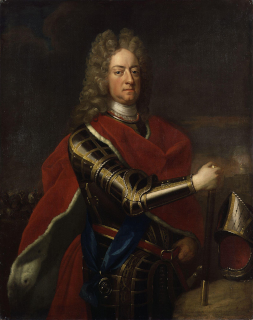
(Pictured: Portrait of James Butler, 2nd Duke of Ormonde, by Michael Dahl, National Portrait Gallery)
Needham then holds a staff appointment in Ireland, and during the Irish Rebellion of 1798 commands the crown forces at the Battle of Arklow on June 9, 1798. He places his approximately 1,600 troops in strong positions at the eastern and western ends of the town, where they can sweep the Arklow Rock Road and the Coolgreany Road with fire if the rebels approach along them. Ultimately, this is what the United Irish force, estimated at 5,000–9,000 strong, does, repeatedly attacking Needham’s right flank, which is in fact his strongest position. Estimates of the United Irish dead range from 200 to 1,000, and the failure of the attack ensures that the rebels lose the military initiative. He is also present at the Battle of Vinegar Hill on June 21, 1798, but his force arrives late, leaving a gap in the British line through which many rebels escape. This is later christened “Needham’s gap,” earning him the nickname of “the late General Needham” among his fellow officers.
Promoted to lieutenant-general in 1802, Needham is made colonel of the 5th Royal Veteran Battalion in 1804, entering House of Commons as MP for Newry in 1806. He is made full general in 1812, and, following the death of his two older brothers, succeeds as 12th Viscount Kilmorey in November 1818, resigning his parliamentary seat. On January 12, 1822, he is created 1st Earl of Kilmorey (Queen’s County) and Viscount Newry and Mourne. He dies on November 21, 1832, at the family seat, Shavington Hall, Shropshire, and is buried in St. Peter’s Church, Adderley.
Needham marries Anne Fisher, daughter of Thomas Fisher of Acton, Middlesex, on February 20, 1787. They have two sons, Francis Jack Needham, who succeeds as 2nd Earl, and the Hon. Francis Henry William Needham, lieutenant-colonel in the Grenadier Guards, and seven daughters. There are Needham letters in the Public Record Office (PRO), Kew, and in the Rebellion Papers in the National Archives of Ireland in Dublin.
Lieutenant-GeneralJames FitzGerald, 1st Duke of Leinster, PC (Ire), Irish nobleman, soldier and politician, is born on May 29, 1722. He is styled Lord Offaly until 1744 and known as The Earl of Kildare between 1744 and 1761 and as The Marquess of Kildare between 1761 and 1766.
In 1761 FitzGerald is created Earl of Offaly and Marquess of Kildare in the Peerage of Ireland and in 1766 he is further honoured when he is made Duke of Leinster, becoming by this time the Premier Duke, Marquess and Earl in the Peerage of Ireland.
FitzGerald dies at the age of 51 at Leinster House, Dublin, on November 19, 1773, and is buried in the city’s Christ Church Cathedral. He is succeeded by his second (but eldest surviving) son, William, Marquess of Kildare. The Duchess of Leinster causes a minor sensation by marrying her lover William Ogilvie in 1774, but continues to be known as The Dowager Duchess of Leinster. She has a further three children by him. She dies in London at the age of 82 in March 1814.
In 1999, Irish Screen, BBC America and WGBH produce Aristocrats, a six-part limited television series based on the lives of Emily Lennox and her sisters. FitzGerald is portrayed by Ben Daniels.
(Pictured: James FitzGerald, 1st Duke of Leinster, by Joshua Reynolds, 1753)



 seamus dubhghaill