seamus dubhghaill

Promoting Irish Culture and History from Little Rock, Arkansas, USA


2 Comments

Black Thursday – The Molly Maguire Executions

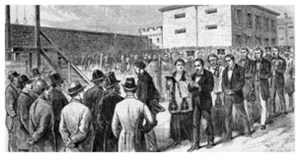
molly-maquires-gallows

On June 21, 1877, a day that will long be remembered as Black Thursday, ten members of the Molly Maguires, an Irish labor organization, are executed in Pennsylvania, the first of twenty executions that make up the largest mass execution of any group by the U.S. federal government in history.

The Molly Maguires is an Irish 19th-century secret society active in Ireland, Liverpool, and parts of the eastern United States, best known for their activism among Irish American and Irish immigrant coal miners in Pennsylvania. The Mollies are believed to have been present in the anthracite coal fields of Pennsylvania in the United States since at least the Panic of 1873.

Members of the Mollies are accused of murder, arson, kidnapping and other crimes, in part based on allegations by Franklin B. Gowen and the testimony of a Pinkerton detective, James McParland, a native of County Armagh. Fellow prisoners testified against the defendants, who were arrested by the Coal and Iron Police. Gowen acts as a prosecutor in some of the trials. The Molly Maguires become largely inactive following the executions of 1877 and 1878.

On June 21, 1877, the first ten executions take place. Six Mollies – James Carroll, James Roarity, Hugh McGehan, James Boyle, Thomas Munley, and Thomas Duffy – are hanged in the prison at Pottsville, Pennsylvania. The sheriff hangs them successively two-by-two rather than build special gallows to accommodate six. An immense crowd gathers covering the surrounding hills. Boyle carries a blood-red rose and McGehan has two roses in his lapel. Carrol and Roarity declare their innocence from the scaffold. In County Donegal, McGehan’s relatives meet in the kitchen and, it is said, the sky blackens at the moment of hanging.

On the same date, Alexander Campbell, John “Yellow Jack” Donohue, Michael J. Doyle, and Edward J. Kelly are hanged at a Carbon County prison in Mauch Chunk for the murders of John P. Jones and Morgan Powell, both mine bosses. Here gallows have been erected to accommodate four hangings and the four are hung at the same instant. Campbell, just before his execution, allegedly slaps a muddy handprint on his cell wall stating, “There is proof of my words. That mark of mine will never be wiped out. It will remain forever to shame the county for hanging an innocent man.” The handprint remains to this day.

Ten more condemned, Thomas Fisher, John “Black Jack” Kehoe, Patrick Hester, Peter McHugh, Patrick Tully, Peter McManus, Dennis Donnelly, Martin Bergan, James McDonnell, and Charles Sharpe, are hanged at Mauch Chunk, Pottsville, Bloomsburg, and Sunbury over the next year. Peter McManus is the last Molly Maguire to be tried and convicted for murder at the Northumberland County Courthouse in 1878.


1 Comment

Death of Terence Bellew MacManus in San Francisco

terrence-bellew-macmanus

Terence Bellew MacManus, an Irish rebel and Young Irelander, dies in San Francisco, California, on January 15, 1861.

MacManus is born in 1811 in Tempo, County Fermanagh, Ireland, and was educated in parochial schools. As a young man he moves to the major port of Liverpool, where he becomes a successful shipping agent. In 1848 he returns to Ireland, where he becomes active in the Repeal Association, which seeks to overturn the Act of Union between Great Britain and Ireland. After joining the Irish Confederation, he is among those who take part with William Smith O’Brien and John Blake Dillon in the July 1848 Young Ireland Rebellion in Ballingarry, County Tipperary, where the only substantial armed action occurs. MacManus and the other leaders are charged and convicted of treason and sentenced to death for their actions.

Due to public outcry for clemency, the men’s sentences are commuted to deportation for life. MacManus, along with O’Brien, Thomas Francis Meagher, and Patrick O’Donoghue, is transported to Van Diemen’s Land in Tasmania, Australia in 1849. They are assigned to different settlements to reduce their collaboration in the new land; however, the Irish men continue to meet secretly.

In 1852 MacManus and Meagher escape from Australia and make their way to San Francisco, California, where MacManus settles. Meagher goes on to New York City. Like other immigrants, the Irish revolutionaries carry their issues to the United States. A Captain Ellis, of a ship that is supposed to carry O’Brien to freedom, also emigrates to San Francisco. MacManus holds a lynch court of Ellis among Irish emigrants for his betrayal of O’Brien in his escape attempt from Van Diemen’s Land. The court-martial acquits Ellis for lack of evidence.

Failing to re-establish his career as a shipping agent, MacManus lives in San Francisco and dies in poverty in 1861. It is after his death, however, that he performs his most valuable service to the cause of Irish freedom. On learning of his death, American Fenian leaders decide to return his body to Ireland for burial. This foreshadows the treatment given to Jeremiah O’Donovan Rossa at his famous funeral in 1915. Crowds of Irish gather in New York as Archbishop John Hughes, like MacManus born in Ulster, blesses MacManus’ body. Thousands greet his body when it arrives in Cork and crowds gather at rail stations all the way to Dublin.

The church, in the person of Archbishop of Dublin Paul Cullen, refuses permission for his body to lie-in-state at any church in Dublin. Thus, for a week MacManus’ body lies in the Mechanics’ Institute, while thousands pass by paying their respects. But Father Patrick Lavelle, a Fenian supporter, defies Cullen and performs the funeral ceremony on November 10, 1861. A crowd estimated at 50,000 follow the casket to Dublin’s Glasnevin Cemetery, and hundreds of thousands line the streets. The MacManus funeral is a seminal moment for the Fenian movement. It invigorates the nationalist movement in Ireland, just as Rossa’s funeral does 54 years later.

MacManus is notable for his statement in court in 1848 where he explains his actions by saying, “It was not because I loved England less, but because I loved Ireland more.”