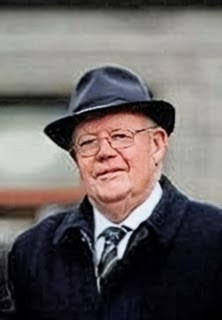
O’Donnell is one of the few senior Catholic judges on the Northern Irish bench and he frequently comes under threat. In 1979, he tries the Shankill Butchers and gives out 42 life sentences, a record in British legal history.
O’Donnell is Chairman of the Northern Ireland Bar Council from 1970 to 1971 and of the Council of Legal Education (Northern Ireland) from 1980 to 1990.
O’Donnell marries Eileen McKinley (died 2008) in 1954. They have two sons and two daughters. Of his sons, Turlough O’Donnell SC is Chairman of the General Council of the Bar of Ireland from 2016 to 2018, and Donal O’Donnell is directly appointed from the Irish Bar to the Supreme Court of Ireland in 2010, before becoming Chief Justice of Ireland in 2021.
O’Donnell dies in Blackrock on April 21, 2017. He is buried at Blackrock/Haggardstown Old Cemetery in Dundalk, County Louth.
Holmes appears to be a stern judge, who does not suffer fools gladly and often imposes exceptionally severe sentences in criminal cases. Although the story is often thought to be apocryphal, Maurice Healy maintains that Holmes did once sentence a man of great age to 15 years in prison, and when the prisoner pleaded that he could not do 15 years, replied “Do as much of it as you can.” His judgments do however display some good humour and humanity, and the sentences he imposes often turned out to be less severe in practice than those he announces in Court.
The quality of his judgments is very high and Holmes, together with Christopher Palles and Gerald FitzGibbon, is credited with earning for the Irish Court of Appeal its reputation as perhaps the strongest tribunal in Irish legal history. His retirement, followed by that of Palles (FitzGibbon had died in 1909), causes a loss of expertise in the Court of Appeal from which its reputation never recovers. Among his more celebrated remarks is that the Irish “have too much of a sense of humour to dance around a maypole.” His judgment in The SS Gairloch remains the authoritative statement in Irish law on the circumstances in which an appellate court can overturn findings of fact made by the trial judge.
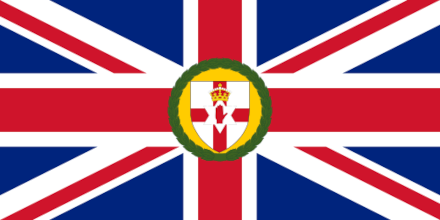
The office of the Governor of Northern Ireland is established on 9 December 9, 1922 under Letters Patent to “do and execute in due manner as respects Northern Ireland all things which by virtue of the [1920] Act and our said Letters Patent of 27 April 1921 or otherwise belonged to the office of Lord Lieutenant at the time of the passing of the Irish Free State Constitution Act 1922.”
The Governor has possession of the Great Seal of Northern Ireland and is the successor to the Lord Lieutenant of Ireland in Northern Ireland, itself established on May 3, 1921. The official residence of the Governor of Northern Ireland is Hillsborough Castle in County Down. Following refurbishment of the Castle, James Hamilton, 3rd Duke of Abercorn, takes up residence in 1925. It remained the official residence until the abolition of the office of governor in 1973. Henceforth it has been the official residence of the Secretary of State for Northern Ireland.