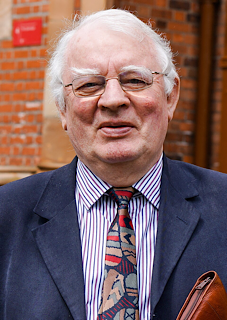
On June 20, 1968, Austin Currie, Nationalist Party Member of the Parliament of Northern Ireland, and a number of other people, begin a protest about discrimination in the allocation of housing by “squatting” (illegally occupying) in a house in Caledon, County Tyrone. The protesters are evicted by officers of the Royal Ulster Constabulary (RUC). The next day the annual conference of the Nationalist Party unanimously approves of the protest action by Currie in Caledon. This is one of the catalysts of the civil rights movement in Northern Ireland.
Born in Coalisland, County Tyrone on October 11, 1939, Austin is the eldest of eleven children born to Mary (née O’Donnell) and John Currie. He is educated at the renowned St Patrick’s Academy, Dungannon, and graduates in politics and history from Queen’s University Belfast (QUB).
Currie becomes an active member in the Northern Ireland Civil Rights Association (NICRA). He later speaks about the effect of partition on Catholics in Northern Ireland: “Partition was used to try to cut us off from the rest of the Irish nation. Unionists did their best to stamp out our nationalism and, the educational system, to the extent it could organise it, was oriented to Britain and we were not even allowed to use names such as Séamus or Seán. When my brothers’ godparents went to register their birth, they were told no such names as Séamus or Seán existed in Northern Ireland and were asked for the English equivalent.”
In 1964 Currie is elected in a by-election as a Nationalist MP for East Tyrone in the 10th House of Commons of the Parliament of Northern Ireland, following the death of the sitting Nationalist MP, Joe Stewart. He retains his seat in the 11th House of Commons in the 1965 Northern Ireland general election and the 12th House of Commons in the 1969 Northern Ireland general election. This is the last election to the home rule Parliament at Stormort, before it is suspended by Government of the United Kingdom in March 1972, and formally abolished by the Northern Ireland Constitution Act 1973.
In 1970, Currie is a founder of the group that establishes the Social Democratic and Labour Party (SDLP). From 1973 to 1974, he is elected as an SDLP member of the short-lived devolved Northern Ireland Assembly. In 1974 he becomes Chief Whip of the SDLP, and in the same year becomes Minister for Housing, Local Government and Planning in the power-sharing Northern Ireland Executive. The Assembly and Executive collapse on May 28, 1974, after opposition from within the Ulster Unionist Party (UUP) and the Ulster Workers’ Council strike. This leads to the imposition of direct rule of Northern Ireland from London.
Currie contests the 1979 United Kingdom general election and 1986 by-election in the Fermanagh and South Tyrone seat, but is unsuccessful on both attempts. He also is elected to the Northern Ireland Assembly in 1982 for the same seat. That Assembly, which is an attempt by the Government of the United Kingdom to reintroduce devolved power-sharing, collapses in 1986 without executive ministerial functions ever being transferred to it from the UK Secretary of State for Northern Ireland as no political agreement can be reached on power-sharing between the parties owing to nationalists abstentionism over the constituency boundaries used to elect members, and unionist opposition to the Anglo-Irish Agreement of 1985.
Following his decision to quit Northern Ireland politics, and relocate his family to County Kildare, Currie becomes actively involved in politics in the Republic of Ireland. Partly due to his long-standing doubts about the commitment of politicians in the Republic to the plight of northern nationalists, he join the Fine Gael party in 1989. He is elected as a Fine Gael TD for Dublin West at the 1989 Irish general election.
In 1990, Fine Gael selects Currie as their candidate for the 1990 Irish presidential election, running against Tánaiste and Fianna Fáil TD, Brian Lenihan Sr, and Senator Mary Robinson for the Labour Party. The 1990 election is the first contested election for the Irish Presidency in 17 years. Currie receives 267,902 first-preference votes (approximately 17%) and is eliminated on the first count. The distribution of his votes sees Mary Robinson elected as Ireland’s first female president on the second count, beating Lenihan by more than 86,000 votes.
In his 2004 autobiography All Hell will Break Loose, Currie writes about his experience of running in the presidential election, and the prejudice he faced as a nationalist from Ulster in southern politics: “What annoyed, indeed angered me most was the suggestion that because I came from the North, I was not a real Irishman … what I called the partitionist mentality … [during the election campaign] the [then Fianna Fáil] Minister for Justice [Ray Burke] said Fine Gael leader Alan Dukes ‘had to go to Tyrone to find a candidate for the presidency’ … it was hard to take, particularly from so-called republicans.”
Following his defeat in the presidential election, Currie holds his Dáil seat in Dublin West at the 1992 and 1997 Irish general elections. Following the formation of the so-called Rainbow Coalition between Fine Gael, Labour and Democratic Left, on December 20, 1994, newly appointed Taoiseach John Bruton appoints him as a Minister of State with responsibility for Children’s Rights at the Departments of Health, Education and Justice, becoming the first ever minister in an Irish Government with dedicated responsibility for children. He holds this post until the appointment of a new Irish Government on June 26, 1997, following the 1997 Irish general election.
At the 2002 Irish general election Currie contests the new constituency of Dublin Mid-West, and fails to be elected. He immediately announces his retirement from electoral politics. He continues to speak and campaign for civil rights across the island of Ireland and for causes he believes in, such as justice for the families of the Disappeared during the Troubles. He and his wife and family are personal friends of the family of one of the Disappeared, Columba McVeigh, from Donaghmore, County Tyrone. His daughter Emer Currie is elected in his former constituency of Dublin West at the 2024 Irish general election.
Following the deaths of Seamus Mallon and John Hume in January and August 2020 respectively, Currie becomes the last surviving founder of the SDLP.
Currie dies on November 9, 2021, at the age of 82 at his residence in Derrymullen, County Kildare. Following an initial funeral mass in Allentown, County Kildare, his remains are transferred to his original family home in Edendork, near Dungannon, County Tyrone, where a second funeral mass was celebrated at St. Malachy’s Church, Edendork. He is buried alongside his parents in the cemetery adjoining the church.