On the morning of February 5, 1923, at about 7:00 a.m., fifty well-armed anti-Treaty Irish Republican Army (IRA) fighters descend on Ballyconnell, County Cavan, from the hills in a military lorry and several cars. The guerrillas, armed with rifles and three machine guns, stop the train to nearby Ballinamore so that word will not get out to adjacent Irish Free Stategarrisons and then go in search of those they hold responsible for the death of anti-Treaty IRA volunteer Michael Cull during a raid on Ballyconnell on January 6.
At Oven’s grocery, the proprietor, William Ovens, is shot through the thigh and badly wounded. One of his employees, William Ryan, is dragged out and shot dead. According to the local press, the guerrillas shout “was it you who shot Cull?” at Ryan before they shoot him. His 80 year old father follows the fighters through the streets, shouting “murder, murder.”
Sean McGrath, an Irish language teacher, originally from Galway, is also dragged out of bed and shot dead, apparently for no other reason than that he is lodging at the home of Free State supporter, John Dunn.
The guerrillas proceed to bomb and burn out three shops, including the car dealership and the Post Office, and to smash the windows of the other premises with shots and rifle butts. The Ulster Bank branch is robbed of £200 and two Ford cars are seized. After a rampage of 35 minutes, the IRA column re-mounts their vehicles and heads back toward the Arigna hills, leaving the little town partially in flames, pockmarked with bullet holes and mourning the death of two of its citizens.
According to the pro-Treaty National Army, “Our troops in Belturbet got word of the raid, and immediately set out in all their transport. They were joined en route by two Fords of troops from Cavan, and all proceeded to Ballyconnell, where they arrived shortly after 9 o’clock. They followed the Irregulars past Ballinamore, but failed to get in touch with them.”
The ruthlessness of the reprisal at Ballyconnell – the premeditated assault on civilians – shocks pro-Treaty opinion. For the Free State government it exemplifies the irrationality and criminality of what they called the “Irregulars.” Such madness justifies the government’s repressive measures, particularly the executions of republican prisoners which had been going on since November of the previous year.
Kevin O’Higgins, Minister for Home Affairs and hard-line supporter of the executions policy, says, “I want to combat the view that it was a natural thing to expect that a body of Irishmen would descend upon this little town and proceed to murder their fellow-citizens. It was not a natural thing. It is perhaps the most unnatural thing that has happened since this unnatural strife began.”
Within a week, a National Army expedition is dispatched to the West Cavan/ Leitrim area in considerable strength to root out Ned Bofin’s anti-Treaty column, which had carried out the Ballyconnell raid. They report that “the people are delighted at our presence and their only fear is that we might leave” but are afraid to give information. “Our only concern,” they report, “is the remarkable agility of the Irregulars in retreating from an engagement with us.”
If one is to believe the National Army version, the Irregulars are simply cowardly bandits without any public support and the conflict in the border region would evaporate with the presence in strength of government troops. And if one is to take the Ballyconnell reprisal alone, this would appear to make sense. However, looked at a little more closely, it is clear that the Irish Civil War in this region is a complex web of national and local conflicts, that the Ballyconnell incident is only the culmination of the collapse of Free State authority in the area over several months.
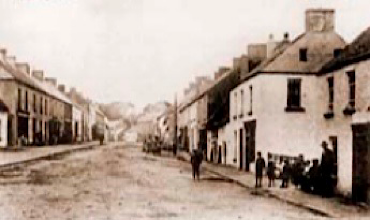
(From: “The Tragedies of Ballyconnell” by John Dorney, The Irish Story, http://www.theirishstory.com, June 2014 | Pictured: The main street in Ballyconnell in the early 20th century)
On April 25, 1915, west of Cape Helles, Gallipoli, Ottoman Empire, Kenealy is 28 years old when he performs an act of bravery for which he is awarded the Victoria Cross. Three companies, and the Headquarters of the 1st Bn. Lancashire Fusiliers, in effecting a landing on the Gallipoli Peninsula to the west of Cape Helles, are met by a very deadly fire from hidden machine guns which causes a great number of casualties. The survivors, however, rush up to and cut the wire entanglements, notwithstanding the terrific fire from the enemy, and after overcoming supreme difficulties, the cliffs are gained and the position is maintained. Among the many very gallant officers and men engaged in this most hazardous undertaking, Capt. Willis, Serjt. Richards, and Pte. Kenealy are selected by their comrades as having performed the most signal acts of bravery and devotion to duty.
Kenealy is one of the six members of the regiment elected by their colleagues in the regiment for the award, and described in the press as “six VC’s before breakfast.” Lieutenant-General Sir Ian Hamilton, the overall Allied army commander at Gallipoli, orders that the beach be renamed Lancashire Landing because of his conviction that “no finer feat of arms has ever been achieved by the British Soldier – or any other soldier – than the storming of these beaches.”
Shortly afterward, Kenealy is promoted to corporal and then lance sergeant. He is seriously wounded in the Battle of Gully Ravine on June 28, 1915, and dies the following day. He is buried at Lancashire Landing Cemetery on the Gallipoli Peninsula.
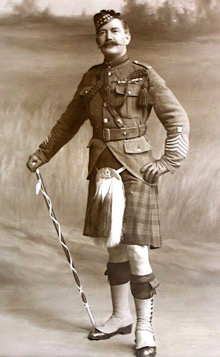
On October 23, 1914, near Ypres, Belgium, Drummer Kenny rescues wounded men on five occasions under very heavy fire. Twice previously he saves machine guns by carrying them out of action, and on numerous occasions he conveys urgent messages under very dangerous circumstances over fire-swept ground.
On March 20, 1999, Kenny’s grave receives a new headstone, arranged by The Gordon Highlanders London Association (Lt. Col. M. H. Burge). He is not otherwise commemorated. His Victoria Cross and other medals are on display at the Gordon Highlanders Museum, Aberdeen, Scotland.
Nationalist forces enter Newcastle West, County Limerick, on Monday, August 7, 1922, after a twelve-hour battle, in which twelve anti-Treaty Irish Republican Army (IRA) members, sometimes referred to as Irregulars, are killed. The casualties of the Nationalists are less than those of the Irregulars.
Taking little respite after Sunday’s labors, the Nationals advance from Rathkele on Monday morning, and by midday are in sight of their fresh objective. Armored cars enter the town and machine gun fire is directed against a party of Irregulars, causing many casualties.
When the artillery goes into action against the headquarters of the Irregulars, the Irregulars flee precipitately along Cord road.
Owing to the slow progress in the operations in Southern Ireland, the meeting of Dáil Éireann, scheduled to open Saturday, is postponed again.
The official army bulletin announces that the Nationals captured Castle Island on Saturday, August 5. It says that the counties of Cork and Kerry with a part of South Tipperary and a small area in County Waterford are the only districts held by the Irregulars with any degree of security.
The streets of Dublin are lined with great crowds of people on Tuesday, August 8, for the military funeral of nine National Army soldiers who were killed in fighting the Republican Irregulars in County Kerry. Michael Collins, Chairman of the Provisional Government, and all the leading officers of the army in Dublin march beside the hearses. Each coffin is covered with the Republican tricolour. There are many clergymen and other civilians in the funeral procession.
Prominent Catholics of Dublin and Belfast are trying to effect a better understanding between the Ulster and Free State Governments, according to the Daily Mail. This newspaper further states that all efforts to this end, which have all been taken with the advice and approval of leading English Catholics, are without official character.
A message from Strabane, County Tyrone, received by the Exchange Telegraph Company on August 8 states that a settlement between the Ulster Government and the Free State authorities is imminent, the terms of agreement having been practically arranged in negotiations proceeding in London.
In Downing Street, however, all knowledge of any such Irish negotiations is disclaimed and a telegram from Belfast quotes Ulster Government officials as denying that a settlement with the Free State is imminent.
The Free State Government is also unaware of any negotiations for a settlement between the Ulster Government and the Free State authorities. It is further states that such negotiations are unlikely to take place.
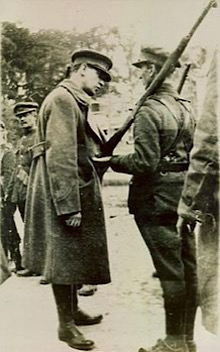
(From: “Irish Irregulars Routed With Loss,” The New York Times, August 9, 1922 | Pictured: General Michael Collins inspects a soldier at Newcastle West, County Limerick, August 8, 1922)
The battle consists of ten days of fighting in the countryside around Kilmallock in County Limerick, in which the National Army of the Irish Free State, advancing south from Limerick city, find their path blocked by anti-Treaty IRA troops, dug into a number of villages at Bruff, Bruree and Patrickswell. The fighting end with the retreat of the anti-Treaty fighters and the occupation of Kilmallock by Free State forces.
The prelude to the battle is the fall of Limerick city to Free State forces. The Republican forces in the city under Liam Deasy withdraw from their positions after a week of fighting and concentrate in Kilmallock and the nearby towns of Bruff and Bruree. The Free State forces, advancing south from the city, find their path blocked by the Republicans dug in at the three hilltop towns.
The National Army’s attempt to break through this position produces the only “line battle” of the war with the two sides facing each other along clear front-lines. The Kilmallock-Bruff-Bruree triangle sees some of the war’s most intense fighting.
Whereas in the fighting in Dublin, Limerick and Waterford, Free State troops equipped with artillery overcome Anti-Treaty resistance relatively easily, at Kilmallock they have a much harder time. The main reason for this is that the Free State troops, most of whom are new recruits, are facing some of the best of the IRA forces without an advantage in numbers or firepower. General Eoin O’Duffy complains of shortage of arms and ammunition. He estimates that while his forces have about 1,300 rifles, the Republicans could muster over 2,000. He is also critical of the quality of the troops at his disposal, whom he describes as, “a disgruntled, undisciplined and cowardly crowd.”
The Republicans know this and are confident of success. Nevertheless, the Republican commanders have their own issues with logistical support and lack of co-operation between forces from different counties. Deasy’s command includes Volunteers from counties Limerick itself, Cork and Kerry, all of whom have their own commanders. They have three improvised armoured cars, some mortars and heavy machine guns but no artillery.
O’Duffy draws up plans for the advance on Kilmallock with the assistance of his second-in-command Major GeneralW. R. E. Murphy who had been a lieutenant colonel in World War I. His experience in the trenches has a major effect on his approach – pre-disposing him to cautious advances and use of trenches for cover.
The Republican forces have the better of the first clashes. On Sunday, July 23, Free State forces take Bruff and begin their advance on Kilmallock, but are twice beaten back by determined Republican resistance. The following day, the Republicans manage to retake Bruff in a counter-attack, taking 76 prisoners. As a result of this setback, O’Duffy calls off the advance for the time being and waits for reinforcements.
National Army forces quickly retake Bruff after reinforcements arrive. However, things get worse for the National Army as the week goes on. They make slow progress in taking the Republican strongpoints, and their casualties also mount. On Tuesday, July 25, a unit of the Dublin Guard under Tom Flood is ambushed on a narrow road. They fight their way clear, but only after losing four men. Three more Free State soldiers are killed two days later. On July 30, Major General Murphy launches an attack to take Bruree. The Dublin Guards attack the town from the southeast, supported by armoured cars and an 18-pound field gun. The Republicans hold out for five hours until Free State artillery is brought into action. At least 13 Free State soldiers and nine Anti-Treaty fighters are killed in the action and more are wounded before the Free State troops secure Bruree.
The Republican commander, Deasy, knows how important Bruree is to the defence of Kilmallock and draws up plans to recapture the town using three armoured cars, trench mortars and machine guns. On August 2, Republicans capture Patrickswell south of Limerick. The armoured cars then attack Bruree, taking Free State forces by surprise. One car attacks Commandant Flood’s headquarters at the Railway Hotel. The Commandant and his men manage to escape out the back of the building under the cover of Lewis gun fire. The second armoured car rams the front door of another post in the school house, which persuades the twenty-five troops inside to surrender.
However, when Free State reinforcements, along with armoured cars arrive, the Republican counter-attack stalls. The Free State reinforcements are led by Commandant General Seamus Hogan, who personally leads his forces, riding in the armoured car nicknamed “The Customs House.” Having failed to secure the surrender of the town, Republican forces retreat.
Having held Bruree against a Republican counterattack, Free State forces prepare to capture Kilmallock itself, but anticipate there will be heavy fighting. Republican Adjutant General Con Moloney comments on August 2, “Up to yesterday we have had the best of the operations there [the Kilmallock area]. There will, I fear, be a big change there now as the enemy have been reinforced very considerably.” In the 3rd Western Division area they have all but disbanded, unwilling to fight Free Staters, destroy roads, and now discouraged by the Catholic church.
On Thursday, August 3, a force of 2,000 Free State troops, backed up by armoured cars and artillery, advance on Kilmallock from Bruree, Dromin and Bulgaden. Seven hundred troops arrive the next day with an armoured car and a field gun. By Saturday, the town is surrounded by Free State forces. The Dublin Guard are also on hand to prevent Republican forces from escaping. Three miles away, Free State artillery is deployed and shells Republican forces on Kilmallock Hill and Quarry Hill. The two hills are soon controlled by Free State forces.
The National Army has, therefore, assembled sufficient force to smother resistance at Kilmallock. They are still, however, expecting hard fighting before they take the town. To their surprise, when the Free State troops enter the town, they encounter only light resistance from a Republican rearguard (volunteers from Cork). Most of the Republican troops have already abandoned their positions and retreated to Charleville.
They departed not because the Free State troops are stronger, but because they have been outflanked by Free State seaborne landings on the coasts of County Kerry and County Cork on August 2 and 8 respectively. The landings in Cork and Kerry force Commandant General Deasy to release units from this area to return home to their own areas. Although the landings in Cork occur after the retreat from Kilmallock, the subsequent loss of brigades from Cork adds to Commandant General Deasy’s problems. The final phase of the fighting in County Limerick comes when the Free State advance south is held up at Newcastle West. Another day of heavy fighting ensues in which the National Army troops have to bring up armoured cars and artillery to dislodge the Republicans, who reportedly lose up to 12 men before they retreat in the direction of Cork.
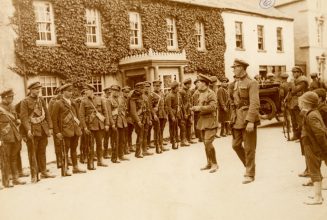
(Pictured: National Army troops lined up for a roll call during the Irish Civil War with local children casting an eye over the proceedings)
MacDermott is born in Belfast on April 12, 1896, the third surviving son and sixth of seven children of the Reverend John MacDermott DD, a Presbyterian clergyman who is minister of Belmont and moderator of the Presbyterian Church in Ireland, and of his wife Lydia Allen MacDermott (née Wilson), the daughter of a Strabane solicitor. He is educated at Campbell College, Belfast, from where he wins a scholarship to read Law at the Queen’s University Belfast (QUB) in 1914.
Eight years later MacDermott is appointed to determine industrial assurance disputes in Northern Ireland, and in 1931 becomes a lecturer in Jurisprudence at Queen’s University Belfast, teaching for four years.
In 1940, MacDermott is appointed Minister of Public Security in the Government of Northern Ireland, and the following year becomes the Attorney General for Northern Ireland. He is succeeded in this post by William Lowry, whose son, Lord Lowry, would eventually succeed MacDermott as Lord Chief Justice. In 1944, he resigns his parliamentary seat on appointment as a High Court Judge for Northern Ireland, and three years later, on April 23, 1947, is made a Lord of Appeal in Ordinary, becoming a life peer as Baron MacDermott, of Belmont in the city of Belfast.
MacDermott returns from the House of Lords to take up his appointment as Lord Chief Justice of Northern Ireland. His successors to the latter office become Law Lords subsequently. Whilst Lord Chief Justice, he is affectionately known as “the Baron.”
In 1977, aged over eighty, MacDermott offers to redeliver a lecture at the Ulster College, which had been interrupted by a bomb meant for him and which had severely wounded him.
Having been made a Northern Ireland Privy Counsellor seven years earlier, MacDermott is sworn of the British Privy Council in 1947.
Four years later, in 1951, MacDermott is appointed Lord Chief Justice of Northern Ireland, a post he holds for twenty years. He is also Pro-Chancellor of his alma mater from 1951 to 1969. In 1958, he chairs the commission on the Isle of ManConstitution. He dies at his home in Belfast on July 13, 1979.
In 1926, MacDermott weds Louise Palmer Johnston, later Lady MacDermott. Their son, Sir John MacDermott, is also sworn into the British Privy Council in 1987, as a Lord Justice of Appeal in Northern Ireland. He later became a Surveillance Commissioner for Northern Ireland.
The East Clare Brigade plans to raid the Limerick train to take mail which will reveal the identity of a local spy. The eight IRA men, under the command of John McCormack, build a stone barricade across the tracks and put a red flag on top to stop the train. They will then board the train and take what they need. Tom Bentley, an IRA volunteer from Cratloe, is aboard the train so he can signal his comrades if there are British soldiers or Black and Tans on the train.
When the driver, a republican and supporter of the cause of Irish freedom, sees the barricade, he knows an ambush is about to take place but he also knows there are 30 British soldiers of the Royal Scots Regiment onboard and, should an ambush take place, the IRA will be out numbered and certainly outgunned. He smashes through the stone barricade, which is for the best, as McCormack does not see the signal from Bentley, their man on the train.
As the train passes, McCormack takes a pot shot at a soldier on the train, which turns out to be a bad idea. Once the train reaches Cratloe station, the soldiers make all civilians disembark and at gunpoint force the train driver to return to Woodcock Hill. McCormack knows the soldiers will alert the local military barracks and enemy troops will soon swarm the area. He climbs a telegraph pole to cut the wire but the shears break. He sends Lieutenant James O’Halloran to a nearby house to get replacement shears.
Gleeson and McCarthy are in charge of a group of volunteers waiting at the top of a field armed with rifles. When they see that something is delaying the cutting of the telegraph wires, they walk down the field to see what is happening. When they reach the edge of the tracks, the train comes around the bend one hundred yards from them. The Scots train their two machine guns and rifles on the fleeing volunteers. McCarthy is wounded during the opening volley and falls to the ground. As the rest of the ambushing party scatters, Gleeson realizes that McCarthy is not with them.
Gleeson races down the open field through a hail of British rifle and machine gun fire. He reaches McCarthy and helps him to his feet. In a desperate attempt to escape, Gleeson draws his revolver and staggers uphill supporting McCarthy with one arm and firing back at the British soldiers with his free hand.
They have only covered a short distance when Gleeson is shot and both men collapse to the ground. Gleeson is unable to continue but McCarthy manages to stagger on. Within a few seconds, the advancing British soldiers surround Gleeson and shoot him dead where he lay. McCarthy carries on through the fields but is soon outrun and is captured and killed by Lieutenant A. Gordan and a group of the Royal Scots, who shoot him several times and stab him with their bayonets.
Meanwhile, on the southern side of the railway track, McCormack is lying flat, hidden from the British soldiers. In order to make good his escape, he needs to climb over a thick fence of wire and hedge in full view of the soldiers. The train is only a short distance away and if the British soldiers make a search of the area, he is likely to become the third casualty the day. When he realises McCormack’s difficulty, James O’Halloran attempts to draw the British soldiers’ fire and attention and give McCormack a chance to escape. From behind a stone pier, O’Halloran opens fire on the British soldiers. He comes under heavy rifle fire but stands his ground and succeeds in wounding one of them before his rifle jams and he is forced to retreat. By this time, O’Halloran’s action has allowed McCormack to escape unseen. All the other IRA volunteers also manage to get away safely.
When the fighting ends, the British soldiers go to the scene of the killings and force a number of farm labourers to help them remove the two bodies. McCarthy’s body had been placed on a wicker gate and Michael Doherty and another farm labourer are ordered to carry it. Doherty lifts back the covering that has been placed over McCarthy’s body and sees that his throat has been cut and his chest is riddled with bullet wounds. Immediately, Doherty receives a blow of a rifle butt from one of the Royal Scots, who replaces the covers on McCarthy’s body.
Both bodies are taken to the house of the Collins family where the soldiers guard them until British reinforcements arrive and take them to Limerick. Gleeson and McCarthy are buried in the Republican plot in Meelick churchyard alongside Patrick White, who had been shot by a British sentry at Spike Island Prison, County Cork, earlier in the month.
This event, subsequently known as The Meelick Ambush, is the only occasion in County Clare during the Irish War of Independence when two Republicans are killed in action fighting against the British forces.
During the mid-1970s, the most violent decade of the Troubles in Northern Ireland, the monitoring of the border between south County Armagh and the Republic of Ireland by the British Army is carried out from several static observation posts. The main goal of these observation posts is to prevent attacks launched from beyond the border. These part-time manned positions are highly vulnerable to attack, as proved by a 1974 bomb attack which claims the lives of two Royal Marines at the outpost of Drummuckavall, a townland 3 kilometers southeast of Crossmaglen close to the border.
It is not until 1986, when the first surveillance watchtowers are erected in operations Condor and Magistrate that the British Army tries to regain the initiative in the region from the IRA.
The intelligence and control over the area relies until then, and for a lapse of ten years, mostly on mobile posts comprising small, uncovered infantry sections.
A section of four soldiers from the Royal Regiment of Fusiliers, coming from Crossmaglen, mount an observation post at 2:00 a.m. on November 21, 1975. The observation post is on a slope at Drummuckavall behind bushes overlooking a small stream that runs along the border. Unknown to them, locals had spotted their position and informed the IRA. At 4:20 p.m. the next day, an IRA unit of up to twelve members attacks the observation post. Heavy gunfire kills three of the Fusiliers and disables their communications equipment. A later inquest finds that the IRA unit had fired from two positions inside the Republic. Those killed are James Duncan (19), Peter McDonald (19), and Michael Sampson (20). The only fusilier on guard duty is McDonald, who is manning a light machine gun. The other soldiers are resting or taking a meal. The lance corporal in charge of the party, Paul Johnson, survives the first burst unscathed. He remains flat on the ground but is seriously injured on the wrist, side and back by a second burst of automatic fire after the IRA unit calls on him to surrender. A second call to surrender is made, followed by more gunfire. The IRA unit then withdraws across the border. According to Johnson, they were shouting “Up the ‘RA!” and laughing. Johnson manages to slip away by crawling 25 yards toward a nearby road, where British troops eventually airlift him to safety in a helicopter.
Shortly after the attack, Merlyn Rees, Secretary of State for Northern Ireland, issues a famous statement dubbing South Armagh Bandit Country. The next year, the British Government declares it is deploying the Special Air Service (SAS) in Northern Ireland, although they had already been deployed unofficially for a number of years. The secretive and undercover nature of this elite force means they are considered the best choice to infiltrate the South Armagh area, after the official report on the action exposes several flaws in the layout of the observation post.
As a complement to the SAS operations, the British Army also changes tactics. Major GeneralRichard Trant establishes small teams of troops, called COPs (Close Observation Platoons), to gather information, often in plain clothes or camouflaged in the landscape. They are also able to set up ambushes, like the ill-fated Operation Conservation on May 6, 1990.
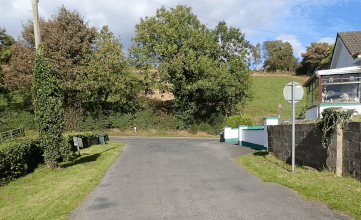
(Pictured: The Drummuckavall border crossing as viewed from the Irish Republic side of the border. At the border the unnamed road crosses a culverted stream to join the Dundalk Road. Photo by Eric Jones and licensed for reuse under Creative Commons License)
At dawn on the morning of November 20, 1917, the 16th (Irish) Division of the British Army assaults an area of the German lines known as “Tunnel Trench,” named for an elaborate tunnel system that runs along it. The attack is meant as a diversion for the main attack, about eight miles to the southeast at Cambrai, France, where six infantry and two cavalry divisions of the British Expeditionary Force, with additional support from fourteen squadrons of the Royal Flying Corps, join the British Tank Corps in a surprise attack on the German lines.
By autumn 1917, three years into World War I, continuous shelling and lack of drainage has transformed the Ypres Salient, on the Western Front, into a waterlogged quagmire. In Ireland, meanwhile, a month earlier, Eamon de Valera becomes president of Sinn Féin and decides to push for an independent Irish republic. Despite the growing political turmoil at home, in France, on firm ground near the town of Cambrai, the British Army’s 16th (Irish) Division again proves to be formidable adversaries for the Germans.
According to the divisional historian, at Cambrai, the “swift and successful operation by 16th Division was a model of attack with a limited objective.” In addition to securing 3,000 yards of trench, 635 prisoners are captured from the German army’s 470th and 471st Regiments and 330 German bodies are counted in the trenches. More importantly, though, the mayhem caused by the diversionary assault contributes greatly to the initial success of the Cambrai offensive, though the offensive eventually sputters, dragging the war into 1918.
Cambrai becomes the field of operations when the British Commander-in-Chief, Field MarshalDouglas Haig, recognising that it is impossible to launch further military operations in the Ypres sector, seeks a new battlefield where he hopes success can be achieved before year’s end. Lieutenant ColonelJohn Fuller of the Tank Corps and GeneralJulian Byng, commander of the Third Army, recommend that a massed assault by 400 tanks should be mounted across the firm, chalky ground to the southwest of Cambrai. Haig adopts this proposal, confident that the tanks can punch a hole through the mighty Hindenburg Line and allow his underused Cavalry Divisions to break through to the enemy rear.
In order to create maximum confusion among the Germans, Sir Aylmer Haldane, commander of VI Corps, is ordered to stage a diversionary attack. The area selected for the assault is about eight miles to the northwest of Cambrai, where the British line passes through the villages of Bullecourt and Fontaine-lès-Croisilles. The units select to make this subsidiary attack are 3rd Army and 16th (Irish) Division.
The defences of the Hindenburg Line opposite VI Corps positions consists of Tunnel Trench, a heavily defended front-line trench, with a second, or support trench, some 300 yards behind. The whole area is scattered with concrete machine gun forts, or Mebus, similar to those that had decimated the 16th (Irish) Division at the Battle of Langemarck three months earlier.
Tunnel Trench is so called because it has a tunnel 30 or 40 feet below ground along its entire length, with staircase access from the upper level every 25 yards. The entire tunnel has electric lighting, and side chambers provide storage space for bunks, food, and ammunition. Demolition charges are set that can be triggered from the German rear in order to prevent the defences from falling into British hands.
The 16th (Irish) Division, attacking on a three-brigade front, is assigned the task of capturing a 2,000-yard section of the trench network. On the right flank of the Irishmen, 3rd Division’s 9th Brigade is detailed to capture an additional 800 yards. One unusual feature of the attack is that there is to be no preliminary bombardment as surprise is the key to the success of the operation. Once the assault begins, however, 16th (Irish) Division’s artillery, reinforced with guns from the 34th Division, is to open a creeping barrage upon the German positions.
The morning of the advance, November 20, is overcast, with low visibility. At 6:20 a.m., the Divisional 18 pounder-field guns open fire, and the leading assault companies spring from their jump-off positions. At the same time, Stokes mortars begin to lay a smoke barrage upon the German trenches in imitation of a gas attack. This deception proves successful, as many German troops don cumbersome gas masks and retreat to the underground safety of the tunnel, thus leaving the exposed portion of the trench undefended.
On the left flank, the attack of the 49th Brigade is launched by 2nd Royal Irish Regiment and 7/8th Royal Irish Fusiliers. They quickly cross the 200 yards of no-man’s-land and reach the enemy frontline just as the barrage lifts. Resistance above ground is minimal, and storming parties began the task of flushing the Germans from the tunnel with Mills bombs and bayonets.
Once the tunnel is secure, sappers, acting on information obtained by 7th Leinster Regiment’s intelligence officer, cut the leads connecting the demolition charges. Supporting companies then press on to capture Tunnel Support Trench, while Divisional support units rapidly wire and made secure the new defensive front in anticipation of German counterattacks.
Only on the extreme left flank does 49th Brigade encounter any serious opposition. In this sector, Company “B” of the 7/8th Royal Irish Fusiliers suffers heavy losses inflicted by concentrated machine gun fire from Mebus Flora. Nearly one-hour elapses before resistance from this strong point can be overcome.
In the centre, 10th and 2nd Royal Dublin Fusiliers head the attack of the 48th Brigade. The advance here is so rapid that the Irish find many Germans still wearing gas masks and unable to fight. Two more Mebus, Juno and Minerva, are stormed and many more prisoners taken, particularly by 10th Royal Dublin Fusiliers which captures 170 Germans.
After capturing their assigned section of Tunnel Trench, two companies of Rangers press forward to assault the strong points known as Mars and Jove. The Division had learned from the disastrous frontal attack made at Langemarck, and so the Rangers work around to the rear before pressing home with the bayonet.
Unfortunately, 3rd Division fails in its attempt to capture the trench network immediately to the right of 16th (Irish) Division, and the flank of the Connaught Rangers is thus exposed to a savage counterattack. The Rangers ferociously engage the Germans and use captured “potato masher” grenades brought up from the tunnel to great effect. Eventually, overwhelming numbers begin to tell, and “A” Company is forced to yield Jove and fall back upon “B” Company, which is holding Mars.
These two isolated companies doggedly hold their ground for several hours. The situation only improves when the Divisional pioneer battalion, the 11th Hampshire Regiment, digs a communication trench across the fire-swept no-man’s-land, thereby allowing the support companies of the Rangers to come to the aid of their comrades. The front is finally stabilised three days later when 7th Leinster Regiment recaptures and consolidates Jove and successfully assaults the untaken section of Tunnel Trench.
On the first day of the Battle of Cambrai, General Byng’s eight attacking Divisions achieve complete surprise and pierce the Hindenburg Line, driving the Germans back four miles toward Cambrai itself. Having captured 8,000 prisoners and 100 guns for the loss of only 5,000 British casualties, it is small wonder that church bells are sounded in celebration in Britain for the first time during the war.
Unfortunately, Byng lacks sufficient reserves to exploit, or consolidate his success, and German counterattacks, launched by some 20 Divisions, recover most of the lost ground. Although the battle ultimately ends in failure for the British, the willingness to employ new weaponry and tactics at Cambrai and during the diversionary assault upon Tunnel Trench, points the way to the final victory in 1918.
Although the capture of Tunnel Trench contributes greatly to the early success at Cambrai, it proves costly as VI Corps suffers 805 casualties. Most of these occur close to Jove Mebus, where the Connaught Rangers had engaged the enemy in hand-to-hand combat.
Perhaps an idea of the ferocious nature of this form of trench warfare can be gleaned from Father William Doyle, chaplain of the 8th Royal Irish Fusiliers, who once remarks, “We should have had more prisoners, only a hot-blooded Irishman is a dangerous customer when he gets behind a bayonet and wants to let daylight through everybody.”
(From: “Tunnel Trench: 16th (Irish) Division Clears the Way at Cambrai,” by Kieron Punch, posted by The Wild Geese, http://www.thewildgeese.irish, January 18, 2013 | Pictured: Troops from the Royal Irish Regiment about to go into action at Cambrai)
Nimy Bridge is being defended by a single company of the 4th Royal Fusiliers and a machine gun section with Dease in command. The gunfire is intense and the casualties very heavy, but the lieutenant continues to fire in spite of his wounds, until he is hit for the fifth time and is carried away.
Dease wins the first Victoria Cross to be awarded in the Great War and he receives it on the first day of the first significant British encounter in that war.
When Lieutenant Dease has been mortally wounded, Private Sidney Godley offers to defend the Railway Bridge while the rest of the section retreats and is also awarded the Victoria Cross. He is taken prisoner of war.






 seamus dubhghaill