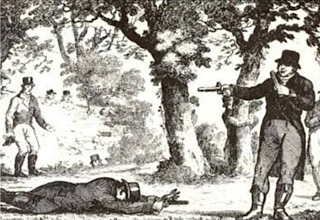
Daniel O’Connell (1775-1847) kills John D’Esterre in a duel on February 1, 1815.
O’Connell is sometimes referred to as an equivalent to Martin Luther King, Jr. or Mahatma Gandhi. Like King and Gandhi, O’Connell attempts to change the circumstances of his people, Irish Catholics in this case, through the use of nonviolence. He can take a great deal of credit for the passage of the Roman Catholic Relief Act 1829, which revokes the remaining discriminatory Penal Laws. This political success is achieved in significant part through mass protest and is notable for the absence of violence. O’Connell, however, is not always non-violent. He is known for being hot-tempered and capable of violence in his early days.
Rosmanagher Bridge and Toll Gate are built by D’Esterre in 1784 at his own expense. The large inscription stone on the bridge commemorates this piece of engineering. He owns extensive lands in the region and the Ratty River hinders both farming and communication, especially as the nearest bridge is at Sixmilebridge, County Clare. Despite objections that the structure will interfere with navigation on the river, he builds his bridge and then tries to recover his costs by erecting toll gates on the western side of the river. O’ Connell refuses to pay the toll according to local tradition and this leads to his famous duel with D’Esterre, a Limerick-born Protestant and former marine who is also a member of the Dublin Corporation. D’Esterre takes exception to O’Connell’s description of the Corporation as being “beggarly.”
D’Esterre is in difficult financial circumstances at the time of the duel. Some thought indicates that he is possibly encouraged into violent confrontation by influential figures who wish to break the forty-year-old O’Connell’s growing political power. Regardless of the motivation, the crack shot D’Esterre arranges to meet O’Connell to settle the matter on February 1, 1815, at the Bishopscourt estate in County Kildare.
D’Esterre shoots first and misses. O’Connell returns fire, wounding his opponent in the groin. The wound proves to be fatal two days later. It seems O’Connell is distressed by the deadly outcome and offers D’Esterre’s widow a pension as compensation. The offer is refused, but an allowance for D’Esterre’s daughter is accepted. O’Connell fulfills this obligation for the subsequent 30 years of his life.
(From: “OTD: O’Connell – D’Esterre Duel – 1815” by Martin Nutty, Irish Stew Podcast, http://www.irishstewpodcast.com, February 1, 2022)
In 1926, Quill emigrates to New York City. After a series of brief jobs, in 1929 he secures employment with the Interborough Rapid Transit Company (IRT) as a subway station change-maker. Attracted to socialism and militant industrial unionism by his reading of James Connolly, in 1933 he is one of a small group of workers seeking to initiate a trade union independent of the IRT’s complacent company union. Comprised largely of ex-IRA men linked by membership of Clan na Gael and the leftist Irish Workers’ Clubs, his group soon joins forces with a New York transit-industry organising effort by the Communist Party, resulting in the launch in April 1934 of the Transport Workers Union (TWU).
With a convivial personality and a flair for oratory, Quill quickly emerges as one of the union’s most effective organisers. During 1935 he leaves his IRT job to work full-time as union organiser. In December 1935 he is elected TWU president, a position he holds until his death. By autumn 1936 the TWU has established a solid base on the IRT and intensifies organisation on New York’s other transit lines: subways, buses, elevated trains, and trolleys. In May 1937 the TWU affiliates with the incipient Congress of Industrial Organizations (CIO). After winning, mostly by large majorities, a series of union representation elections in May–June 1937, the TWU negotiates closed-shop contracts with various New York transit companies, obtaining for its 30,000 members substantial wage increases and benefits and a work-week reduction to forty-eight hours. The ethnic profile of the TWU, which is colloquially nicknamed “the Irish union,” reflects that of New York’s transit workforce, about half of which is Irish born.
First elected to the New York City Council in November 1937 as candidate of the American Labor Party, Quill serves on the body intermittently until 1949. After 1940 he leads the TWU into expansion outside New York, organising in mass transit in other cities, in airlines, and in railroads. Despite modest membership numbers (135,000 by the mid-1960s), the TWU is the United States‘ largest transit union, and Quill maintains a high public profile, owing to his union’s situation in a key economic sector, its base in the country’s largest city, and the colourful and the controversial features of his personality and politics. The 1940 municipal buy-out of New York’s private subway companies and subsequent evolution of a unified civically operated transport system precipitates a lengthy TWU struggle to establish collective bargaining rights and procedures for the transport workforce as public employees. This campaign, by setting precedents for public-sector union organisation nation-wide, marks Quill’s most enduring legacy to the American labour movement.
Quill denies repeated charges that he is a Communist, while retorting that he would “rather be called a Red by the rats than a rat by the Reds.” Communists hold influential positions at all levels in the TWU until the union’s December 1948 convention, when, after months of rancorous conflict over policy, he secures the expulsion from union office of all Communist Party members. His own politics, nevertheless, remain conspicuously leftist in the America of the 1950s and 1960s, as he condemns both the McCarthyite anti-Red witch-hunt and the Vietnam War. Elected a CIO vice-president in 1950, he eschews redefinition as “a labour statesman,” and advocates a national labour party and nationalisation of major industries. A strenuous opponent of racial discrimination by employers and within trade-union structures, he actively supports the black civil rights movement. He is the only top CIO official to oppose its 1955 merger with the conservative, craft-dominated American Federation of Labor (AFL), which he accuses of “the three Rs” of raiding, racketeering, and racism.
Quill’s final battle is his most dramatic. On January 1, 1966, he defies public-sector anti-strike legislation and a court injunction and leads TWU Local 100 into the first total subway-and-bus strike in New York City history, paralysing traffic for twelve days. Arrested on January 4, Quill, who has a history of serious heart disease, collapses during admission to prison and is transferred to hospital under police custody. On January 13 the strike is settled with a 15 percent wage increase, the highest of Quill’s TWU presidency. On January 28, several days after discharge from hospital, he dies of heart failure in his home. He is interred at Gate of Heaven Cemetery in Hawthorne, New York, after a funeral Mass at St. Patrick’s Cathedral, his casket draped by the Irish tricolor.
Speaking after his death, Martin Luther King Jr. eulogises Quill with the following: “Mike Quill was a fighter for decent things all his life—Irish independence, labor organization, and racial equality. He spent his life ripping the chains of bondage off his fellowman. When the totality of a man’s life is consumed with enriching the lives of others, this is a man the ages will remember—this is a man who has passed on but who has not died. Negroes had desperately needed men like Mike Quill who fearlessly said what was true even when it offended. That is why Negroes shall miss Mike Quill.”
Quill marries Maria Theresa O’Neill of Cahersiveen, County Kerry, in 1937. They have one son. Maria dies in 1959. He then marries Shirley Garry (née Uzin) of Brooklyn, New York, his long-serving administrative assistant, in 1961. They have no children. The Michael J. Quill Centre at Ardtully, Kilgarvan, County Kerry, houses a commemorative museum.
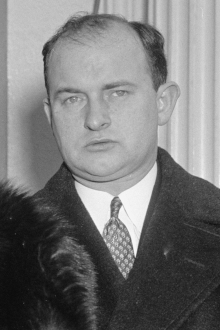
(From: “Quill, Michael Joseph” by Lawrence William White, Dictionary of Irish Biography, http://www.dib.ie | Pictured: Irish-American Trade Unionist Mike Quill during a visit to the White House in 1938)
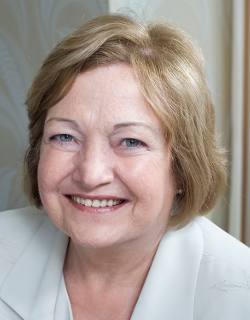
Although Maguire from a young age earns her living as a secretary, she also is from her youth a member of the Legion of Mary, a lay Catholic welfare organization, and through it she becomes deeply involved in voluntary social work among children and teenagers in various Catholic neighbourhoods of Belfast. She is stirred to act against the growing violence in Northern Ireland after witnessing in August 1976 an incident in which a car being driven by an Irish Republican Army (IRA) terrorist goes out of control when the IRA man is shot by British troops. The car strikes and kills three children of Maguire’s sister.
Within days each woman publicly denounces the violence and calls for mass opposition to it. Marches of Catholic and Protestant women, numbering in the thousands, are organized, and shortly afterward the Peace People is founded based on the conviction that genuine reconciliation and prevention of future violence are possible, primarily through the integration of schools, residential areas, and athletic clubs. The organization publishes a biweekly paper, Peace by Peace, and provides a bus service to and from Belfast’s jails for families of prisoners.
In October 2012, Maguire travels to New York City to serve on the Russell Tribunal on Israel/Palestine alongside writer Alice Walker, activist Angela Davis, former Congresswoman Cynthia McKinney, and Pink Floyd’s Roger Waters. The Russell Tribunal’s findings and conclusions challenge governments and civil society to have courage and act by implementing sanctions, thereby refusing to be silent and complicit in the face of Israel ’s violation of International Laws.
In March 2018, Maguire and two Nobel peace laureates, Shirin Ebadi and Tawakkol Karman, visit rohingya camps in Cox’s Bazar and share opinion on the crisis. After returning to Dhaka, they discuss the Rohingya crisis with members of the civil society of Bangladesh.
Maguire is a proponent of the belief that violence is a disease that humans develop but are not born with. She believes humankind is moving away from a mindset of violence and war and evolving to a higher consciousness of nonviolence and love. Among the figures she considers spiritual prophets in this regard are Jesus, Francis of Assisi, Mahatma Gandhi, Abdul Ghaffār Khān, Fr. John L. McKenzie, and Martin Luther King, Jr. She professes to reject violence in all its forms.

 seamus dubhghaill