seamus dubhghaill

Promoting Irish Culture and History from Little Rock, Arkansas, USA


Leave a comment

Death of Johnny Hayes, Member of the Irish American Athletic Club

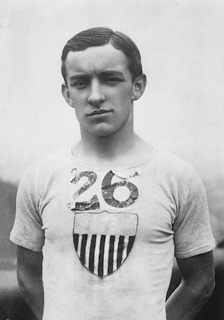
John Joseph Hayes, an American athlete and a member of the Irish American Athletic Club, dies on August 25, 1965, in Englewood, New Jersey. He is the winner of the men’s marathon race at the 1908 Summer Olympics in London. His Olympic victory contributes to the early growth of long-distance running and marathoning in the United States.

Born in New York City on April 10, 1886, to a family of Irish emigrants from NenaghCounty Tipperary, Hayes is probably best known for winning the controversial marathon race at the London Olympics. He is one of only three male American athletes to win the Olympic Marathon, the other two being Thomas Hicks in 1904 and  Frank Shorter in 1972.

In 1905, Hayes joins Bloomingdale Brothers as an assistant to the manager of the sporting goods department. At night, he trains on a cinder track on the roof of the Bloomingdale’s building in New York. He is promoted to manager of the department after returning from his Olympic victory.

Hayes starts his athletics career with a fifth-place finish at the 1906 Boston Marathon, running for the St. Bartholemew Athletic Club in a time of 2:55:38. He improves on that the following year by finishing third in Boston with a time of 2:30:38 and winning the inaugural Yonkers Marathon. In 1908, he finishes second, 21 seconds behind Thomas Morrissey in the Boston Marathon with a time of 2:26:04 and thus qualifies for the Olympic Games held in London that same year.

The British Olympic Association wants to start the race in front of Windsor Castle and finish in front of the royal reviewing stand at the White City Stadium. As a result, the distance is 26 miles and 385 yards (42.195 km). It takes until 1921 for the IAAF to codify that distance as the official length of the marathon. Prior to this, races are usually about 25 miles (40 km).

At the race itself, Dorando Pietri from Italy is the first to enter the stadium. But Pietri has depleted himself to open a more than 10 minute lead over the field and is suffering extreme fatigue and dehydration. When he enters the stadium, he takes the wrong path, and when umpires redirect him, he falls down for the first time. He gets up with their help in front of 75,000 spectators.

Pietri falls four more times, and each time, the umpires help him up. He manages to finish the race first, with a time of 2 hours, 54 minutes, 46 seconds. During all these stumbles and the direct aid from the officials, Hayes has now entered the stadium, finishing the race second, with a time of 2 hours, 55 minutes, 18 seconds.

Pietri is disqualified after the U.S. officials file a protest. Despite the official result, Pietri achieves much more fame than Hayes when Queen Alexandra awards him a special silver cup.

All of the Olympic officials are British, and the Pietri incident joins a list of other controversial calls in the 1908 Olympics, prompting the International Olympic Committee to start appointing judges from a wide variety of countries instead of only the host country.

After the dramatic Olympic battle between Pietri and Hayes, public interest is such that a match race is organized by professional promoters in November 1908 at Madison Square Garden. Pietri wins the race by 75 yards. A second match race is held on March 15, 1909, and again Pietri wins. Both Pietri and Hayes turn professional after the Olympics and achieve great fame.

Hayes is a trainer for the U.S. team for the 1912 Summer Olympics. He later teaches physical education and is a food broker. Hayes dies on August 25, 1965, in Englewood, New Jersey.

The Shore Athletic Club of New Jersey (Shore AC) holds the Johnny Hayes collection as lifetime trustees. Included in the collection are numerous trophies, as well as the 1908 Olympic gold medal for the marathon. This represents the first Olympic gold medal to be won at the modern marathon distance of 26 miles, 385 yards.

Hayes is a guest on the television show I’ve Got a Secret as one of five former Olympic champions, which airs on October 13, 1954.

In 2002, three statues honoring Olympic champions with links to Nenagh, Matt McGrath, Johnny Hayes and Bob Tisdall, are unveiled in front of the Nenagh Courthouse.

Leave a comment

Death of Pat McDonald, Irish American Track & Field Athlete

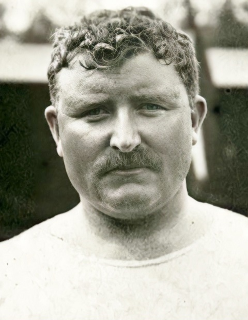
Patrick Joseph McDonald, Irish American track and field athlete, dies in New York City on May 16, 1954. He is a member of the Irish American Athletic Club and of the New York City Police Department, working as a traffic cop in Times Square for many years. He is also part of a group of Irish American athletes known as the “Irish Whales.”

McDonald was born Patrick Joseph McDonnell in Killard, County Clare, on July 29, 1878. When his sister lands at Ellis Island after her sea voyage from Ireland, immigration officials pin a name tag on her with her name spelled “McDonald.” Taking no chances of being deported, she and all the McDonnells who come after her, accept the name McDonald.

Inspired by the feats of his countrymen John Flanagan, Matt McGrath, and Martin Sheridan, McDonald initially has aspirations of becoming a hammer thrower but shows more aptitude as a shot putter. After placing second to Ralph Rose at the USA Outdoor Track and Field Championships in 1909 and 1910, he takes the title in Rose’s absence in 1911 and defeats Rose at the 1912 championships.

McDonald competes for the United States in the 1912 Summer Olympics held in Stockholm, Sweden, in the shot put where he once again defeats Rose and wins the gold medal. He also takes part in the shot put competition where the distance thrown with each hand is added together. This is the only time this event is held in the Olympic program, and he finishes second behind Rose.

McDonald returns eight years later, after World War I, to compete in the 1920 Summer Olympics in Antwerp, Belgium. Here he wins the gold medal in the 56-lb. weight throw in the second and final time this competition is held in the Olympic program.

McDonald continues to be a nationally competitive athlete well into his 50s. At the age of 54, he beats his old rival Matt McGrath to win the weight throw for distance at the 1933 USA Outdoor Track and Field Championships. It is his 26th senior national championship meet, and the Omaha World-Herald notes that he has gray hair at the time of his last victory.

McDonald dies in New York City at the age of 75 on May 16, 1954. He is interred at Gate of Heaven Cemetery in Hawthorne, New York.

McDonald is inducted into the National Track and Field Hall of Fame in 2012.


Leave a comment

Founding of the Irish American Athletic Club

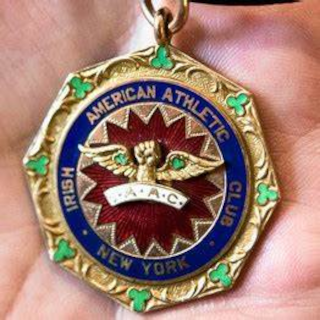
The Irish American Athletic Club, an amateur athletic organization based in Queens, New York, is established on January 30, 1898, originally as the Greater New York Irish Athletic Association. They shorten the name to the Irish American Athletic Club a few years later. They purchase a plot of land in what is then called Laurel Hill, Long Island, near Calvary Cemetery, Queens, and build a state-of-the-art athletic facility on what is farmland. The stadium, called Celtic Park, formally reopens after renovations on May 9, 1901, and until the facility is sold for housing in 1930, some of the greatest American athletes train or compete on Celtic Park’s track and field. The Irish American Athletic Club adopts a winged fist adorned with American flags and shamrocks as their emblem, with the Irish Gaelic motto “Láim Láidir Abú” or “A strong hand will be victorious,” and are often referred to as the “Winged Fists.” At one time they have clubs in Boston, Chicago, San Francisco and Yonkers, New York.

During the thirty odd years of its existence, all of the following athletes compete for the Irish American Athletic Club at some point:  Dan Ahearn, and his brother Tim AhearneCharles BaconGeorge BonhagJoseph BromilowFrank CastlemanRobert CloughenHarvey CohnTom CollinsEdward CookJames CrowleyJohn DalyJames H. DuncanJohn EllerJohn FlanaganWilliam FrankPatrick J. FlynnHarry GissingSidney HatchJohnny HayesDenis HorganBill HorrDaniel KellyAbel KiviatHannes KolehmainenEmilio LunghiAlvah MeyerJames MitchelPat McDonaldMatt McGrathEmil MullerPeter O’ConnorEdwin PritchardHarry PorterMyer PrinsteinRichard RemerJohn J. ReynoldsFrank RileyWilliam RobbinsLawson RobertsonJames RosenbergerMichael J. RyanPat RyanHarry SchaafArthur ShawMel SheppardMartin SheridanJames P. SullivanLee TalbottJohn Baxter Taylor, Jr.Con Walsh, William Galvin and Harold Wilson.

The Irish American Athletic Club is predominantly composed of Irish-born and first generation Irish American athletes, but many of the athletes who compete for the Winged Fist organization are neither.

The Irish American Athletic Club wins the Amateur Athletic Union national outdoor track and field team championship titles in 1904, 1906, 1907, 1908, 1910, 1911, 1912, 1913, 1914 and 1916. They also win the national indoor track and field team championship titles in 1906, 1908, 1909, 1911, 1913, 1914 and 1915. Individual athletes of the IAAC win 81 national outdoor championships titles and 36 individual national indoor championship titles.

In addition to winning numerous local and regional Amateur Athletic Union competitions, Irish American Athletic Club members compete for the United States Olympic team in the 1900 Summer Olympics in Paris, the 1904 Summer Olympics in St. Louis, the 1906 Intercalated Games in Athens, Greece, the 1908 Summer Olympics in London, the 1912 Summer Olympics in Stockholm and the 1920 Summer Olympics in Antwerp. From 1900 to 1924, men who are at one time members of the Irish American Athletic Club win 54 Olympic medals for the U.S. Olympic team, including 26 gold medals.

In 1912–13, 1913–14, 1914–15 and 1916–17 the Irish American Athletic Club has a team, the New York Irish-Americans, represented in the American Amateur Hockey League. The team is coached by James C. “Jimmy” O’Brien and has on its roster for various seasons future NHL players Tom McCarthy and Moylan McDonnell. John McGrath and Patsy Séguin also play for the club.

Before the largest crowd that has ever assembled to see a track meet in the United States, on September 9, 1916, the Irish American Athletic Club defeats the New York Athletic Club at the Amateur Athletic Union’s National Championships, by a score of 38 to 27. Before a crowd of 30,000 spectators at Newark, New Jersey‘s Weequahic Park, the Irish American Athletic Club wins what is to be their last national championship title. The club disbands a year later when the United States becomes a combatant in World War I.


Leave a comment

Birth of Bob Tisdall, Olympic Gold Medalist

bob-tisdall

Robert (“Bob”) Morton Newburgh Tisdall, gold medalist in the 400 metres hurdles at the 1932 Summer Olympics in Los Angeles, is born on May 16, 1907, in Nuwara Eliya, Ceylon (now Sri Lanka).

Born to a family of Irish landed gentry, he lives on his father’s plantation in Ceylon until the age of five, when they return to the family home in Nenagh, County Tipperary. Following prep school at Mourne Grange, he goes on to Shrewsbury School, where he wins the Public Schools 402 metres, and at Gonville and Caius College, Cambridge, where he wins a record four events – 402 metres and 110 metres hurdles, long jump and shot put – in the annual match against Oxford. This record is only equaled nearly 60 years later.

Tisdall sets South African and Canadian records in the 201 metres low hurdles in 1929, a year later setting Greek records in the same event. While at Cambridge in March 1932, he decides to try for a place on the Irish Olympic squad and, after he runs a record 54.2 seconds for the Irish Championship 402 metres hurdles in June that year, the authorities agree to let him run in his new event at the Los Angeles Olympic Games.

Tisdall had run only six 400 metres hurdles when he wins the gold medal at the 1932 Olympic Games in a world record time of 51.7 seconds, which is not recognised under the rules of the time because he had a hit a hurdle. Later, because of the notoriety of this incident, the rules are changed and the President of the International Olympic Committee, Juan Antonio Samaranch, presents Tisdall with a Waterford Crystal rose bowl with the image of him knocking over the last hurdle etched into the glass. Though the International Amateur Athletic Federation (IAAF) did not recognise the record at the time, they now recognise the mark, giving Tisdall credit for setting the milestone of being the first man under 52 seconds.

Following his victory, Tisdall is invited to a dinner in Los Angeles where he is seated next to Amelia Earhart on one side and Douglas Fairbanks, Jr. on the other.

Later in life, Tisdall lives in South Africa, where he runs a gymnasium during the day, which he converts to a night club after dark. He grows coffee in Tanzania, but moves to Nambour, Queensland in 1969 with his wife Peggy, where he farms fruit crops and cattle. He admits to running his last race at the age of 80, though he runs in the Sydney Olympics torch relay at age 93. At that point he is the oldest living recipient of an individual track and field Olympic medal。

At the age of 96 Tisdall falls down a steep set of rock stairs and breaks his shoulder, ribs and ruptures his spleen. He never completely recovers and dies on July 27, 2004. At that time, he is the world’s oldest track and field Olympic Gold medalist. He does not want a funeral because “they are altogether too sad.” His wake is attended by family and a few friends.

In 2002, three statues honouring Olympic champions with links to Nenagh, Matt McGrath, Johnny Hayes and Bob Tisdall, are unveiled in front of the Nenagh Courthouse.