seamus dubhghaill

Promoting Irish Culture and History from Little Rock, Arkansas, USA


Leave a comment

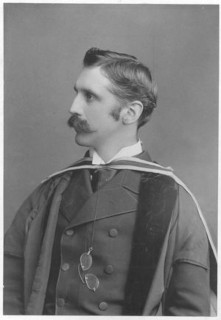
Death of Samuel Henry Butcher, Scholar & Politician

Samuel Henry Butcher, Anglo-Irish classical scholar and politician, dies in London on December 29, 1910.

Butcher is born in Dublin on April 16, 1850, the son of Samuel Butcher, Bishop of Meath, and Mary Leahy. John Butcher, 1st Baron Danesfort, is his younger brother. He is educated at Marlborough College in Wiltshire and then receives a place at Trinity College, Cambridge, attending between 1869 and 1873 where he is Senior Classic and Chancellor’s medalist. He is elected fellow of Trinity in 1874.

Butcher leaves Trinity on his marriage, in 1876, to Rose Julia Trench (1840-1902), the daughter of Archbishop Richard Chenevix Trench. The marriage produces no children.

From 1876 to 1882 Butcher is a fellow of University College, Oxford, and tutors there. From 1882 to 1903 he is Professor of Greek at the University of Edinburgh succeeding Prof. John Stuart Blackie. During this period, he lives at 27 Palmerston Place in Edinburgh‘s West End. He is succeeded at the University of Edinburgh by Prof. Alexander William Mair.

Butcher is one of the two Members of Parliament for Cambridge University, between 1906 and his death, representing the Liberal Unionist Party. He is President of the British Academy from 1909 to 1910.

Butcher dies in London on December 29, 1910, and his body is returned to Scotland and interred at the Dean Cemetery in Edinburgh with his wife. His grave has a pale granite Celtic cross and is located near the northern path of the north section in the original cemetery.

Butcher’s many publications include, in collaboration with Andrew Lang, a prose translation of Homer‘s Odyssey which appears in 1879 and the OCT edition of Demosthenes, Orationes, vol. I (Or. 1-19, Oxford, 1903), II.i (Or. 20–26, Oxford, 1907).


Leave a comment

Sinn Féin Votes to Accept the Good Friday Agreement

Members of Sinn Féin, the political wing of the republican Irish Republican Army (IRA), vote to accept the Good Friday Agreement on May 10, 1998, effectively acknowledging the north-south border. This marks a major shift in modern republicanism as, up until now, Sinn Féin has regarded participation in a Northern Ireland body as a tacit acceptance of partition.

The agreement comes at the party’s annual conference, which includes about thirty IRA prisoners granted special leave in order to vote.

The British and Irish governments welcome the decision to formally approve the peace agreement signed at Stormont in April to create the Northern Ireland Assembly and new cross-border institutions. Taoiseach Bertie Ahern says he now looks forward to an overwhelming “yes” vote in referendums on the deal later in the month. The British government praises Sinn Féin leader Gerry Adams saying the decision marks a final realisation that violence does not pay.

Secretary of State for Northern Ireland Mo Mowlam expresses her delight at the outcome, “I recognise how significant this decision is for republicans and pay tribute to the leadership of Gerry Adams in bringing his party to support the agreement, north and south of the border.” In what she describes as an “exceptional decision,” the IRA’s commanding officer, Patrick Wilson, who is confined in HM Prison Maze, is among the 30 republican inmates freed for the conference in an effort to bring about a “Yes” vote.

Sinn Féin also votes to amend its constitution to allow members to sit in a new Northern Ireland Assembly after Adams tells his members they have a real chance to influence the strategy of the party and the way towards a united Ireland.

Martin McGuinness, one of Sinn Féin’s UK Members of Parliament (MP), tells the BBC he is optimistic about achieving a “Yes” vote in the referendum due to be held on May 22. “I think there are concerns naturally among a small section of the Sinn Féin membership, but I have to say I think the mood all over the island is that moving into the assembly to further our republican objectives towards our ultimate goal of a united Ireland is at this moment in time the sensible thing to do,” he says.

(Pictured: Sinn Féin MP Martin McGuinness and Sinn Féin president Gerry Adams)


Leave a comment

Richard Pigott Exposed as Forger of Phoenix Park Letters

richard-pigott

Richard Pigott, an Irish journalist, is exposed as the forger of The Times Phoenix Park letters on February 10, 1889.

Pigott is born in 1835 in Ratoath, County Meath. As a young man he supports Irish nationalism and works for The Nation and The Tablet before acting as manager of The Irishman, a newspaper founded by Denis Holland. James O’Connor later claims Pigott embezzled funds from the paper and covered his tracks by not keeping written records. Pigott also works for the Irish National Land League, departing in 1883 after accusing its treasurer, Mr. Fagan, of being unable to account for £100,000 of its funds, and for keeping inadequate records. Nothing is done about his accusation, which is publicised in the newspapers, and he turns against the League, which is allied to several Irish nationalist groups including the Irish Parliamentary Party led by Charles Stewart Parnell.

In 1879 Pigott is proprietor of three newspapers, which he soon sells to the Irish Land League, of which Charles Stewart Parnell is president. Hitherto a violent Nationalist, from 1884 Pigott begins to vilify his former associates and to sell information to their political opponents. In an effort to destroy Parnell’s career, Pigott produces fake letters, which purports that Parnell had supported one of the Phoenix Park murders.

The Times purchases Pigott’s forgeries for £1,780 and publishes the most damning letter on April 18, 1887. Parnell immediately denounces it as “a villainous and barefaced forgery.” In February 1889, the Parnell Commission vindicates him by proving that the letters are forgeries. They include misspellings which Pigott has written elsewhere. A libel action instituted by Parnell also vindicates him and his parliamentary career survives the Pigott accusations.

The Commission eventually produces 37 volumes in evidence, covering not just the forgeries but also the surrounding violence that follows from the Plan of Campaign.

After admitting his forgeries to Henry Labouchère, Pigott flees to Spain, and shoots himself in a Madrid hotel room. Parnell then sues The Times for libel, and the newspaper pays him £5,000 in an out-of-court settlement, as well as considerably more in legal fees. When Parnell next enters the House of Commons, he receives a hero’s reception from his fellow Members of Parliament.

(Pictured: Pigott as caricatured by Spy (Leslie Ward) in Vanity Fair, March 1889)