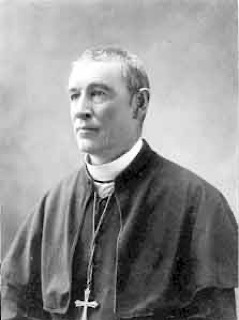
On an 1880 trip through the Colony of Victoria, Gibney is traveling by train between Benalla and Albury when at Glenrowan, he disembarks to offer assistance during the Siege of Glenrowan. Ned Kelly and his gang have been cornered by the police in a local hotel, which the police set afire in order to draw out the remaining bushrangers. Gibney enters the burning building in an attempt to rescue anyone inside, and finds the bodies of gang members Joe Byrne, Dan Kelly and Steve Hart, as well as the mortally wounded hostage Martin Cherry, who he helps retrieve and to whom he gives the last rites. He also tends to the injured Ned Kelly following his capture, hears his confession and gives him the last rites.
In January 1887, Gibney is consecrated as Bishop of Perth. His episcopate is marked by a number of poor investment decisions as the diocese purchases shops, offices, houses, and a hotel in Perth as well as a newspaper, exerting editorial influence by banning the publication of horse racing information, which leads to the paper’s eventual demise. As the diocese’s debts mount, he is forced to resign in May 1910. During his episcopate he is closely involved with the founding of the Beagle BayAboriginal community north of Broome, along with what eventually becomes St. John of God Health Care.
During restoration work in the cathedral from 2003 to 2006, the brick and plaster crypt containing the coffins of Gibney and Bishop Martin Griver are discovered by archaeologists under the floorboards of the cathedral.
Hughes is the third of seven children of Patrick and Margaret (née McKenna) Hughes. He and his family suffer religious persecution in their native land. He is sent with his elder brothers to a day school in the nearby village of Augher, and afterwards attends a grammar school in Aughnacloy. The family emigrates to the United States in 1816 and settles in Chambersburg, Pennsylvania. Hughes joins them there the following year.
After several unsuccessful applications to Mount St. Mary’s College in Emmitsburg, Maryland, he is eventually hired as a gardener at the college. During this time, he befriends Mother Elizabeth Ann Seton, who is impressed by Hughes and persuades the Rector to reconsider his admission. Hughes is subsequently admitted as a regular student of Mount St. Mary’s in September 1820.
Hughes campaigns actively on behalf of Irish immigrants and attempts to secure state support for parochial schools. Although this attempt fails, he founds an independent Catholic school system which becomes an integral part of the Catholic Church’s structure at the Third Plenary Council of Baltimore (1884), which mandates that all parishes have a school and that all Catholic children be sent to those schools. In 1841, Hughes founds St. John’s College in New York City which is now Fordham University.
Hughes is appointed Apostolic Administrator of the diocese due to Bishop Dubois’ failing health. As coadjutor, he automatically succeeds Dubois upon the bishop’s death on December 20, 1842, taking over a diocese which covers the entire state of New York and northern New Jersey. He is a staunch opponent of Abolitionism and the Free-Soil movement, whose proponents often express anti-Catholic attitudes. Hughes also founds the Ultramontane newspaper New York Freeman to express his ideas.
Hughes becomes an archbishop on July 19, 1850, when the diocese is elevated to the status of archdiocese by Pope Pius IX. As archbishop, he becomes the metropolitan for the Catholic bishops serving all the dioceses established in the entire Northeastern United States. To the dismay of many in New York’s Protestant upper-class, Hughes foresees the uptown expansion of the city and begins construction of the current St. Patrick’s Cathedral on Fifth Avenue between 50th and 51st Street, laying its cornerstone on August 15, 1858. At the request of President Abraham Lincoln, Hughes serves as semiofficial envoy to the Vatican and to France in late 1861 and early 1862. Lincoln also seeks Hughes’ advice on the appointment of hospital chaplains.
Hughes serves as archbishop until his death. He is originally buried in St. Patrick’s Old Cathedral, but his remains are exhumed in 1882 and re-interred in the crypt under the altar of the new cathedral he had begun.