seamus dubhghaill

Promoting Irish Culture and History from Little Rock, Arkansas, USA


Leave a comment

Death of Matthew Gibney, Irish-Born Roman Catholic Bishop of Perth

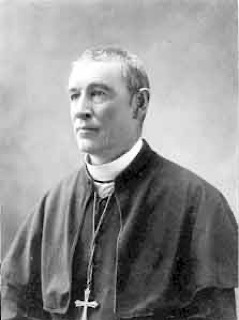
Matthew Gibney, Irish-born metropolitan bishop in Australia and the third Roman Catholic Bishop of Perth (1886-1910), dies on June 22, 1925, in Perth, Western Australia. He is perhaps best known for giving notorious bushranger Ned Kelly his last rites following a shootout at Glenrowan, Victoria, in 1880.

Gibney is born in Killeshandra, County Cavan, and is raised on the family farm in Killygorman townland, parish of Kildallan, County Cavan. He studies for the priesthood at the preparatory seminary at Stillorgan and from 1857 at All Hallows Missionary College in Drumcondra, Dublin. He is ordained a priest in 1863 and arrives in Perth, Western Australia, later in the year.

On an 1880 trip through the Colony of Victoria, Gibney is traveling by train between Benalla and Albury when at Glenrowan, he disembarks to offer assistance during the Siege of Glenrowan. Ned Kelly and his gang have been cornered by the police in a local hotel, which the police set afire in order to draw out the remaining bushrangers. Gibney enters the burning building in an attempt to rescue anyone inside, and finds the bodies of gang members Joe ByrneDan Kelly and Steve Hart, as well as the mortally wounded hostage Martin Cherry, who he helps retrieve and to whom he gives the last rites. He also tends to the injured Ned Kelly following his capture, hears his confession and gives him the last rites.

In January 1887, Gibney is consecrated as Bishop of Perth. His episcopate is marked by a number of poor investment decisions as the diocese purchases shops, offices, houses, and a hotel in Perth as well as a newspaper, exerting editorial influence by banning the publication of horse racing information, which leads to the paper’s eventual demise. As the diocese’s debts mount, he is forced to resign in May 1910. During his episcopate he is closely involved with the founding of the Beagle Bay Aboriginal community north of Broome, along with what eventually becomes St. John of God Health Care.

Gibney dies of cancer in Perth on June 22, 1925, and was buried in St. Mary’s Cathedral in Perth.

During restoration work in the cathedral from 2003 to 2006, the brick and plaster crypt containing the coffins of Gibney and Bishop Martin Griver are discovered by archaeologists under the floorboards of the cathedral.

Gibney is played by John Fernside in The Glenrowan Affair (1951).


Leave a comment

Birth of Joseph Shanahan, Bishop for Southern Nigeria

joseph-shanahan

Joseph Ignatius Shanahan B.Sc., C.S.Sp., priest of the Congregation of the Holy Spirit (Spiritans), is born on June 6, 1871 in Glankeen, Borrisoleigh, County Tipperary. He serves as a bishop in Nigeria, first as prefect apostolic of Lower Niger and then as vicar apostolic of Southern Nigeria.

Shanahan joins the Holy Ghost Order in France in 1886, where his uncle Pat Walsh (Brother Adelm) had also joined the Holy Ghost Fathers. In 1889, he is transferred to the French Juniorate of the Congregation in Cellule in the Auvergne. He makes his profession on Easter Sunday 1898 and his ordination takes place on April 22, 1900 in the Blackrock College chapel.

By mid-July 1902, Shanahan has received his appointment for Nigeria to help Fr. Léon Lejeune make bricks to build the first proper mission house in Onitsha.

Shanahan is instrumental in the setting up of the Saint Patrick’s Society for the Foreign Missions, sometimes known as the Kiltegan Fathers, when in 1920, following his ordination in Maynooth as Bishop for Southern Nigeria (then a British protectorate), he appeals to students in Maynooth College for missionaries to Nigeria and Africa.

In 1924 Bishop Shanahan founds a missionary society for women, the Missionary Sisters of the Holy Rosary, in Killeshandra, County Cavan.

Bishop Shanahan dies at Nairobi, Kenya, on Christmas Day 1943 aged 72 years, and is initially buried in the community cemetery in St. Mary’s School in Nairobi. However, in January 1956 his remains are brought back to Nigeria for the “second burial” in the Cathedral Basilica of the Most Holy Trinity, Onitsha.

Always revered as a saint by those in close contact with him, Shanahan’s cause for Beatification is introduced officially on November 15, 1997 in Onitsha cathedral.


Leave a comment

Phillip O’Reilly Surrenders to the Cromwellian Conquest of Ireland

settlement-of-ireland-1653

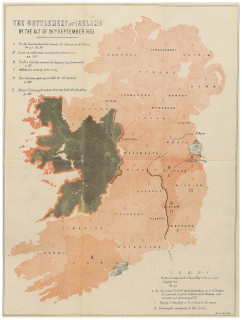
The last major body of Irish Catholic troops under Phillip O’Reilly surrender to the Cromwellian conquest of Ireland at Cloughoughter in County Cavan on April 27, 1653. This marks the end of the Irish Confederate Wars which began in 1641.

Colonel Philip O’Reilly is a member of parliament (MP) for County Cavan in the Parliament of Ireland from 1639 to 1641, and a leading member of the Irish Rebellion of 1641.

O’Reilly’s father, grandfather and several other ancestors are chiefs of the O’Reilly clan and Lords of Breifne O’Reilly. His mother is Catherine MacMahon. He resides at Bellanacargy Castle in the barony of Tullygarvey, near to present day village of Drung. Bellanacargy castle, anciently referred to as Ballynacarraig because it was built on a carraig (rock island) situated in the middle of the River Annalee, is destroyed in May 1689 by Williamite forces led by Thomas Lloyd.

As a young man O’Reilly serves for some time in the Spanish army but returns to Ireland. He is appointed Commissioner of the Peace in 1625 and High Sheriff of Cavan in 1629. He is elected as MP for County Cavan in 1639.

During the Parliamentary session of 1640 O’Reilly is enlisted by Rory O’Moore in the plot to start a rebellion against English rule in Ireland. O’Moore is a distant relation as his sister Cecilia O’Moore is married to O’Reilly’s first cousin, Tirlagh O’Neill. On the outbreak of the Irish Rebellion in October 1641 he is elected chief of the O’Reillys. As a result, the Irish Parliament expels him on November 16, 1641. On November 6, 1641 he orders a general gathering of his clansmen from 16 to 60 years of age, to be held at Virginia, and on December 11, 1641 he has possession of the whole county, except the Killeshandra castles of Keelagh and Croghan which are defended by Sir Francis Hamilton and Sir James Craig. He raises a brigade of twelve hundred men, composed chiefly of his name and family, and serves with distinction as lieutenant-general in the service of the Confederate Catholics of Ireland. The Assembly of Kilkenny appoints him Lord President of Ulster. His second cousin Myles O’Reilly is High Sheriff of Cavan in 1641 at the outbreak of the Rebellion.

O’Reilly is detained for treason by the English government in 1642. In his diary for June 3, 1644, the historian Sir James Ware II states, “Intelligence came to Dublin that Roger Moore and Philip O’Reilly, two of the first incendiaries were committed to prison at Kilkenny.” O’Reilly is further denounced by the Act for the Settlement of Ireland 1652 at the end of the rebellion. Following the collapse of the Irish confederacy, he formally surrenders to Oliver Cromwell at Cloughoughter Castle on April 27, 1653, being the last Irish garrison to do so. He secures favourable terms and is obliged to leave Ireland. He retires with his brigade into Spain and thence to the Netherlands, where he serves in the Spanish army for about two years and dies in 1655. He is buried in the Irish monastery of St. Dominick in Leuven, Belgium.