seamus dubhghaill

Promoting Irish Culture and History from Little Rock, Arkansas, USA


Leave a comment

Birth of Seán McCaughey, Militant & Irish Republican Activist

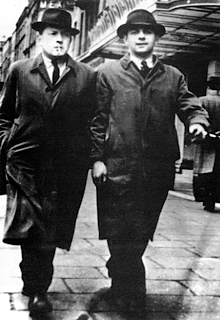
Seán McCaughey (Irish: Seán Mac Eóchaidh), Irish militant and Republican activist, is born on June 8, 1915, in Aughnacloy, County Tyrone. He is an Irish Republican Army (IRA) leader in the 1930s and 1940s and a hunger striker.

In 1921, McCaughey’s family moves to the Ardoyne district in north Belfast. Hus father is a founding member of the Irish republican Dungannon Clubs and organizes the first branch of Sinn Féin in County Tyrone. As a teenager he joins the Gaelic League and Sinn Féin and also becomes a long time student and teacher of the Irish language in the Glens of Antrim. He joins the IRA in 1935 and in 1938 is promoted to Officer Commanding (O/C) of its Northern Command, headquartered near the town of Carrickmore, County Tyrone, which is the ancestral home of Joseph McGarrity and Patrick McCartan, both leaders of the Irish republican organization Clan na Gael. In December 1939, he is arrested and imprisoned at the Curragh Camp. After being released in 1940 he returns to the Northern Command of the IRA. He is held in high regard and is considered to be one of the best officers of the northern IRA. At the time of his arrest in Rathmines, Dublin, on September 2, 1941, he is acting Chief of Staff.

In September 1941, McCaughey is found guilty by a Dublin court of having detained and assaulted Stephen Hayes, IRA Chief of Staff, who was accused of being a spy for the Irish Free State government. Hayes escapes and later testifies against him at a Military Court. He is sentenced to death by firing squad. His sentence is commuted to a life sentence of penal servitude.

Imprisoned in Portlaoise Prison on July 24, 1941, McCaughey joins other IRA prisoners in the ongoing blanket protest. Refusing to wear a criminal’s prison clothes, he is kept in solitary confinement and spends nearly five years naked except for a blanket. This form of resistance by Irish republican prisoners is also used in the 1980s blanket protests in the Maze prison (also known as “Long Kesh”) and the HM Prison Armagh (women’s prison) in Northern Ireland. He and other Irish republican prisoners endure years of hardships. Sitting month after month, year after year in bleak solitary cells, they are taken out once a week for a bath, and for the rest of the week live the life of an animal trapped in a burrow. That they do not go mad is a remarkable comment on mans capacity for survival. During his almost five years in Portlaoise, he Is never permitted to have visitors.

McCaughey commences a hunger strike on April 19, 1946. After ten days, he stops taking water and dies on May 11, 1946, the twenty-third day of his protest. An inquest is held in the prison at which the prison doctor admits that during his over four and a half years of imprisonment that McCaughey had never been allowed out in the fresh air or sunlight and that “he would not treat his dog the way Seán McCaughey had been treated in Portlaoise.”

Sean McCaughey’s funeral cortege passes through large crowds in the streets of Dublin and proceeds north to Belfast where it is met by thousands of mourners at Holy Cross Church, Ardoyne. He Is buried in a family grave in Milltown Cemetery, which is under the care of the National Graves Association, Belfast.

McCaughey is the last person to die on hunger strike in the Irish state. There is a long history of hunger striking in Ireland – within the 20th century a total of 22 Irish republicans die on hunger strike with survivors suffering long-term health and psychological effects. Four men die during the 1920 Cork hunger strike. The largest hunger strike in Irish history is the 1923 Irish hunger strikes, during which five men die. Ten men die during the 1981 Irish hunger strike.

(Pictured: Seán McCaughey (right) and Charlie McGlade, O’Connell Street, Dublin, 1941)

Leave a comment

The Derryard Checkpoint Attack

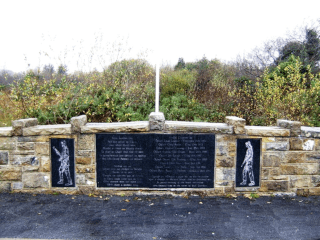
The Provisional Irish Republican Army (IRA) attacks a British Army permanent vehicle checkpoint complex manned by the King’s Own Scottish Borderers (KOSB) near the Northern IrelandRepublic of Ireland border at Derryard, north of Rosslea, County Fermanagh, on December 13, 1989.

According to journalist Ed Moloney, the IRA Army Council, suspecting a great deal of infiltration by double agents at the grassroots level of the IRA, decide to form an experimental flying column (rather than the usual active service unit) to mount a large-scale operation against a permanent vehicle checkpoint along the border. It hopes that this will prevent any information leak that might result in another fiasco like the Loughgall Ambush of 1987.

Moloney maintains that the planning is in the charge of Thomas Murphy, alleged leader of the South Armagh Brigade, and that the raid is to be led by East Tyrone Brigade member Michael “Pete” Ryan. Journalist Ian Bruce instead claims that the IRA unit is led by an Irish citizen who had served in the Parachute Regiment, citing intelligence sources. The column is made up of about 20 experienced IRA volunteers from throughout Northern Ireland, eleven of whom are to carry out the attack itself. Bruce reports that IRA members from County Monaghan, supported by local Fermanagh militants, carry out the raid.

The target is a permanent vehicle checkpoint at Derryard. Described as a “mini base,” it includes an accommodation block and defensive sangars. It is manned by eight soldiers of the 1st Battalion, King’s Own Scottish Borderers and a Royal Ulster Constabulary (RUC) officer. The eleven IRA members are driven to the checkpoint in the back of a makeshift Bedford armoured dumper truck. They are armed with 7.62mm AK-47s, 5.56mm ArmaLite AR-18s, two 12.7mm DShK heavy machine-guns, RPG-7s, different kinds of grenades, and a LPO-50 flamethrower. The heavy machine guns and the flamethrower are mounted on a tripod on the lorry bed. To assure widespread destruction, the column plan to detonate a van bomb after the initial assault.

The attack takes place shortly after 4:00 PM. IRA members seal off roads leading to the checkpoint in an attempt to prevent civilians from getting caught up in the attack. The truck is driven from the border and halted at the checkpoint. As Private James Houston begins to check the back of the truck, the IRA open fire with assault rifles and throw grenades into the compound. Two RPG-7s are fired at the observation sangar while the flamethrower stream is directed at the command sangar. Heavy shooting continues as the truck reverses and smashes through the gates of the compound. At least three IRA volunteers dismount inside the checkpoint and spray the portacabins with gunfire and the flamethrower’s fire stream, while throwing grenades and nail bombs. The defenders are forced to seek shelter in sangars, from where they fire into their own base. A farmer some distance away sees an orange ball of flames and hears gunfire ‘raking the fields.’ As the truck drives out of the now wrecked compound, a red transit van loaded with a 400-lb. (182 kg) bomb is driven inside and set to detonate once the IRA unit has made its escape. However, only the booster charge explodes.

The attack is finally repulsed by a four-men Borderers section from the checkpoint that is patrolling nearby, with the support of a Westland Wessex helicopter. The patrol fires more than 100 rounds at the IRA unit. The Wessex receives gunfire and is forced to take evasive action. The IRA column, at risk of being surrounded, flee toward the border in the armoured truck. It is found abandoned at the border with a 460-lb. (210 kg) bomb on board.

Two soldiers are killed in the attack: Private James Houston (22) from England and Lance-Corporal Michael Patterson (21) from Scotland. Corporal Whitelaw is badly wounded by shrapnel and later airlifted for treatment. Another soldier suffers minor injuries.

There is outrage in Westminster and among unionists, as a supposedly well-defended border post has been overrun by the IRA and two soldiers killed. On the other hand, according to Moloney, there is also some disappointment among republicans. Despite the positive propaganda effect, the quick and strong reaction from the outpost’s defenders convince some high-ranking IRA members that the Army Council has been infiltrated by a mole.

KOSB officers and security sources believe that the IRA unit involved was not locally recruited, putting the blame instead on IRA members from Clogher, County Tyrone and South Monaghan in the Republic. The same sources say that the attack was executed “in true backside-or-bust Para style.”

After the action of Derryard, the British Army in Northern ireland are issued the French designed Luchaire 40mm rifle grenade, fitted on the muzzle of the SA80 rifle. This gives the troops a lightweight armour piercing capability to deal with the threat imposed by improvised armoured vehicles. Permanent checkpoints along the border are also fitted with general-purpose machine guns. From 1990 until the end of the IRA campaign in 1997, there are a number of further bloodless, small-scale attacks against permanent vehicle checkpoints along this part of the border using automatic weapons, particularly in County Fermanagh and against a military outpost at Aughnacloy, County Tyrone.

Two soldiers, Corporal Robert Duncan and Lance Corporal Ian Harvey, are bestowed the Distinguished Conduct Medal (DCM), while Lance-Corporal Patterson receives a posthumous mention in dispatches for his actions during the attack. The checkpoint is dismantled in March 1991, as part of a major border security re-arrangement codenamed Operation Mutilate.

(Pictured: Republican memorial at Carragunt bridge, on the border between Northern Ireland and the Republic, often crossed by Provisional IRA forces during the Troubles to attack British targets inside County Fermanagh)


Leave a comment

Birth of John Hughes, 1st Archbishop of New York

john-joseph-hughes

John Joseph Hughes, prelate of the Roman Catholic Church in the United States and the fourth Bishop and first Archbishop of the Archdiocese of New York, is born in the hamlet of Annaloghan, near Aughnacloy, County Tyrone in Northern Ireland on June 24, 1797.

Hughes is the third of seven children of Patrick and Margaret (née McKenna) Hughes. He and his family suffer religious persecution in their native land. He is sent with his elder brothers to a day school in the nearby village of Augher, and afterwards attends a grammar school in Aughnacloy. The family emigrates to the United States in 1816 and settles in Chambersburg, Pennsylvania. Hughes joins them there the following year.

After several unsuccessful applications to Mount St. Mary’s College in Emmitsburg, Maryland, he is eventually hired as a gardener at the college. During this time, he befriends Mother Elizabeth Ann Seton, who is impressed by Hughes and persuades the Rector to reconsider his admission. Hughes is subsequently admitted as a regular student of Mount St. Mary’s in September 1820.

On October 15, 1826, Hughes is ordained to the priesthood by Bishop Henry Conwell at St. Joseph’s Church in Philadelphia. His first assignment is as a curate at St. Augustine’s Church in Philadelphia, where he assists its pastor by celebrating Mass, hearing confessions, preaching sermons, and other duties in the parish.

Hughes is chosen by Pope Gregory XVI as the coadjutor bishop of the Diocese of New York on August 7, 1837. He is consecrated bishop at St. Patrick’s Old Cathedral on January 7, 1838, with the title of the titular see of Basilinopolis, by the Bishop of New York, John Dubois, his former Rector.

Hughes campaigns actively on behalf of Irish immigrants and attempts to secure state support for parochial schools. Although this attempt fails, he founds an independent Catholic school system which becomes an integral part of the Catholic Church’s structure at the Third Plenary Council of Baltimore (1884), which mandates that all parishes have a school and that all Catholic children be sent to those schools. In 1841, Hughes founds St. John’s College in New York City which is now Fordham University.

Hughes is appointed Apostolic Administrator of the diocese due to Bishop Dubois’ failing health. As coadjutor, he automatically succeeds Dubois upon the bishop’s death on December 20, 1842, taking over a diocese which covers the entire state of New York and northern New Jersey. He is a staunch opponent of Abolitionism and the Free-Soil movement, whose proponents often express anti-Catholic attitudes. Hughes also founds the Ultramontane newspaper New York Freeman to express his ideas.

Hughes becomes an archbishop on July 19, 1850, when the diocese is elevated to the status of archdiocese by Pope Pius IX. As archbishop, he becomes the metropolitan for the Catholic bishops serving all the dioceses established in the entire Northeastern United States. To the dismay of many in New York’s Protestant upper-class, Hughes foresees the uptown expansion of the city and begins construction of the current St. Patrick’s Cathedral on Fifth Avenue between 50th and 51st Street, laying its cornerstone on August 15, 1858. At the request of President Abraham Lincoln, Hughes serves as semiofficial envoy to the Vatican and to France in late 1861 and early 1862. Lincoln also seeks Hughes’ advice on the appointment of hospital chaplains.

Hughes serves as archbishop until his death. He is originally buried in St. Patrick’s Old Cathedral, but his remains are exhumed in 1882 and re-interred in the crypt under the altar of the new cathedral he had begun.


Leave a comment

Death of Archbishop John Joseph Hughes

john-joseph-hughes

John Joseph Hughes, Irish-born prelate of the Roman Catholic Church in the United States and the fourth Bishop and first Archbishop of the Archdiocese of New York, dies in New York City on January 3, 1864.

Hughes is born in the hamlet of Annaloghan, near Aughnacloy, County Tyrone. He emigrates to the United States in 1817.

After several unsuccessful applications to Mount St. Mary’s College in Emmitsburg, Maryland, he is eventually hired as a gardener at the college. During this time, he befriends Mother Elizabeth Ann Seton, who is impressed by Hughes and persuades the rector to reconsider his admission. Hughes is subsequently admitted as a regular student of Mount St. Mary’s in September 1820.

On October 15, 1826, Hughes is ordained to the priesthood by Bishop Henry Conwell at Old St. Joseph’s Church in Philadelphia. His first assignment is as a curate at St. Augustine Church in Philadelphia, where he assists its pastor by celebrating Mass, hearing confessions, preaching sermons, and other duties in the parish.

Hughes is chosen by Pope Gregory XVI as the coadjutor bishop of the Diocese of New York on August 7, 1837. He is consecrated bishop at St. Patrick’s Old Cathedral on January 7, 1838, with the title of the titular see of Basilinopolis, by the Bishop of New York, John Dubois, his former Rector.

Hughes campaigns actively on behalf of Irish immigrants and attempts to secure state support for parochial schools. Although this attempt fails, he founds an independent Catholic school system which becomes an integral part of the Catholic Church’s structure at the Third Plenary Council of Baltimore (1884), which mandates that all parishes have a school and that all Catholic children be sent to those schools. In 1841, Hughes founds St. John’s College in New York City which is now Fordham University.

Hughes is appointed Apostolic Administrator of the diocese due to Bishop Dubois’ failing health. As coadjutor, he automatically succeeds Dubois upon the bishop’s death on December 20, 1842, taking over a diocese which covers the entire state of New York and northern New Jersey. He is a staunch opponent of Abolitionism and the Free Soil movement, whose proponents often express anti-Catholic attitudes. Hughes also founds the Ultramontane newspaper New York Freeman to express his ideas.

Hughes becomes an archbishop on July 19, 1850, when the diocese is elevated to the status of archdiocese by Pope Pius IX. As archbishop, he becomes the metropolitan for the Catholic bishops serving all the dioceses established in the entire Northeastern United States. To the dismay of many in New York’s Protestant upper-class, Hughes foresees the uptown expansion of the city and begins construction of the current St. Patrick’s Cathedral on Fifth Avenue between 50th and 51st Street, laying its cornerstone on August 15, 1858. At the request of President Abraham Lincoln, Hughes serves as semiofficial envoy to the Vatican and to France in late 1861 and early 1862. Lincoln also seeks Hughes’ advice on the appointment of hospital chaplains.

Hughes serves as archbishop until his death. He is originally buried in St. Patrick’s Old Cathedral, but his remains are exhumed in 1882 and reinterred in the crypt under the altar of the new cathedral he had begun.