seamus dubhghaill

Promoting Irish Culture and History from Little Rock, Arkansas, USA


Leave a comment

Death of Robert Patterson, Naturalist & Poet

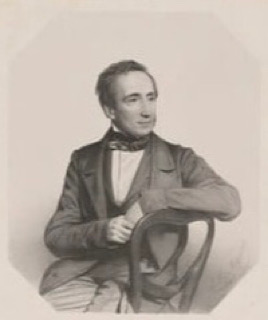
Robert Patterson, naturalist and poet, dies in Belfast on February 14, 1872.

Patterson is born in Belfast on April 18, 1802, the eldest son among three sons and a daughter of Robert Patterson, ironmonger, who supplies equipment for linen mills, and his wife Catherine Patterson (neé Clarke), who is from Dublin. He attends Belfast Royal Academy, and from 1814 is one of the first pupils of the Belfast Academical Institution. He is apprenticed in 1818 to his father, and takes over the business on his father’s death in 1831. Even as a boy, he devotes his leisure time to the study of natural history, and during summer holidays investigates the flora and fauna of the countryside and seaside resorts near Belfast. One of his brothers, William (1805–37), has similar interests.

At the age of 18, Patterson is a founder along with seven others, including James Lawson DrummondJames MacAdam and George Crawford Hyndman, of the Belfast Natural History Society in 1821 (from 1842 “and Philosophical” is added to the society’s name). He is the society’s president for many years, taking a leading role in setting up its museum in 1830–31, and over the years giving many lectures, mostly published in its proceedings. Like many contemporaries, he is an enthusiast for the study of phrenology, and lectures on the subject in Belfast in 1836.

In 1871, Patterson is presented with an illuminated address by the BNHPS for his work to promote the study of natural history, especially as a subject in education. He is the only recipient of the Society’s Templeton medal. Though still engaged in business, he makes a reputation as Belfast’s most distinguished amateur naturalist, publishing monographs such as Letters on the Insects Mentioned by Shakespeare (1838). During dredging excursions in Belfast Lough he discovers several forms of marine life new to Great Britain and Ireland. He is one of the earliest members of the British Association for the Advancement of Science, and secretary of its natural history section from 1839 to 1844. When the Association meets in Belfast in 1852, he acts as local treasurer. He corresponds with prominent naturalists, including Charles Darwin.

In 1843, Patterson publishes in The Zoologist magazine The Reptiles Mentioned by Shakespeare. His Zoology for Schools (2 volumes, 1846, 1848) is followed by First Steps in Zoology (2 volumes, 1849, 1851). A large volume, Zoological Diagrams, with colour illustrations, is published in 1853. All his books have a wide circulation, particularly in the national schools, and stimulates the study of zoology. In accordance with the will of his friend William Thompson, Patterson and James Ramsey Garrett begin to prepare the final volume of Thompson’s Natural History of Ireland for publication. Garrett dies in 1855 and Patterson completes the volume in 1856. He is elected Member of the Royal Irish Academy (MRIA) in 1856, and Fellow of the Royal Society (FRS) in 1859.

Patterson is in the vanguard of a generation of Ulster naturalists who through their work encourage the study of Irish flora and fauna and the establishment of field clubs and natural history societies. He also takes an active part in the public life of Belfast, and in philanthropy. He is a member of the unitarian congregation. He is one of the founders of the Ulster Society for the Prevention of Cruelty to Animals and is particularly interested in the Belfast Society for Promoting Knowledge (the Linen Hall Library), in the Botanic Gardens, and in his old school, Royal Belfast Academical Institution. As a Belfast harbour commissioner (1858–70), he brings commercial and environmental insights to decisions concerning port development.

Patterson marries Mary Elizabeth Ferrar in 1833. She is the daughter of a Belfast magistrate, William H. Ferrar, and writes poetry. Patterson also writes poetry, as well as hymns. Many of their poems are collected in Verses by Robert and Mary Patterson (1886), and they are represented in Selections from the British Poets, published for the use of national schools in 1849. They have five sons and six daughters. His second son, Robert Lloyd Patterson, is also a naturalist. Another son was William H. Patterson. His grandson Robert Patterson, editor of the Irish Naturalist, is secretary of the Belfast Natural History and Philosophical Society, secretary and president of the Belfast Naturalists’ Field Club and secretary of the Ulster Fisheries and Biology Association, which he founds. Robert M. Patterson, a grandson, is a prominent businessman and highly regarded amateur artist. Rosamond Praeger is a granddaughter, and Robert Lloyd Praeger  a grandson. The latter writes of his grandfather: “After seventy-five years I can still see him – a man of middle height, and rather formal manner, pursuing his country rambles on Saturday afternoons in black frock-coat and top hat, and pointing out to us delighted children lady-birds and tree-creepers.”

Patterson retires from business in 1865, and dies on February 14, 1872, at his residence in College Square North, Belfast. He is buried in Belfast City Cemetery, where there is a monument to his memory.

(From: “Patterson, Robert” by Andrew O’Brien, Dictionary of Irish Biography, http://www.dib.ie, October 2009 | Pictured: “Robert Patterson” by Thomas Herbert Maguire, printed by M & N Hanhart lithograph, 1849, National Portrait Gallery)
Leave a comment

Death of John Luke, Northern Irish Artist

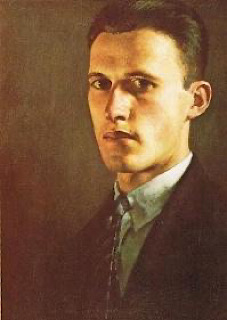
Northern Irish artist John Luke dies in Belfast on February 4, 1975.

Luke is born at 4 Lewis Street in Belfast on January 19, 1906, the fifth of seven sons and one daughter of James Luke and his wife Sarah, originally from Ahoghill, County Antrim. He attends the Hillman Street National School and in 1920 goes to work at the York Street Flax Spinning Company. He goes on soon after to become a riveter at the Workman, Clark shipyard. While working there he enrolls in evening classes at the Belfast School of Art.

Luke excells at the college under the tutelage of Seamus Stoupe and Newton Penpraze. His contemporaries include Romeo Toogood, Harry Cooke Knox, George MacCann and Colin Middleton. In 1927 he wins the coveted Dunville Scholarship which enables him to attend the Slade School of Fine Art in London, where he studies painting and sculpture under the celebrated Henry Tonks, who greatly influences his development as a draughtsman.

Luke remains at the Slade School of Fine Art until 1930, in which year he wins the Robert Ross Scholarship. On leaving the Slade School he stays in London, intent on establishing himself in the art world. For a time he shares a flat with fellow Ulsterman F. E. McWilliam, and enrolls as a part-time student of Walter Bayes at the Westminster School of Art to study wood engraving. He begins to exhibit his work and in October 1930 shows two paintings, Entombment and Carnival, in an exhibition of contemporary art held at Leger Galleries. The latter composition, depicting a group of masked merry-makers, is singled out by the influential critic, Paul George Konody of the Daily Mail (October 3, 1930), as “one of the most attractive features of the exhibition.” But the economic climate is deteriorating and a year later, at the end of 1933, he is driven back to Belfast by the recession. He remains in Belfast, apart from a time during World War II when he goes to KillyleaCounty Armagh.

Luke paints in the style known as Regionalism, whose main proponents are Thomas Hart BentonGrant WoodJohn Steuart Curry and Harry Epworth Allen. His painting technique is painstakingly slow, his manner precise. “I’m afraid I’m very much a one job man,” he once writes to John Hewitt, continuing, “my strength lies in making the most of one job at a time, in sustained thought and effort, to bring it to the highest level of organisation and completeness I desire: the other way I lead to disintegrate in looseness and frustration with its inevitable weakness.” The precision characteristic of his work is manifested, too, in his appearance and personal manner. Dark haired, in stature he is erect and spare of build. Always tidy, his clothes brushed, his hair short, he is, in Hewitt’s words, “not at all close to the romantic stereotype of the artist.”

Apart from Luke’s work as a practising artist, he teaches from time to time in the Belfast School of Art, where he influences a generation of students “especially in the matter of drawing,” as he once puts it. Although principally a painter, throughout his career he occasionally makes sculptures, such as the Stone HeadSeraph of c. 1940 (Ulster Museum). Indeed it is for sculpture that he wins the Robert Ross Prize at the Slade School of Fine Art. He is also much interested in philosophical theories of art. In the 1930s, for example, as John Hewitt records, topical books such as Roger Fry’s Vision and DesignClive Bell’s Art and R. H. Wilenski‘s Modern Movement in Art direct his thinking.

From the late 1930s until 1943, when Luke produces Pax, there is a gap in his output, occasioned, no doubt, by his move to County Armagh in order to escape Belfast after the Blitz. In 1946, he holds his first one-man exhibition at the Belfast Museum and Art Gallery, and this is followed two years later by a similar show, held under the aegis of CEMA, nearby at number 55A Donegal Place. In 1950, to celebrate the Festival of Britain the following year, he is commissioned to paint in Belfast City Hall, a mural representing the history of the city, a work which brings his name to the attention of a wider audience. In later years, other commissions follow for murals in the Masonic Hall, Rosemary Street, in 1956, and the College of Technology at Millfield in the 1960s. He also carves in relief coats of arms for the two Governors of Northern Ireland, John Loder, 2nd Baron Wakehurst (1959) and John Erskine, 1st Baron Erskine of Rerrick (1965). He is also a member of the Royal Ulster Academy.

Having been in declining health for some years, Luke dies, unmarried, at the Mater Infirmorum Hospital in Belfast on February 4, 1975, just a month into his sixty-ninth year. A retrospective exhibition of his work is held, in association with the Arts Councils of Ireland, in the Ulster Museum in 1978, and is accompanied by a short monograph on his life and career written by John Hewitt. Since that time his reputation has grown enormously, his loss rekindling memories in many of his former students of a fastidiously arranged life-room in the College of Art, his coat folded to perfection and his soft, gentle manner of instruction.


Leave a comment

Birth of Dame Jean Iris Murdoch, Novelist & Philosopher

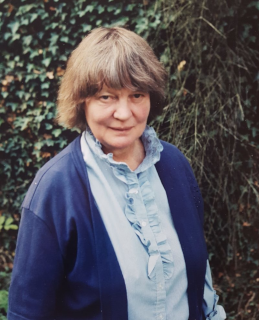
Dame Jean Iris Murdoch DBE, Irish and British novelist and philosopher, is born on July 15, 1919, in PhibsboroughDublin. She is best known for her novels about good and evilsexual relationshipsmorality, and the power of the unconscious. In 2008, The Times ranks her twelfth on a list of “The 50 greatest British writers since 1945.”

Murdoch is the daughter of Irene Alice (née Richardson) and Wills John Hughes Murdoch. Her father, a civil servant, comes from a mainly Presbyterian sheep farming family from HillhallCounty Down. In 1915, he enlists as a soldier in King Edward’s Horse and serves in France during World War I before being commissioned as a second lieutenant. Her mother trains as a singer before Iris is born and is from a middle-class Church of Ireland family in Dublin. Her parents first meet in Dublin when her father is on leave and are married in 1918.  Iris is the couple’s only child. When she is a few weeks old the family moves to London, where her father had joined the Ministry of Health as a second-class clerk.  She is a second cousin of the Irish mathematician Brian Murdoch.

Murdoch is brought up in Chiswick and educated in progressive independent schools, entering the Froebel Demonstration School in 1925 and attending Badminton School in Bristol as a boarder from 1932 to 1938. In 1938 she goes up to Somerville College, Oxford, with the intention of studying English, but switches to “Greats“, a course of study combining classics, ancient history, and philosophy. At Oxford she studies philosophy with Donald M. MacKinnon and attends Eduard Fraenkel‘s seminars on Agamemnon. She is awarded a first-class honours degree in 1942. After leaving Oxford she goes to work in London for HM Treasury. In June 1944 she leaves the Treasury and goes to work for the United Nations Relief and Rehabilitation Administration (UNRRA). At first, she is stationed in London at the agency’s European Regional Office. In 1945 she is transferred first to Brussels, then to Innsbruck, and finally to GrazAustria, where she works in a refugee camp. She leaves the UNRRA in 1946.

From 1947 to 1948 Murdoch studies philosophy as a postgraduate at Newnham College, Cambridge. She meets Ludwig Wittgenstein at Cambridge but does not hear him lecture, as he had left his Trinity College professorship before she arrives. In 1948 she becomes a fellow of St. Anne’s College, Oxford, where she teaches philosophy until 1963. From 1963 to 1967 she teaches one day a week in the General Studies department at the Royal College of Art.

In 1956 Murdoch marries John Bayley, a literary critic, novelist, and from 1974 to 1992 Warton Professor of English at Oxford University, whom she had met in Oxford in 1954. The unusual romantic partnership lasts more than forty years until Murdoch’s death. Bayley thinks that sex is “inescapably ridiculous.” She in contrast has “multiple affairs with both men and women which, on discomposing occasions, Bayley witnesses for himself.”

Murdoch’s first novel, Under the Net, is published in 1954 and is selected in 1998 as one of Modern Library’s 100 best English-language novels of the 20th century. She had previously published essays on philosophy, and the first monograph about Jean-Paul Sartre published in English. She goes on to produce 25 more novels and additional works of philosophy, as well as poetry and drama.

Murdoch’s 1978 novel The Sea, the Sea wins the Booker Prize. Her other books include The Bell (1958), A Severed Head (1961), The Red and the Green (1965), The Nice and the Good (1968), The Black Prince (1973), Henry and Cato (1976), The Philosopher’s Pupil (1983), The Good Apprentice (1985), The Book and the Brotherhood (1987), The Message to the Planet (1989), and The Green Knight (1993).

In 1976, Murdoch is named a Commander of the Order of the British Empire and in 1987 is made a Dame Commander of the Order of the British Empire by Queen Elizabeth II for services to literature.  She is awarded honorary degrees by the University of Bath (D.Litt, 1983), University of Cambridge (1993) and Kingston University (1994), among others. She is elected a Foreign Honorary Member of the American Academy of Arts and Sciences in 1982.

Murdoch’s last novel, Jackson’s Dilemma, is published in 1995. She is diagnosed with Alzheimer’s disease in 1997 and dies on February 8, 1999, in Oxford, England. There is a bench dedicated to her in the grounds of Lady Margaret Hall, Oxford, where she enjoyed walking.


Leave a comment

Death of Dame Jean Iris Murdoch, Novelist & Philosopher

Dame Jean Iris Murdoch DBE, Irish and British novelist and philosopher, dies in Oxford, England, on February 8, 1999. She is best known for her novels about good and evil, sexual relationships, morality, and the power of the unconscious. In 2008, The Times ranks her twelfth on a list of “The 50 greatest British writers since 1945.”

Murdoch is born on July 15, 1919, in Phibsborough, Dublin, the daughter of Irene Alice (née Richardson) and Wills John Hughes Murdoch. Her father, a civil servant, comes from a mainly Presbyterian sheep farming family from Hillhall, County Down. In 1915, he enlists as a soldier in King Edward’s Horse and serves in France during World War I before being commissioned as a second lieutenant. Her mother trains as a singer before Iris is born and is from a middle-class Church of Ireland family in Dublin. Her parents first meet in Dublin when her father is on leave and are married in 1918. Iris is the couple’s only child. When she is a few weeks old the family moves to London, where her father had joined the Ministry of Health as a second-class clerk.  She is a second cousin of the Irish mathematician Brian Murdoch.

Murdoch is brought up in Chiswick and educated in progressive independent schools, entering the Froebel Demonstration School in 1925 and attending Badminton School in Bristol as a boarder from 1932 to 1938. In 1938 she goes up to Somerville College, Oxford, with the intention of studying English, but switches to “Greats“, a course of study combining classics, ancient history, and philosophy. At Oxford she studies philosophy with Donald M. MacKinnon and attends Eduard Fraenkel‘s seminars on Agamemnon. She is awarded a first-class honours degree in 1942. After leaving Oxford she goes to work in London for HM Treasury. In June 1944 she leaves the Treasury and goes to work for the United Nations Relief and Rehabilitation Administration (UNRRA). At first, she is stationed in London at the agency’s European Regional Office. In 1945 she is transferred first to Brussels, then to Innsbruck, and finally to Graz, Austria, where she works in a refugee camp. She leaves the UNRRA in 1946.

From 1947 to 1948 Murdoch studies philosophy as a postgraduate at Newnham College, Cambridge. She meets Ludwig Wittgenstein at Cambridge but does not hear him lecture, as he had left his Trinity College professorship before she arrives. In 1948 she becomes a fellow of St. Anne’s College, Oxford, where she teaches philosophy until 1963. From 1963 to 1967 she teaches one day a week in the General Studies department at the Royal College of Art.

In 1956 Murdoch marries John Bayley, a literary critic, novelist, and from 1974 to 1992 Warton Professor of English at Oxford University, whom she had met in Oxford in 1954. The unusual romantic partnership lasts more than forty years until Murdoch’s death. Bayley thinks that sex is “inescapably ridiculous.” She in contrast has “multiple affairs with both men and women which, on discomposing occasions, Bayley witnesses for himself.”

Murdoch’s first novel, Under the Net, is published in 1954 and is selected in 1998 as one of Modern Library’s 100 best English-language novels of the 20th century. She had previously published essays on philosophy, and the first monograph about Jean-Paul Sartre published in English. She goes on to produce 25 more novels and additional works of philosophy, as well as poetry and drama.

Murdoch’s 1978 novel The Sea, the Sea wins the Booker Prize. Her other books include The Bell (1958), A Severed Head (1961), The Red and the Green (1965), The Nice and the Good (1968), The Black Prince (1973), Henry and Cato (1976), The Philosopher’s Pupil (1983), The Good Apprentice (1985), The Book and the Brotherhood (1987), The Message to the Planet (1989), and The Green Knight (1993).

In 1976 she is named a Commander of the Order of the British Empire and in 1987 is made a Dame Commander of the Order of the British Empire by Queen Elizabeth II for services to literature. She is awarded honorary degrees by the University of Bath (D.Litt, 1983), University of Cambridge (1993) and Kingston University (1994), among others. She is elected a Foreign Honorary Member of the American Academy of Arts and Sciences in 1982.

Murdoch’s last novel, Jackson’s Dilemma, is published in 1995. She is diagnosed with Alzheimer’s disease in 1997 and dies on February 8, 1999, in Oxford. There is a bench dedicated to her in the grounds of Lady Margaret Hall, Oxford, where she enjoyed walking.