seamus dubhghaill

Promoting Irish Culture and History from Little Rock, Arkansas, USA


Leave a comment

Death of Charlotte Brooke, Poet, Dramatist & Author

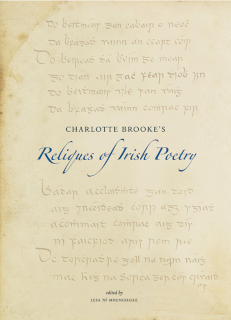
Charlotte Brooke, author of Reliques of Irish Poetry, a pioneering volume of poems collected by her in the Irish language, with facing translations, dies in Longford, County Longford, on March 29, 1793, of a malignant fever.

Brooke is born around 1740 in Rantavan House, Mullagh, County Cavan. She is one of twenty-two children of the writer Henry Brooke, author of the play Gustavus Vasa, and Catherine Brooke (née Meares) of County Westmeath. Only she and her brother Arthur survive childhood.

Brooke is educated by her father and immerses herself in reading history and literature at an early age. While the rest of her family is sleeping, she often goes down to the study where she spends hours reading.

Brooke is part of the first generation of the Protestant Anglo-Irish settler class who take a strong interest in the Irish language and Gaelic history. Her primary interest in Irish language and literature is generated by her hearing it being spoken and recited by the labourers in County Cavan and on the County Kildare estates where her family moves around 1758. She is led to the study of the Irish language, and in less than two years she finds herself in love with it. From reading Irish poetry and admiring its beauties, she proceeds to translate it into English, one of her earliest efforts being a song and monody by Turlough O’Carolan, which appears in Joseph Cooper Walker‘s Historical Memoirs of Irish Bards (1786).

Brooke, who is frail herself, takes care of her father after her mother dies in 1773. Meanwhile, the family has moved back to County Cavan, where they begin living in a house they name Longfield which has been built near the Rantavan Estate. A few years after her father dies in 1783, she runs into financial troubles, after a model industrial village set up in County Kildare by her cousin Captain Robert Brooke goes bankrupt in 1787. Walker and other members of the recently created Royal Irish Academy (RIA) seek to make an income for her, but she realises she has to rely on her writings and translations.

In 1792, though in declining health and poor circumstances, Brooke publishes a selection of her father’s writings in three volumes, prefacing the work with a memoir of her father and a defence of his reputation as a writer. She also publishes a direct and simple presentation of Christian doctrine for children using her father’s didactic method, The school for Christians in dialogue for the use of children (1791). She dies of a malignant fever on March 29, 1793, at Longford, County Longford, in the home of the Brownes, friends with whom she has lived for some years.


Leave a comment

Death of Actor T. P. McKenna

thomas-patrick-mckenna

Character actor Thomas Patrick McKenna, known professionally as T. P. McKenna and for his stage, film, and television work, dies at Royal Free Hospital, Hampstead, London on February 13, 2011, following a long illness.

McKenna is born in Mullagh, County Cavan on September 7, 1929. A prolific theater actor throughout his career, he makes his stage debut in Summer and Smoke by Tennessee Williams at the Pike Theatre in Dublin in 1954.

McKenna makes his film debut in the IRANazi drama The Night Fighters (1960) and from this uncredited beginning he moves up to tenth billing in The Siege of Sidney Street (1960). His next major movie is Girl with Green Eyes (1964), by which time he has also started a successful television career, making his TV debut in Espionage (1963) and over the next few years appears in several more TV shows. His versatility enables him to play three characters in The Avengers (1961). He is also featured in such well-regarded shows as Adam Adamant Lives! (1966), Dixon of Dock Green (1955) and The Saint (1962).

Meanwhile, McKenna’s film career develops along literary lines, and he is featured in Brendan Behan‘s The Quare Fellow (1962), the Sean O’Casey biopic Young Cassidy (1965) and James Joyce‘s Ulysses (1967). He takes smaller parts in such epics as The Charge of the Light Brigade (1968) and Anne of the Thousand Days (1969).

British films such as Perfect Friday (1970) and Villain (1971) allowed McKenna to showcase his suave, urbane persona before trying something different in the controversial Straw Dogs (1971). He appears alongside a young Anthony Hopkins in All Creatures Great and Small (1975) before starring with John Gielgud for the second time, this time in A Portrait of the Artist as a Young Man (1977). Over the next few years his co-stars are as diverse as Leonard Rossiter (Britannia Hospital (1982)), Timothy Dalton (The Doctor and the Devils (1985)), Ben Kingsley (Pascali’s Island (1988)) and Dolph Lundgren (Red Scorpion (1988)). Not all of these films are successes, but he always gives good value for the money and develops themes of his, such as an interest in Irish issues, in The Outsider (1980). His last released film is Valmont (1989), which is unfortunately completely overshadowed by Dangerous Liaisons (1988), which is based on the same novel.

Over the years McKenna makes numerous guest appearances in TV series such as Minder (1979), Casualty (1986), Lovejoy (1986), Inspector Morse (1987), Heartbeat (1992) and Ballykissangel (1996). He is also prominent in TV movies and series, featuring in Charles DickensMasterpiece Theatre: Bleak House (1985), Stendhal‘s Scarlet and Black (1993) and an adaptation of Henry JamesThe American (1998).

McKenna dies on February 13, 2011, at the Royal Free Hospital in Hampstead, London, at the age of 81 following a long period of illness. He is buried alongside his wife at Teampall Cheallaigh Cemetery in his native County Cavan.

Following his death, tributes are paid by President of Ireland Mary McAleese, Prince Charles, and Ireland’s Minister for Tourism, Culture and Sport Mary Hanafin, who says that McKenna was “one of a great generation whose talents on the screen and stage both at home and abroad gave us all great pride in his accomplishments.” In County Cavan, he is commemorated by the T. P. McKenna Drama Scholarships (VEC) and the T. P. McKenna Perpetual Trophy presented as part of the Millrace Annual Drama Festival.