seamus dubhghaill

Promoting Irish Culture and History from Little Rock, Arkansas, USA


Leave a comment

Birth of Richard Orpen, Architect, Painter & Illustrator

Richard Francis Caulfield Orpen, Irish architect, painter, illustrator and designer, is born on December 24, 1863.

Orpen is born to Anne (née Caulfield) and Arthur Herbert Orpen, a solicitor of Oriel, Blackrock, Dublin. His maternal grandfather is the Bishop of Nassau, Charles Caulfield. He is the eldest of four brothers and two sisters. His youngest brother is William, the painter. He attends St. Columba’s College in Whitechurch, Dublin, and graduates from Trinity College Dublin (TCD) with a BA in 1885. While attending St. Columba’s, he publishes an Irish comic alphabet for the present times in 1881, which is a mix of cartoons and verse mocking Charles Stewart Parnell and the home rule movement.

Orpen wants to pursue painting, but “for family reasons” he becomes an architect. He spends eleven years with Thomas Drew, initially as a pupil, and later as a managing assistant from 1885 to 1892. From around 1884, he attends the annual excursions of the English Architectural Association. Around 1890, he establishes his own architectural practice in Drew’s offices at 22 Clare Street, Dublin. In 1896, he moves his office to 7 Leinster Street. In 1888 he is elected as a member of the Royal Institute of the Architects of Ireland (RIAI), serving as a council member from 1902 to 1910, as honorary secretary from 1903 to 1905, and as president from 1914 to 1917. He designs the institute’s official seal in 1909. In 1904, the Irish Builder describes him as the “originator of the bungalow in Ireland.”

From 1888, Orpen exhibits with the Royal Hibernian Academy (RHA), with watercolours and architectural drawings. He continues to exhibit with them until 1936. He collaborates with Percy French on a number of projects, including illustrating Racquetry Rhymes (1888) and The First Lord Liftinant and Other Tales (1890). He provides cartoons for French’s periodical, The Jarvey. His architectural illustrations are included in H. Goldsmith Whitton’s Handbook of the Irish Parliament Houses… (1891). He is one of the original members of the Architectural Association of Ireland, serving as its first president in 1896, and as vice-president in 1910.

Orpen is appointed the architect to St. Columba’s from 1897 to 1938, following a fire at the college in 1896. He becomes a fellow of the college, and the sanatorium becomes known as the Orpen building. He is an active member of the Arts and Crafts Society of Ireland, serving as secretary in 1895, on the committee in 1904, and in 1917 sits on the organising committee for the fifth exhibition. In 1906, he is a founding member of the Arts Club. In 1906 he moves his architectural practice to 13 South Frederick Street, and moves into a house he designed, Coologe, Carrickmines, County Dublin.

At the 1907 Irish International Exhibition, Dublin, Orpen exhibits a number of chalk drawings. The same year he designs the cover of a satirical pamphlet, The Abbey row, not edited by W. B. Yeats, which mocks The Arrow and the riots at the first production of The Playboy of the Western World. He unveils a bust of Hugh Lane at the opening of the Municipal Gallery of Modern Art on Harcourt Street in 1908. He is appointed secretary to the municipal gallery committee by Lane. In 1910, he is appointed architect to Christ Church Cathedral, as well as architect to St. Canice’s Cathedral, Kilkenny, and St. Patrick’s Cathedral, Dublin. In 1911 he is elected an associate of the Royal Hibernian Academy, a full member in 1912, and was the academy’s secretary from 1925 to 1937.

From 1910 to 1914, Orpen is in an architectural partnership with Page Dickinson, with the two collaborating on plans for the new Dublin municipal gallery and conversion of the Turkish Baths, Lincoln Place. Lane rejects his and Dickinson’s gallery plans, leading to him refusing to work with Lane’s choice of architect, Sir Edwin Lutyens. In 1914, he is appointed a guardian of the National Gallery of Ireland, and lectures at the Dublin Metropolitan School of Art on architectural history in 1914 and 1915. He is involved in the design of a number of memorials including the setting for a bronze relief by Beatrice Campbell for the members of the Royal Irish Regiment killed in the Second Boer War and the war memorial at the Rathgar Methodist church. He serves as president of the arts and crafts section of the Royal Dublin Society (RDS). He is also a governor of the Royal National Hospital for Consumption for Ireland in Newcastle, County Wicklow.

Orpen marries Violet Caulfield in 1900. They are both descended from William Caulfeild, 1st Viscount Charlemont. He dies on March 27, 1938, at his home, Coologe, and is buried in Dean’s Grange Cemetery.

Orpen features as one of the many portraits in Seán Keating‘s Homage to Sir Hugh Lane. St. Columba’s College holds a portrait of Orpen by his brother, William, as well as a memorial stained-glass window to him by Catherine O’Brien.

Leave a comment

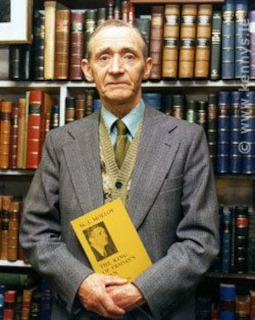
Birth of Playwright Michael Joseph Molloy

Michael Joseph Molloy, Irish playwright, is born March 3, 1914, in Milltown, County Galway, the son of William Molloy, originally of Glenamaddy, County Galway, who runs a shop at Milltown, and Maria Molloy (née Tucker), a native of Claremorris, County Mayo, and a teacher at Milltown girls’ school.

Molloy is the fifth in a family of five boys and three girls. Two other children die at birth. He is educated at Milltown national school and St. Jarlath’s College, Tuam, County Galway, from 1927 to 1931. His father dies when he is six years old and his uncle, Sonny Tucker, becomes an important influence, encouraging his life-long habit of extensive reading. In 1931 he goes to St. Columba’s Seminary at Dalgan Park, Shrule, County Mayo, but discontinues his studies for the priesthood when he contracts tuberculosis. He undergoes several operations, has to use crutches for three years, and is left with a permanent limp. While under the care of the sanatorium in Newcastle, County Wicklow, in the late 1930s, he is encouraged by a friend to attend a performance of two plays by George Bernard Shaw, Candida and Village Wooing, at the Abbey Theatre, Dublin. He becomes a regular playgoer and is inspired to begin a career as a dramatist.

Having lived in the family home at Milltown until 1955, he takes up residence at a nearby farmhouse on the marriage of his brother Christy. Despite his handicap, he works the small farm for the rest of his life to supplement the irregular income from his plays. He never marries and is attended by his housekeeper, Agnes Johnston. He is a familiar sight as he travels around his local area on the high bicycle he had fitted with one fixed pedal. The purpose of these journeys is to collect folklore, which provides a rich body of material for his plays and which he gathers into a prose volume, though this remains unpublished and privately held.

Molloy has nine of his thirteen plays produced at the Abbey Theatre, from Old Road in 1943 to Petticoat Loose in 1979. His plays reveal him as a folklorist in the line of John Millington Synge and draw on the same mixture of Christian and pagan beliefs, but with a more sympathetic understanding of his characters’ Catholicism. There is also the same strong vein of grotesque physical humour. His accomplished one-act play The Paddy Pedlar (1953) is based on a folk tale about a man carrying the body of his dead mother around in a sack and takes its bearings from an extraordinary amalgam of beliefs about the afterlife.

Molloy’s history plays re-create a world that shows the oppressions of colonialism on a subject race who respond with a wild anarchy mixed with subdued acceptance. His plays with a contemporary setting most often take emigration as their theme and are prophetic of later work by John B. Keane and Brian Friel. He writes in a heightened folk idiom, which only rarely loses touch with natural speech. Old Road wins an Abbey Prize and is staged in 1943 with Cyril Cusack as the young farm labourer trying to decide whether to emigrate to England or to stay in Ireland. Joseph Holloway gives a touching account of the shy author taking his curtain at this first production, who, though his lips move, is unable to say anything. The Visiting House follows in 1946, and dramatises a night of singing, dancing, and storytelling, peopled by a richly diverse cast of characters.

Molloy’s first masterpiece, The King of Friday’s Men, is launched in 1948. It takes the uncompromising theme of the droit du seigneur exercised by an eighteenth-century Anglo-Irish landlord on the most beautiful young women on his estate. His latest prey seeks to evade her fate by enticing the aged faction fighter, Bartley Dowd, to fight the landlord on her behalf. The play recreates that eighteenth-century world with colour, immediacy, and a strong sense of how the colonial system envelops all of the characters save the marginalised Bartley, who in the first production is played by the actor and author Walter Macken.

Molloy’s even greater The Wood of the Whispering follows in 1953 at the Queen’s Theatre, where the Abbey company is now playing. It is his most probing treatment of the effects of emigration, an issue of which Molloy, living in Galway, is only too aware. It is the most Beckettian of Irish plays, with its old tramp, Sanbatch Daly, and a host of older characters who are not so much eccentric as damaged in some profound way. At the play’s close Sanbatch feigns madness to gain entry to the asylum, though he is not in truth far from genuine madness. The various younger couples agree to stay and marry in Ireland rather than go their separate ways back to England. This idea of cultural renewal also underscores the importance Molloy places on the staging of his plays by amateur drama companies.

From the 1960s onwards Molloy’s plays are less readily accepted by the Abbey Theatre and a Dublin audience, but they still find a ready reception in his native place. In later works, such as Daughter from Over the Water (1963), the older characters retain their exuberance, but the younger ones seem beyond his reach. His last play, The Bachelor’s Daughter, is given its first performance by the Tuam Theatre Guild on March 3, 1985. The revival by Galway’s Druid Theatre of The Wood of the Whispering in 1983, which Molloy lives to see, is a revelation, and a reminder to the wider theatrical and academic world of the continuing importance of this playwright, not just as the ‘missing link’ between Synge and Keane but as an original in his own right.

In later years Molloy is a member of Aosdána. He dies of aortic aneurysms at Galway Hospital on May 27, 1994. He remains a committed Catholic all his life and his tombstone reads: “Woe to those who call evil good and who call good evil” (Isaiah, 5: 20).

(From: “Molloy, Michael Joseph” by Anthony Roche, Dictionary of Irish Biography, http://www.dib.ie, October 2009)