seamus dubhghaill

Promoting Irish Culture and History from Little Rock, Arkansas, USA


Leave a comment

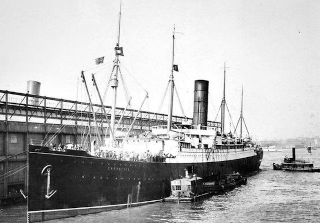
RMS Carpathia Arrives in New York City with RMS Titanic Survivors

The RMS Carpathia, a Cunard Line transatlantic passenger steamship, arrives in New York City on April 18, 1912, with 705 survivors from the RMS Titanic, which sank in the North Atlantic three days earlier.

As she is making her way from New York to Fiume, Austria-Hungary (now Rijeka, Croatia), RMS Carpathia receives a distress call from the “unsinkable” RMS Titanic. RMS Carpathia’s captain, Arthur Rostron, later testifies that the distance to RMS Titanic was 58 nautical miles (67 miles) and was expected to take three and a half hours to reach the doomed liner as its top speed, which was about 14.5 knots.

However, braving dangerous ice fields of its own, Rostron orders extra stokers to feed coal and cut off heating and hot water elsewhere in order to supply the ship’s engines with as much steam as possible. These decisions help accelerate the ship to more than 17 knots and the RMS Carpathia arrives on the scene approximately one hour and 40 minutes after RMS Titanic went down. For the next four and a half hours, the ship rescues 705 survivors from RMS Titanic‘s lifeboats.

Slowed by storms and fog since early Tuesday, April 16, RMS Carpathia arrives in New York City on the cold and rainy evening of Thursday, April 18, escorted by the scout cruiser USS Chester. RMS Carpathia first bypasses Pier 54, its Cunard Line pier, and sails up the Hudson River to Pier 59, the berth for White Star Line and where RMS Titanic was supposed to have arrived. Having dropped off the empty lifeboats, RMS Carpathia then sails back toward Pier 54.

A tugboat filled with photographers follows the ship to the pier, and the flashlight of cameras lights up the ship in the night sky to reveal that the decks are crammed with passengers.

Tens of thousands of people gather around Pier 54 to meet them and receive the first physical confirmation of the maritime disaster. On the orders of Rostron, RMS Carpathia‘s passengers disembark first, believing the scene will become tumultuous as soon as RMS Titanic survivors first appear. That moment comes when a teary-eyed woman with makeshift clothes descends a gangway and stumbles away from the boat into the arms of an officer.

The RMS Carpathia is initially a transatlantic passenger ship that makes its maiden voyage in 1903. During World War I, she is used to transfer Canadian and American Expeditionary Forces to Europe.

On July 15, 1918, under the command of Captain William Prothero, RMS Carpathia is a part of a large convoy that is making its way from Liverpool to Boston. Two days later, carrying 57 passengers and 166 crew, she is torpedoed on the port side by a German U-boat off the southwest coast of Ireland.

A second strike follows, which penetrates the engine room, killing three firemen and two trimmers. Prothero gives the order to abandon ship and all passengers and the surviving crew members board the lifeboats.

A third torpedo strike hits the gunner’s rooms, resulting in a large explosion that dooms the ship. The U-boat starts approaching the lifeboats when the HMS Snowdrop arrives on the scene and drives away the submarine with gunfire before picking up survivors.

The wreck of the RMS Carpathia is only discovered in 2000 after an 80 year-long search for the missing ship.

(From: “On This Day: Carpathia arrives in New York with Titanic survivors” by Michael Dorgan, IrishCentral, http://www.irishcentral.com, April 15, 2022)

Leave a comment

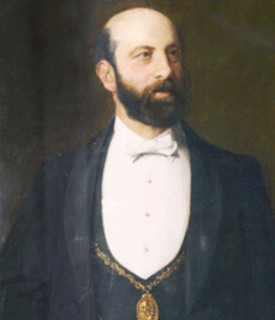
Birth of Otto Moses Jaffe, Lord Mayor of Belfast

otto-jaffe

Sir Otto Moses Jaffe, German-born British businessman who is twice elected Lord Mayor of Belfast, is born in Hamburg on August 13, 1846. He is the first non-Protestant to hold the office of Lord Mayor of Belfast.

Jaffe is born into a Jewish family, one of four boys and five girls born to Daniel Joseph and Frederiké Jaffe. In 1852, his parents bring their family to Belfast. His father, along with his older brothers, Martin, John and Alfred, set up a business exporting linen. He is educated at Mr. Tate’s school in Holywood, County Down, and later in Hamburg and Switzerland.

Jaffe marries Paula Hertz, daughter of Moritz Hertz from Braunschweig, on March 8, 1879. They have two sons, Arthur Daniel and William Edward Berthold Jaffe. Daniel Joseph Jaffé is his nephew, son of his brother Martin.

From 1867 to 1877 Jaffe lives and works in New York. In 1877, his brothers retire so he returns to Belfast to head the family business, The Jaffe Brothers, at Bedford Street. He builds it up to become the largest linen exporter in Ireland. He is a member of the Belfast Harbour Commission and becomes a naturalised citizen in 1888. In 1894, he successfully agitates for the reporting and destruction of shipwrecks in the North Atlantic Ocean.

Jaffe is a Justice of the Peace, a governor of the Royal Hospital, a member of the Irish Technical Education Board and a member of the Senate of Queen’s College, which later becomes Queen’s University Belfast. He is the German consul in Belfast. He is an active member of the committee which gets the Public Libraries Act extended to Belfast, leading to the first free library being established there. In 1910 he erects the Jaffe Spinning Mill on the Newtownards Road, also known as Strand Spinning. This provides work for 350 people, rising to 650 in 1914 when the company expands to make munitions. He is lavishly charitable and contributes to Queen’s College.

Jaffe takes a keen interest in the Jewish community of Belfast. He is life-president of the Belfast Hebrew Congregation, which worships at the Great Victoria Street, Belfast synagogue. His father established it on July 7, 1871. Between 1871 and 1903 the congregation increases from fifty-five to over a thousand. He pays most of the £4,000 cost of building the synagogue in Annesley Street. He opens it in 1904 wearing his mayoral regalia. Three years later with his wife, they set up the Jaffe Public Elementary School on the Cliftonville Road.

Jaffe is a member of the Irish Unionist Party. He represents St. Anne’s Ward for the Belfast Corporation in 1894 and is elected Lord Mayor of Belfast in 1899. As mayor, he launches an appeal for the dependents of soldiers fighting in the Second Boer War. On March 5, 1900, he is knighted at Dublin Castle by George Cadogan, 5th Earl Cadogan, Lord Lieutenant of Ireland. In 1901 he is High Sheriff of Belfast and in 1904 is again elected Lord Mayor.

The outbreak of war sees anti-German sentiment and when the RMS Lusitania passenger liner is torpedoed by a German U-boat of the coast of County Cork on May 7, 1915, resulting in the death of 1,000 people, anti-German feeling in Britain and Ireland rise to breaking point. Even though he is loyal to the Crown, and his eldest son Arthur and his nephew are serving in the British Army, Jaffe is accused of being a German spy. Society women refuse support for the Children’s Hospital so long as Jaffe and his wife remain on the board. He is “overwhelmed with pain and sorrow.”

After twenty-five years of service, Jaffe resigns his post as Alderman of Windsor Ward for Belfast City Council in June 1916 when he is almost 70 years of age and takes up residence in London, where he dies on April 29, 1929. Lady Jaffe is too ill to attend his funeral, and she dies a few months later, in August 1929.