Marrinan becomes ill with infantile paralysis at the age of five, and as a result is tutored privately. He has no formal training in art but is largely influenced by his reading matter, particularly the American comic strips of Bud Fisher. The variety of facial expressions that Fisher can achieve, with only a pencil, intrigues and inspires him. Likewise, the images evoked by Celtic mythology and religious art also contributes to his visual language, and many hours are spent in the Belfast Museum and Art Gallery studying the paintings in their collection.
Marrinan exhibits with the Ulster Academy of Arts from an address at 524 Donegall Road, Belfast, entering “The Wee Gate, Earl Street, Belfast” (1931) and “The Painter’s Father” and the “Apache” (1934), which is judged “picture of the year.” He last exhibits with a landscape, “Connemara,” along with four other works in 1949.
Marrinan paints and sketches portraits of many notable Irish figures, among which is the charcoal drawing of northern Fenian Robert Johnston (1934; National Gallery of Ireland) and a sketch of the Donegal storyteller Niall Duffy (University College Dublin). His literary portraits include one of Brian Friel. He holds a one-man show in 1951 at 55a Donegall Place, Belfast, where he exhibits a bust of John McLaverty. He takes an interest in sculpture although painting and drawing remain his preferred form of expression. Important commissions are for a memorial portrait (completed 1952) of Éamonn Ceannt for Ceannt Barracks officers’ mess, Curragh Camp, County Kildare, and for a portrait of Vice-brigadier Peadar Clancy for Clancy Barracks, Dublin. He paints two memorial portraits of PresidentJohn F. Kennedy, one of which is in the Irish Club, London.
Marrinan is an honorary member of the Royal Ulster Academy and exhibits with them every year from 1950 onward, showing a portrait of Mrs. Padraig Marrinan in 1967 (no other details of his marriage are known). He is preparing for an exhibition to be held at the Irish Club, London, in 1974, but dies on October 25, 1973, at Tyrone County Hospital in Omagh. He is then living at James Street, Omagh.
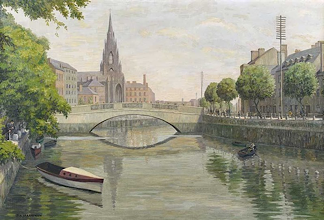
(From: “Marrinan, Padraig H.” by Ruth Devine, Dictionary of Irish Biography, http://www.dib.ie, October 2009 | Pictured: “The River Lee, Cork City, Ireland” by Padraig Marrinan, oil on canvas)
In September 1919, the Commander-in-Chief, Ireland, Sir Frederick Shaw, suggests that the police force in Ireland be expanded via the recruitment of a special force of volunteer British ex-servicemen. During a Cabinet meeting on May 11, 1920, the Secretary of State for War, Winston Churchill, suggests the formation of a “Special Emergency Gendarmerie, which would become a branch of the Royal Irish Constabulary.” Churchill’s proposal is referred to a committee chaired by General Sir Nevil Macready, Commander-in-Chief of the British forces in Ireland. Macready’s committee rejects Churchill’s proposal, but it is revived two months later, in July, by the Police Adviser to the Dublin Castle administration in Ireland, Major-General Henry Hugh Tudor. In a memo dated July 6, 1920, Tudor justifies the scheme on the grounds that it will take too long to reinforce the Royal Irish Constabulary (RIC) with ordinary recruits. Tudor’s new “Auxiliary Force” is to be strictly temporary with its members enlisting for a year. Their pay is to be £7 per week (twice what a constable is paid), plus a sergeant’s allowances, and are to be known as “Temporary Cadets.” At that time, one of high unemployment, a London advertisement for ex-officers to manage coffee stalls at two pounds ten shillings a week receives five thousand applicants.
The Auxiliary Division is recruited in Great Britain from among ex-officers who had served in World War I, especially those who had served in the British Army (including the Royal Flying Corps). Most recruits are from Britain, although some are from Ireland, and others come from other parts of the British Empire. Many have been highly decorated in the war and three, James Leach, James Johnson, and George Onions, have been awarded the Victoria Cross (VC). Enlisted men who had been commissioned as officers during the war often find it difficult to adjust to their loss of status and pay in civilian life, and some historians have concluded that the Auxiliary Division recruited large numbers of these “temporary gentlemen.”
Piaras Béaslaí, a former senior member of the Irish Republican Army (IRA) who supports the Anglo-Irish Treaty, while paying tribute to the bravery of the Auxiliaries, notes that the force is not composed exclusively of ex-officers but contains “criminal elements,” some of whom robbed people on the streets of Dublin and in their homes.
Recruiting began in July 1920, and by November 1921, the division is 1,900 strong. The Auxiliaries are nominally part of the RIC, but actually operate more or less independently in rural areas. Divided into companies, each about one hundred strong, heavily armed and highly mobile, they operate in ten counties, mostly in the south and west, where IRA activity is greatest. They wear either RIC uniforms or their old army uniforms with appropriate police badges, along with distinctive tam o’ shanter caps. They are commanded by Brigadier-General Frank Percy Crozier.
The elite ex-officer division proves to be much more effective than the Black and Tans especially in the key area of gathering intelligence. Auxiliary companies are intended as mobile striking and raiding forces, and they score some notable successes against the IRA. On November 20, the night before Bloody Sunday, they capture Dick McKee and Peadar Clancy, the commandant and vice-commandant of the IRA’s Dublin Brigade, and murder them in Dublin Castle. That same night, they catch Liam Pilkington, commandant of the Sligo IRA, in a separate raid. A month later, in December, they catch Ernie O’Malley completely by surprise in County Kilkenny. He is reading in his room when a Temporary Cadet opens the door and walks in. “He was as unexpected as death,” says O’Malley. In his memoirs, the commandant of the Clare IRA, Michael Brennan, describes how the Auxiliaries nearly capture him three nights in a row.
IRA commanders become concerned about the morale of their units as to many Volunteers the Auxiliaries seem to be “super fighters and all but invincible.” Those victories which are won over the Auxiliaries are among the most celebrated in the Irish War of Independence. On November 28, 1920, for example, a platoon of Auxiliaries is ambushed and wiped out in the Kilmichael Ambush by Tom Barry and the 3rd Cork Brigade. A little more than two months later, on February 2, 1921, another platoon of Auxiliaries is ambushed by Seán Mac Eoin and the North Longford Flying Column in the Clonfin Ambush. On March 19, 1921, the 3rd Cork Brigade of the IRA defeats a large-scale attempt by the British Army and Auxiliary Division to encircle and trap them at Crossbarry. On April 15, 1921, Captain Roy Mackinnon, commanding officer of H Company of the Auxiliary Division, is assassinated by the Kerry IRA.
Successes require reliable intelligence and raids often bring no result — or sometimes worse. In one case, they arrest a Castle official, Law Adviser W. E. Wylie, by mistake. In another, more notorious case, on April 19, 1921, they raid the Shannon Hotel in Castleconnell, County Limerick, on a tip that there are suspicious characters drinking therein. The “suspicious characters” turn out to be three off-duty members of the RIC. Both sides mistake the other for insurgents and open fire. Three people, an RIC man, an Auxiliary Cadet and a civilian, are killed in the shootout that follows.
The Auxiliary Division is disbanded along with the RIC in 1922. Although the 1921 Anglo-Irish Treaty requires the Irish Free State to assume responsibility for the pensions of RIC members, the Auxiliaries are explicitly excluded from this provision. Following their disbandment, many of its former personnel join the Palestine Police Force in the British-controlled territory.
The anti-insurgency activities of the Auxiliaries Division have become interchangeable with those conducted by the Black and Tans, leading to many atrocities committed by them being attributed to the Black and Tans. Nevertheless, both British units remain equally reviled in Ireland.
More than 30 people are killed or fatally wounded in a day of violence in Dublin on November 21, 1920, during the Irish War of Independence. It goes down in Irish history as the first “Bloody Sunday,” though unfortunately not the last.
Through the centuries the British have crushed Irish revolutionary movements through the use of spies and informers. Michael Collins, Minister for Finance of the Irish Republic, head of the secretive Irish Republican Brotherhood and Irish Republican Army (IRA) Chief of Intelligence, is in the process of beating the British at their own game. The day begins in the early morning hours with an IRA operation, organised by Collins, to assassinate members of the “Cairo Gang” – a team of undercover British intelligence agents working and living in Dublin. IRA members go to a number of addresses and kill or fatally wounded 16 men, mostly British Army intelligence officers. Five other men are wounded.
When word of the success of the operation gets back to Collins, knowing the caliber of the men in England‘s infamous “Black and Tan” force, he sends a message to the Gaelic Athletic Association, telling them to cancel that day’s Gaelic football match between Dublin and Tipperary. However, it is too late, and the match goes on.
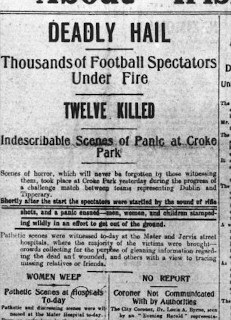
Later that afternoon, lashing out blindly, the Black and Tans surround Croke Park during the match and move in. Their supposed purpose is to attempt to capture members of Sinn Féin who might be in the crowd, but they soon open fire indiscriminately on the players and spectators. They kill or fatally wound fourteen civilians and wound at least sixty others before members of the Auxiliary Division, another brutal force created to crush the Irish insurrection, finally manages to get them to cease-fire.
That evening, two Irish republicans and members of Collins’ squad, Dick McKee and Peadar Clancy, who had helped plan the earlier assassinations, along with a third man, a civilian named Conor Clune, who happened to be caught with the others, are beaten and shot dead in Dublin Castle by their captors, who claim they were killed during an escape attempt.
Overall, Bloody Sunday is considered a victory for the IRA, as Collins’s operation severely damages British intelligence, while the later reprisals do no real harm to the guerrillas but increase support for the IRA at home and abroad.
(Pictured: The headline of the Dublin Evening Herald reads ‘Latest Stories about Irish Tragedies’, 22nd November 1920. The newspaper reports on the massacre at a Croke Park football match, shootings in Dublin, and the discovery of a priest’s corpse in a Galway bog. Photo by Hulton Archive/Getty Images)
Republican activist James Murphy dies in Mater Hospital, Dublin on February 11, 1921. Before he dies, he declares that he and Patrick Kennedy had been shot by their Auxiliary captors. A court of inquiry is held, and Captain W. L. King, commanding officer of F Company Auxiliary Division of the Royal Irish Constabulary (ADRIC), is arrested for the killings.
James Murphy and Patrick Kennedy are arrested by Auxiliaries in Dublin on February 9 and are taken into the custody of ‘F’ company. Two hours later, constables of the Dublin Metropolitan Police find the two men lying shot, with pails on their heads, in Clonturk Park, Drumcondra. Kennedy is dead and Murphy is fatally wounded. He dies in Mater Hospital, Dublin two days later.
Just before dying Murphy testifies that King had taken them and stated that they were “just going for a drive.” King is arrested for the killings. King and two of his men, Hinchcliffe and Welsh, are court-martialed on February 13-15, but are acquitted after Murphy’s dying declaration is ruled inadmissible and two officers from ‘F’ Company provide perjured alibis for King at the time of the shootings.
King is implicated and court-martialed for the deaths of Conor Clune, Peadar Clancy, and Dick McKee, the latter two leading lights in the Dublin Irish Republican Army, the former a luckless Gaelic League member, who are all captured in Dublin on November 20, 1920, the day before Bloody Sunday. Clune is caught at Vaughn’s Hotel in Parnell Square, Dublin and the two IRA leaders at Lower Gloucester Street, complete with British Army officer uniforms and detonators.
Sometime between then and the next day, in the Dublin Castle guardroom, as news filters in of the deaths of several British intelligence officers, the prisoners are killed in questionable circumstances. According to an official report from Dublin Castle, they attempted to grab rifles and hurl unfused grenades and are killed in that action. The guards of ‘F’ Company in the room at the time are cleared of wrongdoing by a court inquiry. A Major Reynolds of ‘F’ Company is said to have passed details of the killers to Michael Collins. The Times notes that it seems as if the prisoners had been lined up and shot. In a later novel, a Captain Hardy more or less confesses to the killing of one of the prisoners.
Ironically, Captain King is on Michael Collins’s list of British Intelligence officers to be executed on the morning of November 20, 1920, he is not in his room when the assassins arrive but rather, he is interrogating the prisoners in Dublin Castle.
(Pictured: Mixed gunmen of the Royal Irish Constabulary’s Auxiliary Division and Black and Tans contingents, Stair na hÉireann | History of Ireland)



 seamus dubhghaill