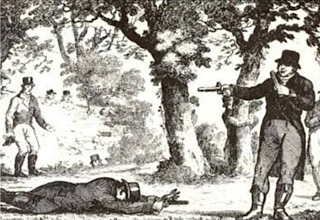
Daniel O’Connell (1775-1847) kills John D’Esterre in a duel on February 1, 1815.
O’Connell is sometimes referred to as an equivalent to Martin Luther King, Jr. or Mahatma Gandhi. Like King and Gandhi, O’Connell attempts to change the circumstances of his people, Irish Catholics in this case, through the use of nonviolence. He can take a great deal of credit for the passage of the Roman Catholic Relief Act 1829, which revokes the remaining discriminatory Penal Laws. This political success is achieved in significant part through mass protest and is notable for the absence of violence. O’Connell, however, is not always non-violent. He is known for being hot-tempered and capable of violence in his early days.
Rosmanagher Bridge and Toll Gate are built by D’Esterre in 1784 at his own expense. The large inscription stone on the bridge commemorates this piece of engineering. He owns extensive lands in the region and the Ratty River hinders both farming and communication, especially as the nearest bridge is at Sixmilebridge, County Clare. Despite objections that the structure will interfere with navigation on the river, he builds his bridge and then tries to recover his costs by erecting toll gates on the western side of the river. O’ Connell refuses to pay the toll according to local tradition and this leads to his famous duel with D’Esterre, a Limerick-born Protestant and former marine who is also a member of the Dublin Corporation. D’Esterre takes exception to O’Connell’s description of the Corporation as being “beggarly.”
D’Esterre is in difficult financial circumstances at the time of the duel. Some thought indicates that he is possibly encouraged into violent confrontation by influential figures who wish to break the forty-year-old O’Connell’s growing political power. Regardless of the motivation, the crack shot D’Esterre arranges to meet O’Connell to settle the matter on February 1, 1815, at the Bishopscourt estate in County Kildare.
D’Esterre shoots first and misses. O’Connell returns fire, wounding his opponent in the groin. The wound proves to be fatal two days later. It seems O’Connell is distressed by the deadly outcome and offers D’Esterre’s widow a pension as compensation. The offer is refused, but an allowance for D’Esterre’s daughter is accepted. O’Connell fulfills this obligation for the subsequent 30 years of his life.
(From: “OTD: O’Connell – D’Esterre Duel – 1815” by Martin Nutty, Irish Stew Podcast, http://www.irishstewpodcast.com, February 1, 2022)
She is the fifth child and youngest daughter of pork butcher and grocer, John Kearney (1854–97), and his wife Kathleen Kearney (née McGuinness) (1860–1907). She has four brothers and two sisters. Her father is from Rosybrook, County Louth and her mother is from Rathmaiden, Slane, County Meath, both coming from prosperous farming families. Her father has a business on Lower Dorset Street, with a grocery, pub and a row of houses. Owing to his own poor management, by the time she is born he has a smaller business on Dolphin’s Barn Lane. Following his death in 1897, she and her sisters are placed in the Goldenbridge orphanage at Inchicore by their mother. She is there from 1898 to 1904 where she becomes an avid reader. When she leaves, she rejoins her family in a one-room tenement flat on Gloucester Street.
Her oldest sibling, Peadar Kearney, is an ardent republican who writes the lyrics to the song that becomes the Irish national anthem, ”Amhrán na bhFiann”(English: “The Soldier’s Song”). It is through him that she meets a printer’s compositor and member of the Irish Volunteers, Jack Furlong. They marry in 1916. She is an active member of Cumann na mBan, and serves as a courier to the General Post Office, Dublin and other outposts during the 1916 Easter Rising. At the same time, Furlong fights in the Jacob’s factory garrison. The couple has two sons: Roger Casement (Rory) Furlong (1917–87) and Sean Furlong (born March 1919). Sean is born six month’s after she is widowed when Furlong dies in the Spanish flu epidemic of 1918. She lives with her mother-in-law, who is also a republican and seamstress who makes Irish Volunteer uniforms. She is arrested for running an Irish Republican Army (IRA) safe house. She works for a short time for Maud Gonne as a housekeeper, where she meets W. B. Yeats and Sarah Purser. A study painted of her by Purser (above) is now in the National Gallery of Ireland entitled The Sad Girl. From 1918 to 1922 she works as a clerk in the Dublin Corporation, while also a caretaker in the Harcourt Street branch of the Irish White Cross republican aid association.
In 1922 she marries Stephen Behan, house painter, trade unionist and fellow republican. The couple has four sons and one daughter: Brendan (b. 1923), Seamus (b. 1925), Brian (b. 1926), Dominic (b. 1928), and Carmel (b. 1932). Brendan is born while his father is imprisoned during the Irish Civil War, and Behan claims that Michael Collins gives her money while she is pregnant. Stephen’s mother owns three slum tenements, so the Behans live rent-free in a one-room basement flat at 14 Russell Street. Owing to her disdain at gossiping on the house steps, she is nicknamed “Lady Behan” by her neighbours. When Stephen’s mother dies in 1936, the Behans moved to a newly built council house in Crumlin, living at 70 Kildare Road. The family finds the new house far from work and school, and the local area devoid of community.
The family experiences extreme poverty frequently, owing to Stephen’s unemployment and during the nine month long building strike of 1936. Behan attempts to claim a pension as her first husband had served in 1916, but her application is rejected. She had said the exposure to flour had effected Furlong’s lungs negatively. It is declined as she had remarried before the enactment of the Army Pensions Act 1923. Despite their circumstances, the house attracts conversation, music, books and politics. The Behan’s republican, socialist, labour activist and anti-clericalism have a strong effect on their sons, particularly Brendan and Dominic. Such is the volume of radical meetings that take place at the Behan home, it is dubbed “the Kremlin” by their neighbours, and a “madhouse” by Stephen. During The Emergency of 1939 to 1945 she fights against local shopkeepers who ignore price controls, and is labelled as “red” for her anti-Franco and pro-Stalin sympathies. Her reply to the branding of her as such is “I’m not red, I’m scarlet.”
From the 1950s onwards, Behan shares international fame with her sons Dominic and Brendan. She often travels to London to see their plays, eventually appearing on British and Irish television and cultivating her own following. She is badly injured when she is struck by a motorcycle, a day before Stephen’s death in 1967. Owing to the effect of these injuries, she moves in 1970 to the Sacred Heart Residence of the Little Sisters of the Poor, Sybil Hill, Raheny.
In 1981, she records an album When All the World Was Young. Taped conversations of her reminiscences are made into an autobiographic book, Mother of all the Behans, by her son Brian in 1984. A one-woman stage adaptation of the book by Peter Sheridan and starring Rosaleen Linehan is acclaimed in Ireland, Britain and North America.
The Sweepstake is generally referred to as the Irish Sweepstake or Irish Sweepstakes, frequently abbreviated to Irish Sweep or Irish Sweeps. The Public Charitable Hospitals (Temporary Provisions) Act, 1930 is the act that establishes the lottery. This act expires in 1934, in accordance with its terms, and the Public Hospitals Acts are the legislative basis for the scheme thereafter. The main organisers are Richard Duggan, Captain Spencer Freeman and Joseph McGrath. Duggan is a well known Dublinbookmaker who has organised a number of sweepstakes in the decade prior to setting up the Hospitals’ Sweepstake. Captain Freeman is a Welsh-born engineer and former captain in the British Army. After the Constitution of Ireland is enacted in 1937, the name Irish Hospitals’ Sweepstake is adopted.
The sweepstake is established because there is a need for investment in hospitals and medical services and the public finances are unable to meet this expense at the time. As the people of Ireland are unable to raise sufficient funds, because of the low population, a significant amount of the funds are raised in the United Kingdom and United States, often among the emigrant Irish. Potentially winning tickets are drawn from rotating drums, usually by nurses in uniform. Each such ticket is assigned to a horse expected to run in one of several horse races, including the Cambridgeshire Handicap, Epsom Derby and the Grand National. Tickets that draw the favourite horses thus stand a higher likelihood of winning and a series of winning horses have to be chosen on the accumulator system, allowing for enormous prizes.
The original sweepstake draws are held at the Mansion House, Dublin on May 19, 1939 under the supervision of the Chief Commissioner of Police, and are moved to a more permanent fixture at the Royal Dublin Society (RDS) in Ballsbridge later in 1940.
The Adelaide Hospital in Dublin is the only hospital at the time to not accept money from the Hospitals Trust, as the governors disapprove of sweepstakes.
From the 1960s onwards, revenues decline. The offices are moved to Lotamore House in County Cork. Although giving the appearance of a public charitable lottery, with nurses featured prominently in the advertising and drawings, the Sweepstake is in fact a private for-profit lottery company, and the owners are paid substantial dividends from the profits. Fortune magazine describes it as “a private company run for profit and its handful of stockholders have used their earnings from the sweepstakes to build a group of industrial enterprises that loom quite large in the modest Irish economy. Waterford Glassworks, Irish Glass Bottle Company and many other new Irish companies are financed by money from this enterprise and up to 5,000 people are given jobs.” At the time of his death in 1966, Joe McGrath has interests in the racing industry, and holds the Renault dealership for Ireland in addition to large financial and property assets. He is notorious throughout Ireland for his ruthless business attitude and his actions during the Irish Civil War.
In 1986, the Irish government creates a new public lottery, the National Lottery, and the company fails to secure the new contract to manage it. The final sweepstake is held in January 1986 and the company is unsuccessful for a licence bid for the National Lottery, which is won by An Post later that year. The company goes into voluntary liquidation in March 1987. The majority of workers do not have a pension scheme but the sweepstake has fed many families during lean times and is regarded as a safe job. The Public Hospitals (Amendment) Act, 1990 is enacted for the orderly winding up of the scheme, which has by then almost £500,000 in unclaimed prizes and accrued interest.
A collection of advertising material relating to the Irish Hospitals’ Sweepstakes is among the Special Collections of National Irish Visual Arts Library.



 seamus dubhghaill