seamus dubhghaill

Promoting Irish Culture and History from Little Rock, Arkansas, USA


Leave a comment

Birth of Donal Donnelly, Theatre & Film Actor

Donal Donnelly, Irish theatre and film actor, is born to Irish parents in BradfordWest YorkshireEngland, on July 6, 1931. Perhaps best known for his work in the plays of Brian Friel, he has a long and varied career in film, on television and in the theatre. He lives in Ireland, the United Kingdom and the United States at various times, and his travels lead him to describe himself as “an itinerant Irish actor.”

Donnelly’s father, James, is a doctor from County Tyrone, and his mother, Nora O’Connor, is a teacher from County Kerry.

Donnelly is raised in Dublin where he attends Synge Street CBS, where he acts in school plays with Milo O’SheaEamonn AndrewsJack MacGowran, Bernard Frawley (Seattle Repertory Co.) and Jimmy Fitzsimons (brother of Maureen O’Hara), under the direction of elocution teacher, Ena Burke.

Donnelly gets his start in an amateur group calling itself the Globe Theatre Players. It is organised and run by Jim Fitzgerald and Monica Brophy. He then later tours with Anew McMaster‘s Irish repertory company before moving to England where he stars with Rita Tushingham in the film The Knack …and How to Get It.

Donnelly’s breakthrough role comes when he is cast as Gar Private in the world premiere of Brian Friel’s Philadelphia, Here I Come! directed by Hilton Edwards for the Gate Theatre at the Dublin Theatre Festival in 1964. The production subsequently transfers to Broadway where it plays for over 300 performances and establishes Donnelly and Patrick Bedford, who plays his alter-ego Gar Public, as formidable new talents to be reckoned with. They are jointly nominated for the Tony Award for Best Performance by a Leading Actor in a Play in 1966.

Donnelly returns to Broadway a number of times, replacing Albert Finney in A Day in the Death of Joe Egg in 1968, playing Milo Tindle in Anthony Shaffer‘s Sleuth and appearing as Frederick Treves opposite David Bowie as The Elephant Man. He also renews his relationship with Brian Friel, appearing in the world premieres of Volunteers at the Abbey Theatre in 1975 and Faith Healer with James Mason at the Longacre Theatre in New York City in 1979, as well as the Broadway premieres of Dancing at Lughnasa in 1991 and Translations in 1995.

For many years, Donnelly tours a one-man performance of the writings of George Bernard Shaw, adapted and directed by Michael Voysey and entitled My Astonishing Self.

Donnelly’s film roles include Archbishop Gilday in The Godfather Part III and as Freddy Malins in John Huston‘s final work, The Dead, based on the short story by James Joyce, where he gains particular acclaim for his performance.

On television, Donnelly plays the lead role of Matthew Browne in the 1970s ITV sitcom Yes, Honestly, opposite Liza Goddard. But from the late 1950s onwards, he often appears in such British TV programs as The AvengersZ-Cars and The Wednesday Play.

Donnelly is an acclaimed audiobook reader whose catalogue includes PinocchioPeter PanVoltaire‘s Philosophical Dictionary, and several audio versions of the works of James Joyce.

In 1968, Donnelly records an album of Irish songs, Take the Name of Donnelly, which is arranged, produced and conducted by Tony Meehan formerly of the Shadows.

Donnelly, who is a heavy smoker all his life, dies from cancer at the age of 78 in Chicago, Illinois, on January 4, 2010. He is survived by his wife, Patricia ‘Patsy’ Porter, a former dancer he met working on Finian’s Rainbow, and two sons, Jonathan and Damian. Their only daughter, Maryanne, predeceases him after being killed in a riding accident. A brother, Michael Donnelly, is a Fianna Fáil senator and councillor, and Lord Mayor of Dublin(1990–91).

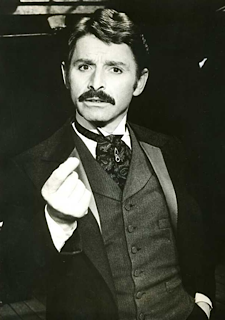
(Pictured: Publicity still of Donal Donnelly as Frederick Treves in the Broadway’s play The Elephant Man)


3 Comments

Death of Donal Donnelly, Irish Theatre & Film Actor

Donal Donnelly, Irish theatre and film actor, dies in Chicago, Illinois, on January 4, 2010. Perhaps best known for his work in the plays of Brian Friel, he has a long and varied career in film, on television and in the theatre. He lives in Ireland, the United Kingdom and the United States at various times, and his travels lead him to describe himself as “an itinerant Irish actor.”

Donnelly is born to Irish parents in Bradford, West Yorkshire, England, on July 6, 1931. His father James is a doctor from County Tyrone, and his mother Nora O’Connor is a teacher from County Kerry.

Donnelly is raised in Dublin where he attends Synge Street CBS, where he acts in school plays with Milo O’Shea, Eamonn Andrews, Jack MacGowran, Bernard Frawley (Seattle Repertory Co.) and Jimmy Fitzsimons (brother of Maureen O’Hara), under the direction of elocution teacher, Ena Burke.

Donnelly gets his start in an amateur group calling itself the Globe Theatre Players. It is organised and run by Jim Fitzgerald and Monica Brophy. He then later tours with Anew McMaster‘s Irish repertory company before moving to England where he stars with Rita Tushingham in the film The Knack …and How to Get It.

Donnelly’s breakthrough role comes when he is cast as Gar Private in the world premiere of Brian Friel’s Philadelphia, Here I Come! directed by Hilton Edwards for the Gate Theatre at the Dublin Theatre Festival in 1964. The production subsequently transfers to Broadway where it plays for over 300 performances and establishes Donnelly and Patrick Bedford, who plays his alter-ego Gar Public, as formidable new talents to be reckoned with. They are jointly nominated for the Tony Award for Best Performance by a Leading Actor in a Play in 1966.

Donnelly returns to Broadway a number of times, replacing Albert Finney in A Day in the Death of Joe Egg in 1968, playing Milo Tindle in Anthony Shaffer‘s Sleuth and appearing as Frederick Treves opposite David Bowie as The Elephant Man. He also renews his relationship with Brian Friel, appearing in the world premieres of Volunteers at the Abbey Theatre in 1975 and Faith Healer with James Mason at the Longacre Theatre in New York City in 1979, as well as the Broadway premieres of Dancing at Lughnasa in 1991 and Translations in 1995.

For many years, Donnelly tours a one-man performance of the writings of George Bernard Shaw, adapted and directed by Michael Voysey and entitled My Astonishing Self.

Donnelly’s film roles include Archbishop Gilday in The Godfather Part III and as Freddy Malins in John Huston‘s final work, The Dead, based on the short story by James Joyce, where he gains particular acclaim for his performance.

On television, Donnelly plays the lead role of Matthew Browne in the 1970s ITV sitcom Yes, Honestly, opposite Liza Goddard. But from the late 1950s onwards, he often appears in such British TV programs as The Avengers, Z-Cars and The Wednesday Play.

Donnelly is an acclaimed audiobook reader whose catalogue includes Pinocchio, Peter Pan, Voltaire‘s Philosophical Dictionary, and several audio versions of the works of James Joyce.

In 1968, Donnelly records an album of Irish songs, Take the Name of Donnelly, which is arranged, produced and conducted by Tony Meehan formerly of the Shadows.

Donnelly, who is a heavy smoker all his life, dies from cancer at the age of 78 in Chicago, Illinois, on January 4, 2010. He is survived by his wife, Patricia ‘Patsy’ Porter, a former dancer he met working on Finian’s Rainbow, and two sons, Jonathan and Damian. Their only daughter, Maryanne, predeceases him after being killed in a riding accident. A brother, Michael Donnelly, is a Fianna Fáil senator and councillor, and Lord Mayor of Dublin (1990–91).


Leave a comment

Death of Brendan the Navigator

brendan-the-navigator

Saint Brendan of Clonfert, called “the Navigator” and one of the early Irish monastic saints, dies on May 16, 577, in Annaghdown, County Galway.

In 484, Brendan is born in Tralee, County Kerry, in the province of Munster. He is born among the Altraige, a tribe originally centred around Tralee Bay, to parents called Finnlug and Cara. He is baptised at Tubrid, near Ardfert by Saint Erc, and is originally to be called “Mobhí” but signs and portents attending his birth and baptism lead to him being christened “Broen-finn” or “fair-drop.” For five years he is educated under Saint Ita, “the Brigid of Munster.” When he is six, he is sent to Saint Jarlath‘s monastery school at Tuam to further his education. Brendan is one of the “Twelve Apostles of Ireland,” one of those said to have been tutored by the great teacher, Finnian of Clonard.

At the age of twenty-six, Brendan is ordained a priest by Saint Erc. Afterwards, he founds a number of monasteries. Brendan’s first voyage takes him to the Aran Islands, where he founds a monastery. He also visits Hinba, an island off Scotland where he is said to meet Columcille. On the same voyage he travels to Wales, and finally to Brittany, on the northern coast of France. Between the years 512 and 530 Brendan builds monastic cells at Ardfert and, at the foot of Mount Brandon, Shanakeel— Seana Cill, usually translated as “the old church.” From here he supposedly sets out on his famous seven-year voyage for Paradise.

St. Brendan is chiefly renowned for his legendary journey to the Isle of the Blessed as described in the ninth century Voyage of St. Brendan the Navigator. Many versions exist that tell of how he sets out onto the Atlantic Ocean with sixteen pilgrims searching for the Garden of Eden. One of these companions is said to be Saint Malo, the namesake of Saint-Malo. This occurs sometime between 512 and 530 AD, before his travel to the island of Great Britain. On the trip, Brendan supposedly sees Saint Brendan’s Island, a blessed island covered with vegetation. He also encounters a sea monster, an adventure he shares with his contemporary, Saint Columba. The most commonly illustrated adventure is his landing on an island which turns out to be a giant sea monster called Jasconius or Jascon. This too, has its parallels in other stories, not only in Irish mythology but in other traditions, from Sinbad the Sailor to Pinocchio.

Brendan travels to Wales and the holy island of Iona, off the west coast of Scotland. Returning to Ireland, he founds a monastery at Annaghdown, where he spends the rest of his days. He also founds a convent at Annaghdown for his sister Briga. Having established the bishopric of Ardfert, St. Brendan proceeds to Thomond and founds a monastery at Inis-da-druim, in the present parish of Killadysert, County Clare, about the year 550. He then journeys to Wales and studies under Saint Gildas at Llancarfan, and then to Iona, for it is said that he leaves traces of his apostolic zeal at Kil-brandon and Kil-brennan Sound. After a three years’ mission in Britain, he returns to Ireland, and does more proselytising in various parts of Leinster, especially at Dysart, Killiney, and Brandon Hill. He establishes churches at Inchiquin, County Clare and at Inishglora, County Mayo, and founds Clonfert in County Galway around 557 AD.

Brendan dies on May 16, 577 at Annaghdown, while visiting his sister Briga. Fearing that after his death his devotees might take his remains as relics, Brendan arranges before his death to have his body secretly carried back to the monastery he founded at Clonfert concealed in a luggage cart. He is buried in Clonfert Cathedral.