seamus dubhghaill

Promoting Irish Culture and History from Little Rock, Arkansas, USA


Leave a comment

Birth of E. R. Dodds, Irish Classical Scholar

Eric Robertson Dodds, Irish classical scholar, is born in Banbridge, County Down, on July 26, 1893. He is Regius Professor of Greek at the University of Oxford from 1936 to 1960.

Dodds is the son of schoolteachers. His father Robert is from a Presbyterian family and dies of alcoholism when Dodds is seven years old. His mother Anne is of Anglo-Irish ancestry. When he is ten, he moves with his mother to Dublin, and he is educated at St. Andrew’s College, where his mother teaches, and at Campbell College in Belfast. He is expelled from the latter for “gross, studied, and sustained insolence.”

In 1912, Dodds wins a scholarship at University College, Oxford, to read classics, or Literae Humaniores, a two-part, four-year degree program consisting of five terms of study of Latin and Greek texts followed by seven terms of study of ancient history and ancient philosophy. His friends at Oxford include Aldous Huxley and T. S. Eliot. In 1916, he is asked to leave Oxford due to his support for the Easter Rising, but he returns the following year to take his final examinations in Literae Humaniores, and is awarded a first-class degree to match the first-class awarded him in 1914 in Honour Moderations, the preliminary stage of his degree. His first tutor at Oxford is Arthur Blackburne Poynton.

After graduation, Dodds returns to Dublin and meets W. B. Yeats and George William Russell. He teaches briefly at Kilkenny College and in 1919 is appointed as a lecturer in classics at the University of Reading, where in 1923 he marries a lecturer in English, Annie Edwards Powell. They have no children.

In 1924, Dodds is appointed Professor of Greek at the University of Birmingham, and comes to know W. H. Auden, whose father George, Professor of Public Medicine and an amateur classicist, is a colleague. He is also responsible for Louis MacNeice‘s appointment as a lecturer at Birmingham in 1930. He assists MacNeice with his translation of Aeschylus, Agamemnon (1936), and later becomes the poet’s literary executor. He publishes one volume of his own poems, Thirty-Two Poems, with a Note on Unprofessional Poetry (1929).

In 1936, Dodds becomes Regius Professor of Greek at the University of Oxford, succeeding Gilbert Murray. Murray decisively recommends him to British Prime Minister Stanley Baldwin and it is not a popular appointment. He is chosen over two prominent Oxford dons, Maurice Bowra of Wadham College and John Dewar Denniston of Hertford College. His lack of service in World War I and his support for Irish republicanism and socialism in addition to his scholarship on the non-standard field of Neoplatonism, also does not make him initially popular with colleagues. He is treated particularly harshly by Denys Page at whose college, Christ Church, the Regius Chair of Greek is based.

Dodds has a lifelong interest in mysticism and psychic research, being a member of the council of the Society for Psychical Research from 1927 and its president from 1961 to 1963.

On his retirement in 1960, Dodds is made an Honorary Fellow of University College, Oxford, until his death on April 8, 1979. He dies in the village of Old Marston, northeast of Oxford.

Among Dodds’s works are The Greeks and the Irrational (1951), which charts the influence of irrational forces in Greek culture up to the time of Plato, and Pagan and Christian in an Age of Anxiety, a study of religious life in the period between Marcus Aurelius and Constantine I. He is also editor of three major classical texts for the Clarendon Press, Proclus: Elements of Theology, EuripidesThe Bacchae and Plato’s Gorgias, all published with extensive commentaries, and a translation in the case of the first. His autobiography, Missing Persons, is published in 1977. He edits Louis MacNeice’s unfinished autobiography The Strings are False (1965) and MacNeice’s Collected Poems (1966).

Leave a comment

The Homosexuality Trial of Oscar Wilde

The trial of Oscar Wilde on charges of homosexuality, then considered a crime, begins at the Old Bailey on April 26, 1895.

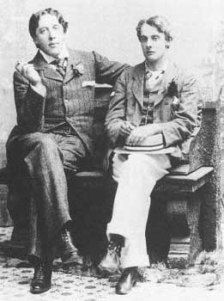
With a warrant for Wilde’s arrest on charges of sodomy and gross indecency having been issued, Robbie Ross finds Wilde at the Cadogan Hotel, Knightsbridge, with Reginald Turner. Both men advise Wilde to go at once to Dover and try to get a boat to France. His mother advises him to stay and fight. Wilde, lapsing into inaction, can only say, “The train has gone. It’s too late.” Wilde is arrested for “gross indecency” under Section 11 of the Criminal Law Amendment Act 1885, a term meaning homosexual acts not amounting to buggery, an offence under a separate statute. At Wilde’s instruction, Ross and Wilde’s butler force their way into the bedroom and library of 16 Tite Street, packing some personal effects, manuscripts, and letters. Wilde is then imprisoned on remand at HM Prison Holloway where he receives daily visits from his partner, Lord Alfred Douglas.

Events move quickly and his prosecution opens on April 26, 1895. Wilde pleads not guilty. He has already begged Douglas to leave London for Paris, but Douglas complains bitterly, even wanting to give evidence. He is pressed to go and soon flees to the Hotel du Monde. Fearing persecution, Ross and many others also leave the United Kingdom during this time.

Under cross examination by Charles Gill, Wilde is at first hesitant, but then eloquently responds to Gill’s question about the meaning of “the love that dare not speak its name.” Wilde replies, “‘The love that dare not speak its name” in this century is such a great affection of an elder for a younger man as there was between David and Jonathan, such as Plato made the very basis of his philosophy, and such as you find in the sonnets of Michelangelo and Shakespeare. It is that deep spiritual affection that is as pure as it is perfect. It dictates and pervades great works of art, like those of Shakespeare and Michelangelo, and those two letters of mine, such as they are. It is in this century misunderstood, so much misunderstood that it may be described as ‘the love that dare not speak its name,’ and on that account of it I am placed where I am now. It is beautiful, it is fine, it is the noblest form of affection. There is nothing unnatural about it. It is intellectual, and it repeatedly exists between an older and a younger man, when the older man has intellect, and the younger man has all the joy, hope and glamour of life before him. That it should be so, the world does not understand. The world mocks at it, and sometimes puts one in the pillory for it.”

Wilde’s response is counter-productive in a legal sense as it only serves to reinforce the charges of homosexual behaviour. The trial ends with the jury unable to reach a verdict. Wilde’s counsel, Sir Edward Clarke, is finally able to get a magistrate to allow Wilde and his friends to post bail. The Reverend Stewart Headlam puts up most of the £5,000 surety required by the court, having disagreed with Wilde’s treatment by the press and the courts. Wilde is freed from Holloway and, shunning attention, goes into hiding at the house of Ernest and Ada Leverson, two of his firm friends. Edward Carson approaches Frank Lockwood QC, the Solicitor General and asks, “Can we not let up on the fellow now?” Lockwood answers that he would like to do so, but fears that the case has become too politicised to be dropped.

The final trial is presided over by Alfred Wills. On May 25, 1895 Wilde and Alfred Taylor are convicted of gross indecency and sentenced to two years’ hard labour. The judge describes the sentence, the maximum allowed, as “totally inadequate for a case such as this,” and that the case is “the worst case I have ever tried.” Wilde responds, “And I? May I say nothing, my Lord?” but it is drowned out by cries of “Shame” in the courtroom.

Oscar Wilde enters prison on May 25, 1895 and is released on May 18, 1897.

(Pictured: Oscar Wilde and Lord Alfred Douglas)