seamus dubhghaill

Promoting Irish Culture and History from Little Rock, Arkansas, USA


Leave a comment

Birth of Composer Geoffrey Molyneux Palmer

Geoffrey Molyneux Palmer (Irish: Seathrún de Pámar), Irish composer, is born to Protestant Irish parents in Staines, Middlesex, England, on October 8, 1882. His compositions consist mainly of operas and vocal music, among them the first musical settings of poems by James Joyce.

Palmer grows up in South Woodford, an area of East London, where his father, Abram Smythe Palmer, is vicar at Holy Trinity Church. He studies at the University of Oxford where, in 1901, he is the youngest Bachelor of Music (BMus) in college history. Between 1904 and 1907 he studies composition with Charles Villiers Stanford at the Royal College of Music, London. He moves to Ireland in 1910 where he is initially active as a church organist in Dublin suburbs. From his early twenties he suffers from multiple sclerosis, which makes a professional independence increasingly difficult.

Palmer’s music includes at least three operas, a number of choral pieces and many songs. His strong interest in opera comes during a politically difficult period in Irish history. Ireland is struggling for independence, and cultural politicians often regard opera (and classical music in general) as alien to Irish culture. Initially, however, he is successful, his earliest stage work being Finn Varra Maa (a transliteration from the Gaelic meaning “good Finbar”), subtitled The Irish Santa Claus. It survives as a libretto only, published in a drama series by Talbot Press, Dublin, in 1917. Contrary to what the (sub-)title may suggest, the work is a political satire that is much criticised for its nationalismSruth na Maoile (“The Sea of Moyle”) is first performed in July 1923 and restaged by the O’Mara Opera Company in the cultural by-programme of the Tailteann Games in August 1924. Its story is based on the legend of the Children of Lir, while the music relies on numerous references to Irish traditional music, including the song Silent O Moylefrom Thomas Moore‘s Irish Melodies. A third work, Grania Goes (1924), conceived as a light, comic opera, cannot be performed in the years following Irish independence. The manuscript scores of the Sruth na Maoile and Grania Goes are in the National Library of Ireland.

Between 1925 and 1930, Palmer embarks on a cycle of three full-scale operas on the Cuchullain cycle to words by William Mervyn Crofton. In one of them, Deirdre of the Sorrows (1925), Crofton acknowledges Palmer’s “beautiful music.” Despite this, Palmer’s illness prevents the completion of the score, which is later handed over to the composer Staf Gebruers (1902–70), but they are never performed. The manuscript scores of the operas Cuchullain and Deirdre of the Sorrows composed by Gebruers are held by his son Adrian. Unfortunately, despite extensive searching, the score of The Wooing of Emer has not been located, though it is referenced in Gebruers’ own inventories and mentioned as being of three hours duration. In addition, there is a copy of The King’s Song, also composed by Gebruers with lyrics by Crofton and described as from Act 1 of The Black Hag, but whether or not this has any connection with Palmer is unknown.

Palmer is mainly known as the composer of light songs and ballads, often in a folkloristic style, that find publishers in England and are frequently performed. “They show a skilled hand with a talent for vocal harmony but little originality.” His choral music is mainly on a similar miniature scale, an exception being the early cantata The Abbot of Innisfallen (1909). There are some isolated examples of orchestral music performed by the orchestra of Radio Éireann, but the surviving references may not give a full picture of his output.

In the last decades of his life, Palmer was confined to a wheelchair and depends upon the care of his two sisters, who were running Hillcourt, a private girls’ boarding school in Glenageary, near their home in Sandycove (south Dublin). Palmer dies in Dublin on November 29, 1957.


Leave a comment

Birth of Roddy Doyle, Novelist, Dramatist & Screenwriter

Roddy Doyle, novelist, dramatist and screenwriter known for his unvarnished depiction of the working class in Ireland, is born in Dublin on May 8, 1958. His distinctively Irish settings, style, mood, and phrasing make him a favourite fiction writer in his own country as well as overseas.

Doyle grows up in a middle-class family in Kilbarrack. His mother, Ita Bolger Doyle, is a first cousin of the short story writer Maeve Brennan. After majoring in English and geography at University College Dublin, he teaches those subjects for fourteen years at Greendale Community School, a Dublin grade school. During the summer break of his third year of teaching, he begins writing seriously. In the early 1980s he writes a heavily political satire, Your Granny’s a Hunger Striker, but it is never published.

Doyle publishes the first editions of his comedy The Commitments (1987; film 1991) through his own company, King Farouk, until a London-based publisher takes over. The work is the first installment of his internationally acclaimed The Barrytown Trilogy novels, which also include The Snapper (1990; film 1993), and The Van (1991; film 1996). The series centres on the ups and downs of the never-say-die Rabbitte family, who temper the bleakness of life in an Irish slum with familial love and understanding.

Doyle’s fourth novel, Paddy Clarke Ha Ha Ha (1993), wins the 1993 Booker Prize. Set in the 1960s in a fictional working-class area of northern Dublin, the book examines the cruelty inflicted upon children by other children. The protagonist, 10-year-old Paddy Clarke, fears his classmates’ ostracism, especially after the breakup of his parents’ marriage. In 1994 he writes the BBC miniseries Family, which generates heated controversy throughout conservative Ireland. The program sheds harsh light on a family’s struggle with domestic violence and alcoholism and portrays the bleaker side of life in a housing project, the same venue he had used in the more comedic Barrytown novels. The Woman Who Walked into Doors (1996) and its sequel, Paula Spencer (2006), concern the ramifications of domestic abuse and alcoholism.

A Star Called Henry (1999) centres on an Irish Republican Army (IRA) soldier named Henry Smart and his adventures during the Easter Rising. Smart’s further adventures are detailed in Oh, Play That Thing (2004), which follows him as he journeys through the United States, and The Dead Republic (2010), which chronicles his return to Ireland. In Smile (2017) a lonely middle-aged man looks back on his life, especially his troubled childhood. His next novel, Love (2020), follows two old friends as they spend a night drinking and looking back at their lives. The Deportees and Other Stories (2007), Bullfighting (2011), and Life Without Children (2021) are short-story collections. He also writes a number of books for children, including Wilderness (2007) and A Greyhound of a Girl (2011).

In 1987 Doyle marries Belinda Moller, granddaughter of former Irish President Erskine Childers. They have three children – Rory, Jack and Kate.

In the television series Father Ted, the character Father Dougal Maguire‘s unusual sudden use of (mild) profanities, such as saying “I wouldn’t know, Ted, you big bollocks!,” is blamed on his having “been reading those Roddy Doyle books again.”


Leave a comment

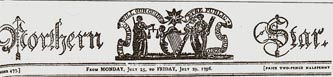
Publication of the First Issue of the “Northern Star”

northern-star

The first issue of the Northern Star, the newspaper of the Society of United Irishmen, is published in Belfast on January 4, 1792. It is published from 1792 until its suppression by the British army in May 1797.

The publication of an Irish newspaper that reflects and disseminates liberal views is an early goal of Irish republicans in the late 18th century. By the founding of the Society of United Irishmen in October 1791, the project is well underway, and the first edition of the Northern Star appears in Belfast in January 1792. Like the United Irishmen, the first financial backers of the Northern Star are Presbyterian and one of the United Irish leadership, Samuel Neilson, is made editor.

Political content dominates the Northern Star but its publication of local news, as opposed to the focus on British and international affairs of other Irish newspapers of the time, brings it wide popularity. Leading members of the United Irishmen are regular contributors and mixed direct political analyses with cutting political satire. William Orr is among those who contributed to its content and his letters lead to his eventual arrest and execution under the Insurrection Act of 1797. The newspaper also enjoys an excellent voluntary distribution network as its penetration follows rapidly wherever the United Irishmen set up new branches. It was estimated that for each copy of the Northern Star sold there are at least five readers, as the reading aloud of articles from the paper is a regular feature of United Irish meetings.

The newspaper is initially protected from the authorities due to the support of well-connected liberals but following the outbreak of war between Great Britain and Revolutionary France in 1793 and the subsequent banning of the United Irishmen as a seditious body it begins to draw increasing attention. The massive popularity of the newspaper protects it from serious harassment until January 1797 when the establishment goes into a state of panic following the French invasion scare at Bantry Bay. The paper is alleged to be behind the Dublin-based Union Star, a militant, low-circulation newssheet, often posted in public places, which specializes in naming informers, “notorious Orangemen,” and other enemies of the United Irishmen, being regarded by Dublin Castle as a republican hitlist.

The extensive distribution network and potency of the Northern Star in spreading United Irish opinion alarms the authorities and possession of a copy comes to be regarded as an admission of seditious intent. The end finally comes with the uncovering of supposed United Irish infiltration of the Monaghan militia in Belfast, which results in the execution of four soldiers. General Gerard Lake, 1st Viscount Lake, already engaged in a brutal counter-insurgency campaign, is quick to put much of the blame on the Northern Star and requests permission to suppress the paper.

As it turns out, official suppression is not necessary as on May 19, 1797, three days after the execution of their ex-comrades, a mob of Monaghan militiamen anxious to prove their loyalty attack the offices of the Northern Star and destroy not only the printing presses but the building itself. The attack results in the demise of the Northern Star to the undoubted satisfaction of the authorities as no action is taken against those involved in the destruction. The Chartist movement later pays tribute to the Northern Star by using the same name for their newspaper that is founded in 1837 by Feargus O’Connor.