seamus dubhghaill

Promoting Irish Culture and History from Little Rock, Arkansas, USA


Leave a comment

Death of Joseph Cooper Walker, Irish Antiquarian & Writer

Joseph Cooper Walker, Irish antiquarian and writer, dies on April 12, 1810, in Enniskerry, County Wicklow.

Walker is born in Dublin, son of Cooper Walker, merchant, and educated by Thomas Ball. He suffers from asthma, which prevents him from attending college. Instead he travels to Italy, where he possibly receives some private tuition in Latin, Greek, French, Italian, and Spanish. He takes a special interest in Italian literature and Irish antiquities, and on his return to Ireland (where he is employed in the Irish treasury as third clerk in the upper department) resides in an Italianate villa, St. Valerie, on the road from Bray to Enniskerry.

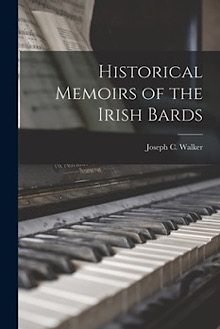
In 1785, Walker is elected one of the original members of the Royal Irish Academy (RIA) and on March 17, 1786, is requested to sit on its committee of antiquities. In this capacity he submits several essays to the Academy’s Transactions. However, his best-known work is Historical Memoirs of the Irish Bards (1786). His interest in poetry, and in eighteenth-century vernacular survivals of the ancient bardic tradition, suggests important new contemporary and literary dimensions for what had previously been antiquarian and scholarly pursuits. He also breaks new ground by considering modern as well as historical Irish culture, and introduces it to an Anglo-Irish audience by providing English translations of Gaelic songs and poems.

The authorities Walker cites covers the entire range of Irish and Anglo-Irish scholarship on Irish antiquities. He includes excerpts from his correspondence with Charles O’ConorCharles Vallancey, and Sylvester O’Halloran and carries out an extensive correspondence with Thomas Percy after he becomes Bishop of Dromore in 1782. He focuses on both poetry and music, which according to the popular eighteenth-century view has been the two traditional pursuits of the Irish bards. He presents a historical outline of their progress from the earliest times to the eighteenth century and ends with nine appendices, which are almost as lengthy as the main text. In these, his appreciation of what he considers to be the contemporary survivals of the ancient Irish bardic tradition is apparent in his including an account of Cormac Common, a blind eighteenth-century poet from Mayo, as well as a lengthy biographical notice of Turlough O’Carolan, together with translations of several of his songs. The book brings together many of the literary, scholarly, popular, Celtic, antiquarian, political, and musical dimensions of eighteenth-century Irish culture and prefigures the synthesis of literary modes, cultural theories, and musical styles that would occur in the literary productions of the United Irishmen.

Despite his linguistic skills, Walker has little knowledge of the Irish language, yet he (a member of the Anglo-Irish elite) is consistent in his praise of Gaelic culture, portraying it as sophisticated and literate and, although he highly romanticises his work, he does help to challenge negative appraisals of the Irish character. By the standards of the time it is a work of great erudition. However, today the book is judged to be of limited academic merit as Walker is severely hampered by a shortage of primary documents and by his limited grasp of the Irish language. This is illustrated by his ambiguous use of James Macpherson‘s volumes of Ossianic poems, published in the 1760s, which he quotes as authentic in the text while hinting in the footnotes that they are unreliable.

Charlotte Brooke translates three poems, and in return Walker encourages her to produce her Reliques of Irish Poetry (1789). Her work reflects Walker’s influence and she thanks him in the preface for affording her “every assistance which zeal, judgment and extensive knowledge, could give” as well as for prevailing on people to subscribe to her work and for being a subscriber himself. He is part of a literary circle that includes Edward Ledwich, Charles O’Conor, Edward BerwickJohn Philpot Curran, and Henry Grattan. He also writes Historical essay on the dress of the ancient and modern Irish (1788), dedicated to his friend James Caulfeild, 1st Earl of Charlemont, for which he interviews the older generation, consults manuscripts, and even visits tombs to examine the clothing of corpses, and admits he has received copious aid from Elizabeth Rawdon, Countess of Moira. The English Review receives it warmly but Richard Gough, the reviewer for The Gentleman’s Magazine, states he is “much disappointed in the perusal of this high priced history.” Other works by Walker include “an historical essay on the Irish stage,” RIA Trans., ii (1788), Historical Memoir on Italian Tragedy (1799) and contributions to Vallancey’s Collectanea de rebus Hibernicis (Dublin, 1770–1804). In the 1790s he subscribes to Anthologia Hibernica: a monthly collection of science, belles lettres and history and in December 1794 submits an “Historical essay on the Irish stage” which surveys Irish drama from bardic times through to contemporary folk plays.

Walker dies on April 12, 1810, in Enniskerry, County Wicklow, leaving a fine gallery of pictures, a library containing Irish manuscripts, and a collection of antiquities. He is buried on April 14 in St. Mary’s Churchyard, Dublin. His memoirs of Alessandro Tassoni are published posthumously in London in 1815 (with a lengthy preface by his brother Samuel), as is the second edition of Historical Memoirs of the Irish Bards (2 vols., Dublin, 1818).

(From: “Walker, Joseph Cooper” by Rosemary Ritchie, Dictionary of Irish Biography, http://www.dib.ie, October 2009)


Leave a comment

Birth of Composer Geoffrey Molyneux Palmer

Geoffrey Molyneux Palmer (Irish: Seathrún de Pámar), Irish composer, is born to Protestant Irish parents in Staines, Middlesex, England, on October 8, 1882. His compositions consist mainly of operas and vocal music, among them the first musical settings of poems by James Joyce.

Palmer grows up in South Woodford, an area of East London, where his father, Abram Smythe Palmer, is vicar at Holy Trinity Church. He studies at the University of Oxford where, in 1901, he is the youngest Bachelor of Music (BMus) in college history. Between 1904 and 1907 he studies composition with Charles Villiers Stanford at the Royal College of Music, London. He moves to Ireland in 1910 where he is initially active as a church organist in Dublin suburbs. From his early twenties he suffers from multiple sclerosis, which makes a professional independence increasingly difficult.

Palmer’s music includes at least three operas, a number of choral pieces and many songs. His strong interest in opera comes during a politically difficult period in Irish history. Ireland is struggling for independence, and cultural politicians often regard opera (and classical music in general) as alien to Irish culture. Initially, however, he is successful, his earliest stage work being Finn Varra Maa (a transliteration from the Gaelic meaning “good Finbar”), subtitled The Irish Santa Claus. It survives as a libretto only, published in a drama series by Talbot Press, Dublin, in 1917. Contrary to what the (sub-)title may suggest, the work is a political satire that is much criticised for its nationalismSruth na Maoile (“The Sea of Moyle”) is first performed in July 1923 and restaged by the O’Mara Opera Company in the cultural by-programme of the Tailteann Games in August 1924. Its story is based on the legend of the Children of Lir, while the music relies on numerous references to Irish traditional music, including the song Silent O Moylefrom Thomas Moore‘s Irish Melodies. A third work, Grania Goes (1924), conceived as a light, comic opera, cannot be performed in the years following Irish independence. The manuscript scores of the Sruth na Maoile and Grania Goes are in the National Library of Ireland.

Between 1925 and 1930, Palmer embarks on a cycle of three full-scale operas on the Cuchullain cycle to words by William Mervyn Crofton. In one of them, Deirdre of the Sorrows (1925), Crofton acknowledges Palmer’s “beautiful music.” Despite this, Palmer’s illness prevents the completion of the score, which is later handed over to the composer Staf Gebruers (1902–70), but they are never performed. The manuscript scores of the operas Cuchullain and Deirdre of the Sorrows composed by Gebruers are held by his son Adrian. Unfortunately, despite extensive searching, the score of The Wooing of Emer has not been located, though it is referenced in Gebruers’ own inventories and mentioned as being of three hours duration. In addition, there is a copy of The King’s Song, also composed by Gebruers with lyrics by Crofton and described as from Act 1 of The Black Hag, but whether or not this has any connection with Palmer is unknown.

Palmer is mainly known as the composer of light songs and ballads, often in a folkloristic style, that find publishers in England and are frequently performed. “They show a skilled hand with a talent for vocal harmony but little originality.” His choral music is mainly on a similar miniature scale, an exception being the early cantata The Abbot of Innisfallen (1909). There are some isolated examples of orchestral music performed by the orchestra of Radio Éireann, but the surviving references may not give a full picture of his output.

In the last decades of his life, Palmer was confined to a wheelchair and depends upon the care of his two sisters, who were running Hillcourt, a private girls’ boarding school in Glenageary, near their home in Sandycove (south Dublin). Palmer dies in Dublin on November 29, 1957.


Leave a comment

Birth of John Edgar, Minister & Professor of Theology

John Edgar, minister, professor of theology, moderator of the Secession Synod in 1828 and moderator of the Presbyterian Church in Ireland in 1842 is born near Ballynahinch, County Down, on June 13, 1798. He is Honorary Secretary to the Presbyterian Home Mission during the Great Famine in 1847.

Edgar is the eldest son of Samuel Edgar (1766-1826) and Elizabeth McKee (1771-1839). He attends the Royal Belfast Academical Institution where he excels as a student. He is ordained a minister in the Presbyterian church in 1820. He becomes D.D. of Hamilton College in Kirkland, New York, in 1836, is elected moderator of the Presbyterian Church in Ireland for 1842–43, and obtains LL.D. of New York in 1860.

Edgar is known as the origin of the Temperance movement in Ireland because he pours alcohol out his window in 1829. On August 14, 1829, he writes a letter in the Belfast Telegraph advocating temperance.

Edgar forms the Ulster Temperance Movement. In 1834, he tells a parliamentary committee inquiring into the causes and consequences of drunkenness in the United Kingdom that there are 550 “dram shops” in Belfast and 1,700 shops selling intoxicants in Dublin as well as numerous illicit distillers “even in the most civilised districts of Ulster.”

Edgar is also the founder of the Ulster Female Penitentiary in 1839 which is a residential home for prostitutes. He is also instrumental in getting the Deaf, Dumb and Blind Institute set up in Belfast. A meeting which leads to the establishment of the Presbyterian Orphan Society is held in 1866 in his drawing room.

Edgar is also involved in the relief effort by the Presbyterian church in Connacht during the Irish famine. The church is accused of proselytizing during the famine period. In the May Street Presbyterian Church he says, “I hope soon to have an opportunity of directing public attention to spiritual famine in Connacht, but our effort now is to save the perishing body … Our brother is starving, and, till we have satisfied his hunger, we have no time to inquire whether he is Protestant or Romanist.”

Edgar is interested in Gaelic language and culture, and is critical of other Protestant faiths particularly the Church of Ireland (Anglican) for not preaching in the Irish language.

Edgar dies at the age of 68 on August 26, 1866, in Cremore, Rathgar, Dublin, where he had gone to get medical treatment. He is survived by his wife Susanna, and is buried in Balmoral Cemetery, Belfast.