seamus dubhghaill

Promoting Irish Culture and History from Little Rock, Arkansas, USA


Leave a comment

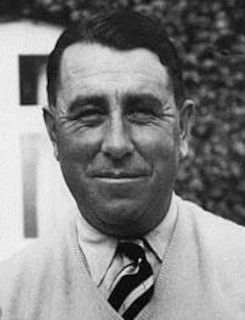
Death of Professional Golfer Harry “The Brad” Bradshaw

Harry Bradshaw, a leading Irish professional golfer of the 1940s and 1950s, dies on December 22, 1990, in St. Vincent’s hospital, County Dublin.

Bradshaw is born on October 9, 1913, in Killincarrig, County Wicklow, eldest among four sons and two daughters of Edward ‘Ned’ Bradshaw, golf caddie and later golf professional, and Elizabeth Bradshaw (née Walsh) of Killincarrig. He is educated locally. A golf prodigy, he has a hole-in-one at the age of ten on an 80-yard par three at Delgany Golf Club, County Wicklow. He joins Delgany Golf Club, where he progresses from caddie to assisting his father, who is the club’s professional. As a teenager, he tends to hook the ball wildly, before he develops a grip that allows him to hit with great accuracy. Thereafter, he concentrates on honing his peerless approach play from within 100 yards of the hole. Another feature of his game is what is called his “hit and hark” approach to putting: he never lifts his head to follow the ball until he hears it drop.

Bradshaw plays in his first tournament as a professional in 1932, the same year he shoots a course record 68 at Delgany. In 1938, he wins his first professional tournament, the Bromford-Adgey Cup at Skerries Golf Club, County Dublin. In 1941, he is appointed golf professional at Kilcroney, County Wicklow, and in 1950 he begins his long association with Portmarnock Golf Club, County Dublin, when he is appointed golf professional there. By then he has already made his mark on domestic Irish golf, having won the Irish Open in 1947 and 1949. In Ireland he wins the Irish Dunlop Trophy three times, the Willie Nolan Trophy eleven times, the Moran Cup twelve times and the Irish Professional Championship ten times, the last a record later equaled by Christy O’Connor Snr.

Bradshaw is not well known outside of Ireland prior to the famous “bottle” incident at the 1949 Open Championship at Royal St. George’s Golf Club in Sandwich, Kent, England. Having headed the qualifiers and shooting an opening 68, he continues his good form into the second round when his drive at the par four fifth hole just misses the fairway and lands in a beer bottle that is standing upright with the neck and shoulder broken off. The rules are unclear on whether the bottle constitutes a hazard, and he elects to play the ball where it lay, judging (correctly) that he is not entitled to a free drop. Closing his eyes and turning his head away, he swings, shattering the bottle and advancing the ball about twenty-five yards. He is shaken and records a lacklustre round of 77. Back to his best in the next two rounds, he would win the title had his putt on the last not stopped just short. Instead, he ties with the South African Bobby Locke who defeats him by twelve strokes in the thirty-six-hole play-off with superlative rounds of 67 and 68. As a result of his experience with the broken bottle, the rules are changed to cater for the possibility of such an incident recurring. It is the closest a golfer from the Republic of Ireland comes to winning the Open Championship until Pádraig Harrington’s victory in 2007.

Bradshaw subsequently revenges himself on Locke by narrowly beating him to the Irish Open title the following month. He is then one of four British and Irish golfers to participate in a sixteen-week tour of South Africa from December 1950 to March 1951 during which he engages in further jousts with Locke, deepening their new-found friendship.

Establishing himself on the international golf circuit, Bradshaw goes on to win the Dunlop British Masters on two occasions (1953, 1955), and in 1958 he becomes the first Irishman to win the PGA Close Championship. He had also won the Dunbar Open Tournament in Scotland in 1953 and the Gleneagles Hotel Foursomes Tournament pro-am with Joe Carr in 1955. The highlight of his career comes in Mexico City in 1958, when, in partnership with Christy O’Connor Snr, he wins the Canada Cup, later known as the World Cup, for Ireland, also losing a play-off for the individual title. His performance is particularly impressive, given that he is forty-five and carrying weight while competing at altitude in oppressive heat. He and O’Connor are fêted upon their return home, and their victory is considered to play the determining role in popularising golf in Ireland. He caps a memorable year by receiving the Association of Golf Writers’ Trophy for 1958.

Bradshaw appears on three Ryder Cup teams. At the Wentworth Club in 1953, he wins his foursomes match partnering Fred Daly and his singles match against Fred Haas, but in 1955 he loses both his foursomes and singles matches at the Thunderbird Country Club in California. In 1957, he is a member of the side that defeats the American team 7–4 at Lindrick Golf Club in South Yorkshire, only the third victory by the Britain and Ireland side in the twelve matches played up to that time. He holes a five-footer to tie his match with U.S. Open champion Dick Mayer after a classic encounter. In 1963, he takes on Billy Casper, one of America’s top golfers, in a match at Portmarnock televised as part of the prestigious Shell’s Wonderful World of Golf series. Bradshaw’s three-stroke victory earns him $3,000, which is then considered a bonanza in golfing terms.

Bradshaw remains the golf professional at Portmarnock until 1983, latterly spending most of his day in the club shop. Even after his formal retirement, he remains on the payroll at Portmarnock as an informal ambassador for the club. Nicknamed “the Brad,” he is extremely popular with amateur and professional alike, is a great raconteur and tremendous company, and is noted for his lack of rancor towards, or criticism of, other players.

Bradshaw dies on December 22, 1990, at St. Vincent’s hospital, County Dublin, and is buried in St. Fintan’s Cemetery, Sutton, Dublin.

Bradshaw marries Elizabeth Foley from Carlow in 1944 and they have four children. His three brothers, Eddie, Hughie and Jimmy, are all professional golfers.

(From: “Bradshaw, Harry” by Jim Shanahan, Dictionary of Irish Biography, http://www.dib.ie, November 2022)

Leave a comment

Death of Supreme Court Judge Adrian Hardiman

Adrian Hardiman, Irish judge who serves as a Judge of the Supreme Court of Ireland from 2000 to 2016, dies in Portobello, Dublin, on March 7, 2016. He writes a number of important judgments while serving on the Court. He also presides, as does each Supreme Court judge on a rotating basis, over the Court of Criminal Appeal.

Hardiman is born on May 21, 1951, in Coolock, Dublin. His father is a teacher and President of the Association of Secondary Teachers, Ireland (ASTI). He is educated at Belvedere College, Dublin, and University College Dublin, where he studies history, and the King’s Inns. He is president of the Student Representative Council at UCD and Auditor of the Literary and Historical Society (UCD) and wins The Irish Times National Debating Championship in 1973.

Hardiman is married to Judge Yvonne Murphy, from County Donegal, a judge of the Circuit Court between 1998 and 2012, who conducts important inquiries relating to sex abuse including the Murphy Report and the Cloyne Report. She serves as chair of the Mother and Baby Homes Commission of Investigation. They have three sons, Eoin, who is a barrister and has been a member of the Mountjoy Prison Visiting Committee, Hugh, who is a personal assistant to Minister for Justice, Equality and Law Reform Michael McDowell, and Daniel, a doctor.

Hardiman joins Fianna Fáil while a student in University College Dublin and stands unsuccessfully for the party in the local elections in Dún Laoghaire in 1985. In 1985, he becomes a founder member of the Progressive Democrats but leaves the party when he is appointed to the Supreme Court. He remains very friendly with the former party leader and ex-Tánaiste, Michael McDowell, who is a close friend at college, a fellow founding member of the party, and best man at his wedding.

Hardiman is called to the Irish Bar in 1974 and receives the rare honour of being appointed directly from the Bar to Ireland’s highest court. Prior to his elevation to the Supreme Court in 2000, he has a successful practice as a barrister, focusing on criminal law and defamation.

Politically, Hardiman supports the liberal side in Ireland’s debates over abortion, being active in the “anti-amendment” campaign during the 1982 Abortion Referendum and later represents the Well Woman Centre in the early 1990s. After his death, he is described by Joan Burton as a liberal on social issues. But he could be an outspoken opponent of Political Correctness, such as when he rejects the Equality Authority‘s attempt to force Portmarnock Golf Club to accept women as full members. He also believes that certain decisions, such as those involving public spending, are better left to elected politicians rather than unelected judges, regardless of how unpopular that might sometimes be in the media (which he tends to hold in low esteem) and among what he describes as the “chattering classes.”

Hardiman’s concern for individual rights is not confined to Ireland. In February 2016, he criticizes what he describes as the radical undermining of the presumption of innocence, especially in sex cases, by the methods used in the UK‘s Operation Yewtree inquiry into historical sex allegations against celebrities, and he also criticizes “experienced lawyer” and then United States presidential candidate Hillary Clinton for allegedly declaring in January that “every accuser was to be believed, only to amend her view when asked if it applied to women who had made allegations against her husband”, former U.S. President Bill Clinton.

In a tribute following his death in 2016, President Michael D. Higgins says Justice Hardiman “was one of the great legal minds of his generation”, who was “always committed to the ideals of public service.” He is described as a “colossus of the legal world” by Chief Justice Susan Denham.

One commentator writes that “Hardiman’s greatest contribution …was the steadfast defence of civil liberties and individual rights” and that “He was a champion of defendants’ rights and a bulwark against any attempt by the Garda Síochána to abuse its powers.”


Leave a comment

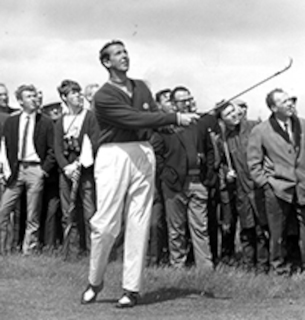
Birth of Joe Carr, Irish Amateur Golfer

Joseph Benedict Carr, Irish amateur golfer, is born in Inchicore, a suburb of Dublin, on February 22, 1922.

Carr is the fifth of seven children born to George and Margaret Mary “Missie” Waters. At ten days old, he is adopted by his maternal aunt, Kathleen, and her husband, James Carr, who are childless and have recently returned home from India. The Carrs have just been appointed steward and stewardess of the Portmarnock Golf Club, allowing young Joe to play golf from a very early age.

Carr wins his first major tournament, the East of Ireland Amateur, at the age of 19 in 1941, which starts one of Ireland’s greatest golfing careers. He goes on to win twelve East of Ireland titles, twelve West of Ireland titles, six Irish Amateur Close Championships, four Irish Amateur Opens, and three South of Ireland titles.

Carr wins The Amateur Championship three times, in 1953, 1958, and 1960, and is runner-up in 1968. He is a semi-finalist at the United States Amateur Championship in 1961, and is low amateur at The Open Championship in both 1956 and 1958 and finishes 8th overall in 1960. In 1967, he becomes the first Irishman to play in the Masters Tournament, making the cut. He receives the Bob Jones Award in 1961, the USGA‘s highest honour, which is given for “distinguished sportsmanship in golf.” He is the first non-American to win the award.

Internationally, Carr represents Ireland in numerous amateur golfing events. He is a member of a record eleven Walker Cup teams from 1947 to 1967, including non-playing captain in 1965 and playing captain in 1967, amassing a record of 5–14–1. After several years of playing against the United States’ top-ranked players, he is moved down in the order for the 1961 event, only to be paired against Jack Nicklaus who wins the match. He plays and captains on multiple Eisenhower Trophy teams, and represents Ireland in the Men’s Home Internationals every year from 1947 to 1969. He retires from competitive golf in 1971, after his son Roddy plays for the winning Great Britain & Ireland Walker Cup team.

In 1991, Carr is named Captain of The Royal and Ancient Golf Club of St. Andrews, the first Irishman to hold the post. In July 2007, he is elected to the World Golf Hall of Fame in the Lifetime Achievement category, and is inducted in November 2007.

From 1992 until his death on June 3, 2004, Carr is president of Mount Juliet Golf Club in Thomastown, County Kilkenny. Mount Juliet still hosts the annual J.B. Carr Trophy for its members.


Leave a comment

Death of Open Champion Fred Daly

fred-daly

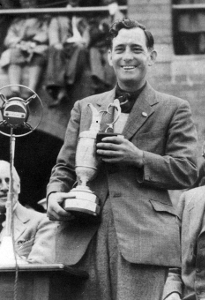
Frederick J. Daly, Northern Irish professional golfer best known for winning The Open Championship in 1947 at the Royal Liverpool Golf Club, Hoylake, dies on November 18, 1990.

Born in Portrush, County Antrim, Daly is the only Irishman from either side of the border to have won The Open until Pádraig Harrington wins it in 2007 and the only Northern Irish major winner until Graeme McDowell wins the U.S. Open in 2010. Daly wins the Open in 1947 while professional to the Balmoral Club in Belfast. He wins with a score of 293, a single stroke ahead of runners-up Reg Horne and amateur Frank Stranahan.

During his acceptance speech at Royal Liverpool, Daly says he is very honoured to receive the Claret Jug and take it back to Northern Ireland. He goes on to say that the trophy has never been to Ireland and that he is hoping that the change of air will help it. There is much applause and laughter at his humorous comments.

In addition, he adds the News of the World Match Play tournament, which is the main British Match Play Championship, becoming the first since James Braid (1905) to win both the Open and the Match Play title in the same year.

Daly is the only Ulsterman to win the Irish Open until 2016, when Rory McIlroy wins at The K Club. Daly wins in 1946 at Portmarnock, and plays on four Ryder Cup teams, in 1947, 1949, 1951, and 1953. Daly is awarded the MBE in the 1984 New Year Honours “for services to golf.”

Fred Daly, age 79, dies in Belfast on November 18, 1990, of a heart attack.