Before the Act, a number of “Penal laws” had been enacted in Britain and Ireland, which varied between the jurisdictions from time to time but effectively excluded those known to be Roman Catholics from public life.
By this Act, an oath is imposed, which besides a declaration of loyalty to the reigning sovereign, contains an abjuration of the Pretender, and of certain doctrines attributed to Roman Catholics, such as that excommunicated princes may lawfully be murdered, that no faith should be kept with heretics, and that the Pope has temporal as well as spiritual jurisdiction in Great Britain.
Those taking this oath are exempted from some of the provisions of the Popery Act 1698. Although it does not grant freedom of worship, it allows Catholics to join the army and purchase land if they take an oath of allegiance. The section as to taking and prosecuting priests is repealed, as well as the penalty of perpetual imprisonment for keeping a school. Roman Catholics are also enabled to inherit and purchase land, nor is an heir who conformed to the Established church any longer empowered to enter and enjoy the estate of his “papist” kinsman.
The passing of this act is the occasion of the Gordon Riots (1780) in which the violence of the mob is especially directed against William Murray, 1st Earl of Mansfield, who had objected to various prosecutions under the statutes now repealed.
Simnel is born around 1477. His real name is not known, and contemporary records call him John, not Lambert, and even his surname is suspect. Different sources have different claims of his parentage, but he is most definitely of humble origin. At the age of about ten, he is taken as a pupil by an Oxford-trained priest named Richard Simon who apparently decides to become a kingmaker. He tutors the boy in courtly manners and contemporaries describe the boy as handsome. He is taught the necessary etiquette and is well educated by Simon.
Simon notices a striking resemblance between Lambert and the sons of Edward IV, so he initially intends to present Simnel as Richard, Duke of York, son of King Edward IV, the younger of the vanished Princes in the Tower. However, when he hears rumours (at the time false) that the Edward Plantagenet, 17th Earl of Warwick has died during his imprisonment in the Tower of London, he changes his mind. The real Warwick is a boy of about the same age, having been born in 1475, and has a claim to the throne as the son of George Plantagenet, 1st Duke of Clarence, King Edward IV’s executed brother.
Simon spreads a rumour that Warwick has actually escaped from the Tower and is under his guardianship. He gains some support from Yorkists. He takes Simnel to Ireland where there is still support for the Yorkist cause and presents him to the head of the Irish government, Gerald FitzGerald, 8th Earl of Kildare, Lord Deputy of Ireland. Kildare is willing to support the story and invade England to overthrow King Henry. Simnel is paraded through the streets, carried on the shoulders of “the tallest man of the time,” an individual called D’Arcy of Platten.
On May 24, 1487, Simnel is crowned in Christ Church Cathedral in Dublin as King Edward VI. He is about 10 years old. Lord Kildare collects an army of Irish soldiers under the command of his younger brother, Thomas FitzGerald of Laccagh.
Simnel’s army, mainly Flemish and Irish troops, lands on Piel Island in the Furness area of Lancashire on June 5, 1487, and are joined by some English supporters. However, most local nobles, with the exception of Sir Thomas Broughton, do not join them. They clash with the King’s army on June 16 at the Battle of Stoke Field in Nottinghamshire and are defeated. Lincoln and Thomas FitzGerald are killed. Lovell goes missing and there are rumours that he has escaped to Scotland with Sir Thomas Broughton and hidden to avoid retribution. Simons avoids execution due to his priestly status but is imprisoned for life. Kildare, who had remained in Ireland, is pardoned.
King Henry pardons young Simnel, probably because he recognises that Simnel had merely been a puppet in the hands of adults and puts him to work in the royal kitchen as a spit-turner. When he grows older, he becomes a falconer. Almost no information about his later life is known. He dies sometime between 1525 and 1535. He seems to have married, as he is probably the father of Richard Simnel, a canon of St. Osyth’s Priory in Essex during the reign of Henry VIII.
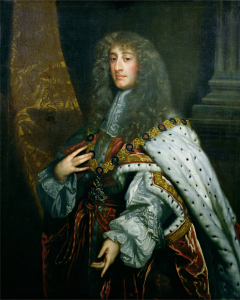
The second surviving son of Charles I, James ascends the throne upon the death of his brother, Charles II. There is little initial opposition to his accession, and there are widespread reports of public rejoicing at the orderly succession. The new Parliament that assembles in May 1685, which gains the name of “Loyal Parliament,” is initially favourable to James, and the new King sends word that even most of the former exclusionists will be forgiven if they acquiesce to his rule.
Members of Britain’s Protestant political elite increasingly suspect him of being pro-French and pro-Catholic and of having designs on becoming an absolute monarch. When he produces a Catholic heir, leading nobles call on his Protestant son-in-law and nephew William of Orange to land an invasion army from the Dutch Republic, which he does in the Glorious Revolution of 1688. James flees England and thus is held to have abdicated. He is replaced by his eldest, Protestant daughter Mary and her husband William of Orange.
James is best known for his struggles with the English Parliament and his attempts to create religious liberty for English Roman Catholics and Protestant nonconformists, against the wishes of the Anglican establishment. This tension makes James’s four-year reign a struggle for supremacy between the English Parliament and the Crown, resulting in his deposition, the passage of the Bill of Rights, and the accession of his daughter and her husband as king and queen.


 seamus dubhghaill