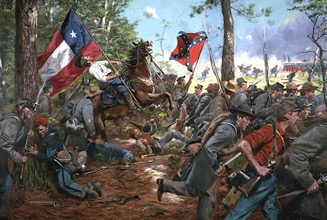
The battle is part of the Northern Virginia campaign. Union army General John Pope’s Army of Virginia faces Robert E. Lee’s Army of Northern Virginia. On August 28, Jackson attacks a Union column at Brawner’s Farm, drawing Pope’s attention. On August 29, Pope launches assaults on Jackson’s position along an unfinished railroad grade, which are repulsed with heavy casualties. On August 30, General James Longstreet’s arrival and a massive Confederate counterattack forces the Union retreat.
The 6th Louisiana, as part of Jackson’s command, is engaged in the defensive positions along Stony Ridge and in the fighting around the railroad grade. While specific casualty records for the regiment on this date are not detailed in the provided sources, the Irish Brigade is known for its tenacity in defensive and assault roles, and its participation in this battle is part of its service in the Army of Northern Virginia until the war’s end.
Following the Second Battle of Bull Run, the 6th Louisiana continues to serve in the Army of Northern Virginia through the Maryland campaign and other major battles, eventually being consolidated with the 5th and 7th Louisiana Infantry Regiments in November 1864 and mustered out at Appomattox in April 1865.
In summary, on August 28–30, 1862, the 6th Louisiana Infantry (Irish Brigade) fights under Jackson’s command in the Second Battle of Bull Run, contributing to the Confederate victory that allows Lee to invade Maryland.
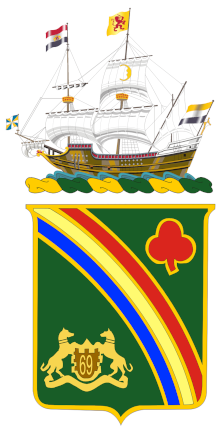
The battle, called the Battle of First Manassas by the Confederate State Army, is fought in Prince William County, Virginia, just north of the city of Manassas and about thirty miles west-southwest of Washington, D.C. The Union Army is slow in positioning themselves, allowing Confederate reinforcements time to arrive by rail. Each side has about 18,000 poorly trained and poorly led troops. The Union army suffers an ignominious defeat that day, but the 69th is among a handful of Union regiments that perform well during the battle. Held in reserve at first, the 69th soon advances and routs the 4th Alabama. But when the brigade meets stiffer opposition, Sherman attacks with one regiment at a time, wasting his numbers. The battle is followed by a disorganized post-battle retreat of the Union forces.
Just months after the start of the war at Fort Sumter, the northern public clamors for a march against the Confederate capital of Richmond, Virginia, which is expected to bring an early end to the Confederacy. Yielding to political pressure, Brigadier GeneralIrvin McDowell leads his unseasoned Union Army across Bull Run against the equally inexperienced Confederate Army of Brigadier General P. G. T. Beauregard, whose forces are camped near Manassas Junction. McDowell’s ambitious plan for a surprise flank attack on the Confederate left is poorly executed; nevertheless, the Confederates, who had been planning to attack the Union left flank, find themselves at an initial disadvantage.
Confederate reinforcements under Brigadier General Joseph E. Johnston arrive from the Shenandoah Valley by railroad, and the course of the battle quickly changes. A brigade of Virginians under a relatively unknown brigadier general from the Virginia Military Institute, Thomas J. Jackson, stands its ground, which results in Jackson receiving his famous nickname, “Stonewall.” The Confederates launch a strong counterattack, and as the Union troops begin withdrawing under fire, many panic and the retreat turns into a rout. McDowell’s men frantically run without order in the direction of Washington, D.C.
One of the last regiments off the field, the 69th loses 38 men that day, the first being Capt. James Haggerty from Donegal, and 59 wounded. Ninety-five are sent to Confederate prison camps, including its Sligo-born colonel, Michael Corcoran. One of the last men off the field is Waterford‘s Thomas Francis Meagher, captain of Company K, who eventually swims the last yards to safety across Bull Run creek. It is a rough beginning, but the regiment has begun a storied history that soon earns them the sobriquet “Fighting 69th.”
Both armies are sobered by the fierce fighting and the many casualties and realize that the war is going to be much longer and bloodier than anticipated. The First Battle of Bull Run highlights many of the problems and deficiencies that are typical of the first year of the war. Units are committed piecemeal, attacks are frontal, infantry fails to protect exposed artillery, tactical intelligence is minimal, and neither commander is able to employ his whole force effectively. McDowell, with 35,000 men, can commit only about 18,000, and the combined Confederate forces, with about 32,000 men, also commit 18,000.