seamus dubhghaill

Promoting Irish Culture and History from Little Rock, Arkansas, USA


1 Comment

King Edward VII Begins Eight-Day Visit to Ireland

In 1904, King Edward VII and Queen Alexandra travel to Ireland for a semi-official eight-day visit, arriving in Kingstown (now Dún Laoghaire) on April 26. They are accompanied by their daughter, Princess Victoria.

They travel by rail to Naas via the Great Southern and Western Railway Company. They are seated in a luxuriously upholstered carriage, the engine decorated with flags and streamers. The visit triggers a frenzy of preparation among the elite and merchants of Naas. Leading citizens from diverse backgrounds, including Protestants, Catholics, Loyalists, and Home Rulers, come together to welcome the royal visitors. The town is adorned with bunting, banners, and arches bearing royal and loyalist symbols, creating an extravagant showpiece of imperial loyalty.

During their visit to Naas, the King and Queen attend the Punchestown Races, adding a touch of glamour to the occasion.

They stay in the Dublin area for a few days, attending several events and ceremonies. After finishing in Dublin, the royals board their royal train for a three-day visit to Kilkenny.

For the arrival of the King and Queen in Kilkenny, significant efforts are undertaken to ensure the city is elegantly presented. In the weeks and months prior to the visit, local businessmen convene meetings in how best to organise the occasion.

The city is heavily festooned with bunting and streamers, and the route from the railway station to Kilkenny Castle is decorated with tiny fairy lights of every colour. During the visit, Princess Victoria plants three trees on the grounds of the Castle.

The visit is well-received in Kilkenny, although sometimes expressed in primitive fashion: an old man remarks, “Sure, the King’s a man after all,” his wife correcting him, “But he’s a great man, and the lovely lady’s an angel.” Although well-supported, black flags protesting the visit are hung from some buildings along the route. (It is more than 110 years before another royal visit is made to Kilkenny when Prince Charles and Princess Camilla visit the city on May 11, 2017.)

The King and Queen travel to Waterford on May 2, where they stay at Lismore Castle, home of the Duke of Devonshire. Thomas Horgan of Youghal, County Cork, makes the first known film in Ireland of this event.

The royal visit to Ireland comes to an end on May 4.

(Pictured: King Edward VII and Queen Alexandra in the grandstand of the Kilkenny Agricultural Show 1904)

2 Comments

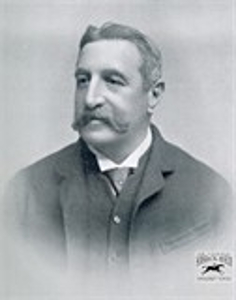
Birth of John Gubbins, Racehorse Breeder & Owner

john-gubbins

John Gubbins, breeder and owner of racehorses, is born on December 16, 1838 at the family home in Kilfrush, County Limerick. He is fourth son of Joseph Gubbins by his wife Maria, daughter of Thomas Wise of Cork.

Of three surviving brothers and five sisters, the third brother, Stamer, breeds horses at Knockany after distinguishing himself in the Crimean War. He dies at the age of 46 on August 7, 1879, after a horse falls on him while “schooling” over fences.

John Gubbins, after being educated privately, inherits the Knockany property from his brother and purchases the estate of Bruree, County Limerick. A fortune is also left him by an uncle, Francis Wise of Cork. Settling at Bruree in 1868, he builds kennels and stables and purchases horses and hounds. He hunts the Limerick country with both stag and fox hounds, and is no mean angler, until forced to stop by the operations of the Land League in 1882.

From his youth he takes a keen interest in horse racing. At first his attention is mainly confined to steeplechasers, and he rides many winners at Punchestown Racecourse and elsewhere in Ireland. He is the owner of Seaman when the horse wins the grand hurdle race at Auteuil, but sells him to Lord Manners before he wins the Grand National at Liverpool in 1882. Usna is another fine chaser in his possession. Buying the stallions Kendal and St. Florian, he breeds, from the mare Morganette, Galtee More by the former and Ard Patrick by the latter. Galtee More wins the 2000 Guineas Stakes and the St. Leger Stakes as well as the Epsom Derby in 1897, and is afterwards sold to the Russian government who later pass him on to the Prussian government. The Prussian government also purchases Ard Patrick just days before he wins the Eclipse Stakes in 1903, when he defeats Sceptre and Rook Sand after an exceptionally exciting contest.

Other notable horses bred by John Gubbins are Blairfinde, winner of the Irish Derby, and Revenue. In 1897 he heads the list of winning owners and is third in the list in 1903. In 1903 Gubbins is rarely seen on a racecourse due to failing health and sells his horses in training. In 1905, however, his health apparently improving, he sends some yearlings to Cranborne, Dorset, to be trained by Sir Charles Nugent, but before these horses can run he dies of bronchitis at Bruree on March 20, 1906.  His final instructions are, “As I aspired to breed fast horses, please see that my hearse is pulled at speed on my final journey.” Gubbins is buried in the private burial ground at Kilfrush.

In 1889 he marries Edith, daughter of Charles Legh, of Addington Hall, Cheshire. She predeceases him without issue. His estates pass to his nephew, John Norris Browning, a retired naval surgeon.