seamus dubhghaill

Promoting Irish Culture and History from Little Rock, Arkansas, USA


Leave a comment

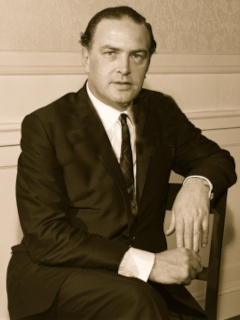
Birth of Donogh O’Malley, Fianna Fáil Politician & Rugby Union Player

Donogh Brendan O’Malley, Irish Fianna Fáil politician and rugby union player, is born on January 18, 1921, in Limerick, County Limerick. He serves as Minister for Education (1966-68), Minister for Health (1965-66) and Parliamentary Secretary to the Minister for Finance (1961-65). He also serves as a Teachta Dála (TD) for the Limerick East constituency (1954-68). He is best remembered as the Minister who introduces free secondary school education in the Republic of Ireland.

O’Malley is one of eight surviving children of Joseph O’Malley, civil engineer, and his wife, Mary “Cis” (née Tooher). Born into a wealthy middle-class family, he is educated by the Jesuits at Crescent College and later at Clongowes Wood College, County Kildare. He later studies at University College Galway (UCG), where he is conferred with a degree in civil engineering in 1943. He later returns to Limerick, where he works as an engineer before becoming involved in politics.

O’Malley plays rugby at provincial level for Munster, Leinster and Connacht and at club level for Bohemians and Shannon RFC. His chances at an international career are ruined by the suspension of international fixtures during World War II. It is at a rugby match in Tralee that he first meets Dr. Hilda Moriarty, who he goes on to marry in August 1947.

Although O’Malley runs as a Fianna Fáil candidate, he is born into a politically active family who supports Cumann na nGaedheal until a falling-out with the party in the early 1930s. He first becomes involved in local politics as a member of Limerick Corporation. He becomes Mayor of Limerick in 1961, the third O’Malley brother to hold the office (Desmond from 1941-43 and Michael from 1948-49). He is a strong electoral performer, topping the poll in every general election he runs in.

O’Malley is first elected to Dáil Éireann as a Fianna Fáil TD for Limerick East at the 1954 Irish general election. Fianna Fáil is not returned to government on that occasion. He spends the rest of the decade on the backbenches. However, his party is returned to power in 1957. Two years later, the modernising process begins when Seán Lemass takes over from Éamon de Valera as Taoiseach. Lemass introduces younger cabinet ministers, as the old guard who has served the party since its foundation in 1926 begin to retire.

In 1961, O’Malley joins the government as Parliamentary Secretary to the Minister for Finance. He is part of a new, brasher style of politician that emerges in the 1960s, sometimes nicknamed “the men in the mohair suits.” It is expected that this generation of politician, born after the Irish Civil War, will be a modernising force in post-de Valera Ireland.

Although his sporting background is in rugby and swimming, it is association football which O’Malley gets involved in at a leadership level, becoming President of the Football Association of Ireland despite never having played the sport.

Following Fianna Fáil’s retention of power in the 1965 Irish general election, O’Malley joins the cabinet as Minister for Health. He spends just over a year in this position before he is appointed Minister for Education, a position in which he displays renowned dynamism. Having succeeded Patrick Hillery, another dynamic young minister, he resolves to act swiftly to introduce the recommendations of an official report on education.

As Minister for Education, O’Malley extends the school transport scheme and commissions the building of new non-denominational comprehensive and community schools in areas where they are needed. He introduces Regional Technical Colleges (RTCs), now called Institutes of Technology, in areas where there is no third level college. The best example of this policy is the University of Limerick, originally an Institute of Higher Education, where O’Malley is credited with taking the steps to ensure that it becomes a university. His plan to merge Trinity College Dublin and University College Dublin arouses huge controversy, and is not successful, despite being supported by his cabinet colleague Brian Lenihan. Access to third-level education is also extended, the old scholarship system being replaced by a system of means-tested grants that give easier access to students without well-off parents.

Mid-twentieth century Ireland experiences significant emigration, especially to the neighbouring United Kingdom where, in addition to employment opportunities, there is a better state provision of education and healthcare. Social change in Ireland and policies intending to correct this deficit are often met with strong resistance, such as Noël Browne‘s proposed Mother and Child Scheme. As a former Health Minister, O’Malley has first-hand experience of running the department which had attempted to introduce this scheme and understood the processes that caused it to fail, such as resistance from Department of Finance and John Charles McQuaid. This influences his strategy in presenting the free-education proposal.

Shortly after O’Malley is appointed, he announces that from 1969 all education up to Intermediate Certificate level will be without cost, and free buses will bring students in rural areas to their nearest school, seemingly making this decision without consulting other ministers. However, he does discuss it with Lemass. Jack Lynch, who, as Minister for Finance, has to find the money to pay for the programme, is not consulted and is dismayed at the announcement.

By announcing the decision first to journalists and on a Saturday (during a month when the Dáil is in recess), the positive public reaction tempers resistance to the idea before the next cabinet meeting. O’Malley’s proposals are hugely popular with the public, and it is impossible for the government to go back on his word.

Some Irish commentators consider that O’Malley’s extension of education, changing Ireland from a land where the majority are schooled only to the age of 14 to a country with universal secondary-school education, indirectly leads to the Celtic Tiger boom of the 1990s-2000s when it is followed for some years by an extension of free education to primary degree level in university, a scheme that is launched in 1996 by the Labour Party and axed in 2009 by Fianna Fáil’s Batt O’Keeffe.

In 1967, O’Malley appoints Justice Eileen Kennedy to chair a committee to carry out a survey and report on the reformatory and industrial school systems. The report, which is published in 1970, is considered ground-breaking in many areas and comes to be known as the Kennedy Report. The Report makes recommendations about a number of matters, including the Magdalene laundries, in relation to which they are not acted upon. The report recommends the closure of a number of reformatories, including the latterly infamous reformatory at Daingean, County Offaly.

O’Malley’s reforms make him one of the most popular members of the government. He is affectionately known as “the School Man” for his work in education. His sudden death in Limerick on March 10, 1968, before his vision for the education system is completed, comes as a shock to the public. He is buried with a full Irish state funeral.

Following O’Malley’s death, his widow, Hilda O’Malley, does not run in the subsequent by-election for the seat he has left vacant. It is won narrowly by their nephew Desmond O’Malley. Hilda seeks the Fianna Fáil nomination for the 1969 Irish general election, but Fianna Fáil gives the party nomination to Desmond, as the sitting TD. Hilda runs as an Independent candidate in that election. After what proves a bitter campaign against her nephew, she fails to get the fourth seat in Limerick East by just 200 votes.

Leave a comment

Birth of Singer-Songwriter Sinéad O’Connor

Sinéad Marie Bernadette O’Connor, Irish singer-songwriter dubbed the first superstar of the 1990s by Rolling Stone magazine, is born on December 8, 1966, in Dublin. During her career she attracts publicity not only for her voice, which is alternately searing and soothing, but also for her controversial actions and statements.

O’Connor is born at the Cascia House Nursing Home on Baggot Street in Dublin, the third of five children of John Oliver “Seán” O’Connor, a structural engineer later turned barrister and chairperson of the Divorce Action Group, and Johanna Marie O’Grady, who marry in 1960 at the Church of Our Lady of Good Counsel, Drimnagh, Dublin. She is named Sinéad after Sinéad de Valera, the mother of Éamon de Valera, Jnr., the doctor who presides over her delivery, and Bernadette in honour of Saint Bernadette of Lourdes. An older brother is the novelist, Joseph O’Connor. She attends Dominican College Sion Hill school in Blackrock, Dublin.

O’Connor’s parents divorce when she is eight years old, and she and her siblings are sent to live with their abusive mother, who beats the children on a regular basis. Eventually, she leaves to live with her father and stepmother, but the child, who habitually shoplifts, proves to be too troublesome for the couple, and they send her to reform school. Although she hates the reform school, it is there that she makes her first contacts with the music world. A teacher introduces her to the drummer of a local band, In Tua Nua, and for a brief period she works with the band and even cowrites one of their hit singles. After a year and a half at the reform school, she is transferred to a boarding school in Waterford, but it proves unbearable. She eventually returns to Dublin, where she attempts to start her own music career.

In Dublin O’Connor eventually joins the pub rock band Ton Ton Macoute. In 1985, while singing with the group, she attracts the attention of the London-based record label Ensign Records, which asks her for a demo tape. Soon afterward she signs a contract with the label and begins work on her debut album, The Lion and the Cobra, which is released in 1987 to critical praise. She follows the album with the largely autobiographical I Do Not Want What I Haven’t Got (1990). The album is propelled to the top of the U.S. pop charts on the strength of the number one single “Nothing Compares 2 U”—a transcendent cover of a 1985 Prince song.

In the following year O’Connor attracts attention not only for her singing but also for a series of controversial statements, actions, and appearances, including refusing to appear on NBC’s Saturday Night Live because of objections to the week’s guest host, boycotting the 1991 Grammy Awards ceremony and declining to sing there, and refusing to allow the U.S. national anthem to be played before one of her performances. She also attracts criticism for her public support of the Irish Republican Army (IRA) and for tearing up a picture of Pope John Paul II on Saturday Night Live in 1992. Nevertheless, she wins the Grammy Award for Best Alternative Music Album in 1991 for “I Do Not Want What I Haven’t Got” and continues to be highly regarded for her musical abilities.

In 1992 O’Connor releases an album of torch songs, Am I Not Your Girl?, which receives only minor publicity, and she releases a fourth album, Universal Mother, in 1994. Soon afterward she takes a hiatus from public life, spending time with her children and attending therapy in order to work through problems that linger from her harsh childhood. Her struggles with mental health continue throughout her life.

O’Connor occasionally actes, appearing in such films as Hush-a-Bye Baby (1990), Emily Brontë’s Wuthering Heights (1992; as novelist Emily Brontë), and The Butcher Boy (1997; as the Virgin Mary). She is ordained a priest in a controversial religious group led by Bishop Michael Cox, the leader of a religious sect that has broken off from the Roman Catholic Church. In 2000 she releases her fifth album, Faith and Courage, which includes the hit song “No Man’s Woman.” The album is praised by several music reviewers as one of the best albums of the year. Subsequent albums include Sean-Nós Nua (2002), Throw Down Your Arms (2005), Theology (2007), How About I Be Me (and You Be You)? (2012), and I’m Not Bossy, I’m the Boss (2014).

In 2018 O’Connor announces that she has converted to Islam and changes her name to Shuhadāʾ Sadaqat, although she states that she will continue to perform as Sinéad O’Connor. Her memoir, Rememberings (2021), receives broad critical praise, and she is the subject of the documentary Nothing Compares (2022).

O’Connor’s sudden death in her flat in Herne Hill, south London, at the age of 56 on July 26, 2023, prompts a massive outpouring of public grief. Irish President Michael D. Higgins praises her for her “beautiful, unique voice.” A year later, upon the registration of her death certificate, it is revealed that she had died of chronic obstructive pulmonary disease and bronchial asthma.

(From: “Sinéad O’Connor,” written and fact checked by The Editors of Encyclopedia Britannica, http://www.britannica.com, last updated September 30, 2024)


Leave a comment

Death of Vincent “Mad Dog” Coll, Mob Hitman

vincent-mad-dog-coll

Vincent “Mad Dog” Coll, born Uinseann Ó Colla, Irish American mob hitman in the 1920s and early 1930s in New York City, dies on February 8, 1932.

Coll is born in Gweedore, County Donegal, on July 20, 1908. When he is not quite one year old, the Coll family emigrates to New York in search of a better life. At age 12, he is sent to a reform school. After being expelled from multiple Catholic reform schools, he joins The Gophers street gang. He joins up with Dutch Schultz‘s gang and quickly rises through the ranks. By the late 1920s he is working as an armed guard for the illegal beer delivery trucks of Schultz’s mob.

Coll is a loose cannon, and Schultz soon grows tired of his reckless behavior. In 1929, Coll robs a dairy in the Bronx of $17,000 without Schultz’s permission. When Schultz confronts him about the robbery, rather than being apologetic, Coll demands he be made an equal partner.

By January 1930 Coll has formed his own gang and is engaged in a shooting war with Schultz. One of the earliest victims is Peter Coll, shot dead on May 30, 1931, while driving down a Harlem street. Coll goes into a rage of grief and vengeance. Over the next three weeks he guns down four of Schultz’s men. In all, around 20 men are killed in the bloodletting. The exact figure is hard to pin down as New York is also in the midst of the vicious Castellammarese War at the same time. It is mayhem on the streets of Manhattan and the police often have difficulty in deciding which corpse belongs to which war.

On July 28, 1931, Coll allegedly participates in a kidnapping attempt that results in the shooting death of a child. His target is bootlegger Joseph Rao, a Schultz underling who is lounging in front of a social club. Several children are playing outside a nearby apartment house. A large touring car pulls up to the curb, and several men point shotguns and submachine guns towards Rao and start shooting. Rao throws himself to the sidewalk, however, and four young children are wounded in the attack. One of them, five-year-old Michael Vengalli, later dies at Beth David Hospital. After the Vengalli killing, New York City Mayor Jimmy Walker dubs Coll a “Mad Dog”.

On October 4, 1931, after an extensive manhunt, New York police arrest Coll at a hotel in the Bronx. He surrenders peacefully. On October 5, a grand jury in New York city indicts Coll in the Vengalli murder. The trial begins in December 1931. He retains famed defense lawyer Samuel Leibowitz. The prosecution case soon falls apart. At the end of December, the judge issues a directed verdict of not guilty.

It was said that both Dutch Schultz and Owney Madden put a $50,000 bounty on Coll’s head. On February 1, 1932, four or five gunmen invade a Bronx apartment which Coll is rumored to frequent and open fire with pistols and submachine guns. Three people, Coll gangsters Patsy Del Greco and Fiorio Basile and bystander Emily Tanzillo, are killed. Three others are wounded. Coll himself does not show up until 30 minutes after the shooting.

At 12:30 AM on February 8, one week after the Bronx shootings, Coll is using a phone booth at a drug store at Eighth Avenue and 23rd Street in Manhattan. He is reportedly talking to Madden, demanding $50,000 from the gangster under the threat of kidnapping his brother-in-law. Madden keeps Coll on the line while it is traced. Three men in a dark limousine soon arrive at the drug store. While one waits in the car, two others step out. One man waits outside while the other walks inside the store. The gunman tells the cashier to stay calm, draws a Thompson submachine gun from under his overcoat and opens fire on Coll in the glass phone booth. He dies instantly. The killers take off in their car and are chased unsuccessfully up Eighth Avenue.

A total of 15 bullets are removed from Coll’s body at the morgue and even more may have passed through him. He is buried next to his brother Peter at Saint Raymond’s Cemetery in the Bronx. Dutch Schultz sends a floral wreath bearing a banner with the message, “From the boys.”