
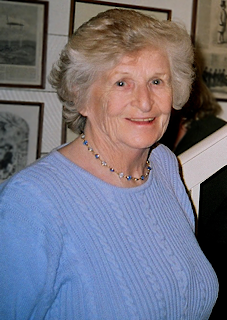
Ronnie Masterson, one of the best-known Irish stage actors of her generation from the 1940s to the 1970s, dies at the age of 87 in Rush, County Dublin, on February 10, 2014. Following her stage career she builds a solid film and television career with RTÉ, and independent directors including Peter Kosminsky, Alan Parker and Neil Jordan.
Masterson is born in Dublin on April 4, 1926. She trains at the Abbey Theatre and first appears on stage there in 1944. At the Abbey, she meets and then marries actor Ray McAnally in 1951, and they remain married until his death in 1989, although they reside in different homes; her husband with Irish actress Britta Smith. McAnally and Masterson have four children: Conor, Aonghus, Máire and Niamh.
In the late 1960s Masterson and McAnally leave the permanent and pensionable security of the national theatre to set up their own company, Old Quay Productions. The company brings contemporary American and British theatre to Irish audiences, including Alan Ayckbourn‘s Relatively Speaking, Edward Albee‘s Who’s Afraid of Virginia Woolf?, Bill Naughton‘s Alfie, and Robert Patrick‘s Kennedy’s Children.
Kennedy’s Children nearly bankrupts the company, having to be pulled early in a 14-week run, when playgoers in Dublin mistake its title as an adverse comment on the children of assassinated and revered U.S. president John F. Kennedy, whereas the play is actually a series of monologues exploratory of U.S. society in the Vietnam War era. They are rescued by two giants of Irish independent theatre, Phyllis Ryan of Gemini Productions – whose Eblana Theatre the couple had hired- and John B. Keane, who has just published Letters of a Matchmaker , a novel written as a series of letters between a rural matchmaker and his clients.
Film and television work follow, including many episodes of RTÉ soap opera Glenroe, in which Masterson plays Madge O’Regan, and in 1988 her first film, The Dawning, an adaptation of Jennifer Johnston‘s story The Old Jest, which wins first prize as best film at the Montreal World Film Festival and where she acts opposite Anthony Hopkins, Trevor Howard and a young Hugh Grant.
Masterson’s best film work is probably as a memorable Grandma Sheehan in Alan Parker’s screen version of Frank McCourt‘s Angela’s Ashes in 1999, where, in her own words in an interview with her grandson, Aonghus Óg McAnally, she says, “Without doubt I had the best script.”
Other notable film roles include Fools of Fortune, The Real Charlotte and Kosminsky’s dramatisation of the events which led to the Stalker inquiry in Northern Ireland, Shoot to Kill, where she plays Mrs. Tighe opposite her old Abbey colleague Peadar Lamb, as Mr. Tighe.
Speaking to The Irish Times , Lamb remarks how, as a young actor at the Abbey in 1949, Masterson had been a “striking” Kathleen Ní Houlihan in W. B. Yeats‘s play, her height, green eyes and vivid red hair perfect for the part.
Lamb, who serves for many years with Masterson on the committee of Irish Actors’ Equity Association, pays tribute also to her work for other actors: “She didn’t waste words, but spoke very strongly when she did speak.” RTÉ producer Laurence Foster also pays a tribute to this aspect of Masterson’s career on the SIPTU website.
Masterson also plays in the Edinburgh International Festival and in many Dublin Theatre Festival productions. She appears on many series broadcast on RTÉ, BBC and ITV and tours extensively in the United States in her own one woman shows.
In November 2005, Masterson is in the United States again, this time to take the lead role in The Sea Captain, a short film directed by her son, veteran television producer Conor McAnally.
Masterson dies on February 10, 2014, at Rush Nursing Home in Rush, County Dublin. She is buried at St. Fintan’s Cemetery, Sutton, Dublin.


 seamus dubhghaill