seamus dubhghaill

Promoting Irish Culture and History from Little Rock, Arkansas, USA


Leave a comment

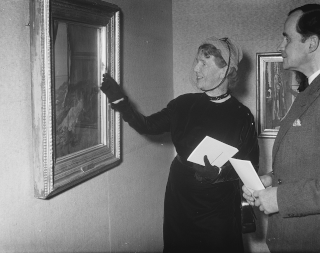
Death of Josephine McNeill, First Irish Female Diplomat

Josephine McNeill, Irish diplomat, dies in Dublin on November 19, 1969. She is the first Irish female diplomat appointed to represent Ireland abroad in a ministerial capacity.

McNeill is born Josephine Ahearne on March 31, 1895, in FermoyCounty Cork, the daughter of shopkeeper and hotelier, James Ahearne, and his wife Ellen Ahearne (née O’Brien). She attends the Loretto Convent, Fermoy, and goes on to graduate from University College Dublin (UCD) with a BA,  H.Dip.Ed. in French and German. With this she begins a teaching career, at St. Louis’ Convent, Kiltimagh, at the Ursuline Convent, Thurles, and at Scoil Íde. Scoil Íde, the female counterpart to St. Enda’s School, had been established by her friend, Louise Gavan Duffy. She is fluent in the Irish language and takes an active part in the cultural elements of the Irish independence movement, such as literature and music. She is a member of Cumann na mBan, serving as a member of the executive committee in 1921.

McNeill becomes engaged to Pierce McCan, but he dies of influenza in Gloucester Gaol in March 1919. She marries James McNeill in 1923, while he is serving as Irish High Commissioner in London. Despite her reservations, she becomes a noted hostess, both in London and later in Dublin when her husband becomes the Governor-General of the Irish Free State from 1928 to 1932.

After the death of her husband in 1938, McNeill becomes the honorary secretary of the council of the Friends of the National Collections, as well as serving as chair of the executive committee of the Irish Countrywomen’s Association until 1950. As a member of the Department of External Affairs advisory committee on cultural relations, she writes on economic, social and cultural issues. She represents Ireland at the UNESCO general assembly in Paris in 1949.

McNeill is an active member of Clann na Poblachta from its foundation in 1946. She is appointed the minister to the Netherlands in 1950 by Seán MacBride, making her the first Irish female diplomat to represent the Republic of Ireland abroad in a ministerial capacity. This appointment is not well received by diplomats in the Department of External Affairs. Her reports from The Hague focus on the issues the Netherlands faces with decolonisation. In 1955, she becomes the minister to Sweden, going on to hold the joint appointment to Austria and Switzerland from 1956 to 1960, after which she retires. While serving in Switzerland she puts aside the resentment she feels towards Éamon de Valera based on how he had treated her husband, to sit with him during a convalescence while de Valera recovers from an eye operation.

McNeill is an amateur pianist and collects paintings and porcelains. In 1933, she publishes the Irish language book, Finnsgéalta ó India.

McNeill dies in St. Vincent’s Hospital, Dublin, on November 19, 1969. She is buried in Kilbarrack Cemetery. Her papers are held in the UCD Archives.


Leave a comment

Birth of Irish Historian Robert Walter Dudley Edwards

CREATOR: gd-jpeg v1.0 (using IJG JPEG v62), default quality

Robert Walter Dudley Edwards, Irish historian, is born in Dublin on June 4, 1909.

Edwards, known to his friends as Robin and his students as Dudley, is the son of Walter Dudley Edwards, a journalist who comes to Ireland with his wife, Bridget Teresa MacInerney from Clare, and becomes a civil servant. His mother is a supporter of women’s rights and Edwards recalls that he had a ‘Votes for Women’ flag on his pram. His mother is a suffragette and a member of Cumann na mBan, a women’s organisation designed to support the Irish Volunteers. Members of Cumann na mBan gather intelligence, transport arms, nurse wounded men, provide safe houses, and organise support for Irish Republican Army (IRA) men in prison.

Edwards is first educated at the Catholic University School, then moves to St. Enda’s School, a school set up by 1916 Irish revolutionary leader Patrick Pearse, after the 1916 rising, and then Synge Street CBS, finally returning to the Catholic University School. In his final exams he fails French and Irish but gains first place in Ireland in history.

In University College Dublin, Edwards is auditor of the Literary and Historical Society, gains a first-class degree in history in 1929 followed by a first-class master’s degree in 1931 with the National University of Ireland prize. He carries out postgraduate work at the University of London and earns his PhD in 1933, published in 1935 as Church and State in Tudor Ireland.

Also in 1933, Edwards marries Sheila O’Sullivan, a folklorist and teacher. They have three children, Mary Dudley Edwards a teacher and rights activist, Ruth Dudley Edwards, a historian, crime novelist, journalist and broadcaster, and Owen Dudley Edwards, a historian at the University of Edinburgh.

Along with Theodore William Moody, Edwards founds the Irish Historical Society in 1936, and its journal Irish Historical Studies is first published in 1938.

In 1937 Edwards is awarded a D.Litt by the National University of Ireland and in 1939 is appointed to a statutory lectureship in Modern Irish History at University College Dublin. He succeeds Mary Hayden to the Chair of Modern Irish History in 1944, which he holds until he retires in 1979. His contribution to the discipline of History in Ireland is substantial and includes the setting up of University College Dublin Archives Department, now part of the School of History.

The introduction to Edwards’ book Age of Atrocity records how the leading Irish history journal, Irish Historical Studies, edited by Edwards and Moody, for the first half-century and more of its existence, systematically avoids the theme of violence, killing and atrocity during the 16th and 17th centuries.

Following his wife’s death in April 1985, Robert Dudley Edwards dies on June 5, 1988, in St. Vincent’s Hospital in Dublin after a short illness.

(Pictured: Robert Walter Dudley Edwards (left) and Theodore William Moody (right).)