seamus dubhghaill

Promoting Irish Culture and History from Little Rock, Arkansas, USA


Leave a comment

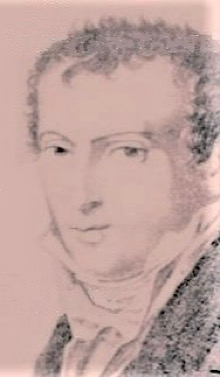
Death of David Bailie Warden, United Irishman & Diplomat

David Bailie Warden, United Irishman, diplomat, and bibliographer, dies in Paris on October 9, 1845, where he had lived for the previous thirty-eight years.

Warden is born in the townland of Ballycastle, near Newtownards in County Down, the eldest among three sons of Robert Warden, tenant farmer, and Elizabeth Warden (née Bailie). Educated locally, he studies for the Presbyterian ministry, despite being told by a clergyman that he is a “blockhead.” Entering the University of Glasgow, he wins a silver medal for his work on barometers, receives a certificate in midwifery, and graduates MA in April 1797. Returning to Ireland, he accepts a provisional license to preach from the Presbytery of Bangor, County Down, and becomes a popular preacher in the region. A patriot in politics, he joins the United Irishmen. Because of this a warrant was issued for his arrest in 1798 and he surrenders himself to the government. Banished from Ireland, he decides to emigrate to the United States and writes a pamphlet explaining his decision, A farewell address to the junto of the presbytery of Bangor, in which he accuses the church leaders of “meanness, injustice and cruelty.”

On his arrival in New York City in 1799, Warden decides to abandon his career as a clergyman and become a teacher. Interested in mathematics, science and literature, he becomes principal of the Columbia Academy in Kinderhook, New York, and is appointed in 1801 the head tutor at Kingston Academy in Ulster County, New York. Employed by General John Armstrong, Jr. to teach his children, he makes useful connections in American society. He becomes a citizen in 1804 and is asked to accompany Armstrong to France when he is appointed ambassador. Arriving in Paris in 1806, he gives strong support to Armstrong and defends him from criticism in the American press. He is appointed acting consul in 1808, and serves as head of the legation on two occasions when Armstrong is absent. Surprisingly, despite their ties of friendship, Armstrong does not recommend Warden to succeed him permanently, and advises President Thomas Jefferson that although “honest and amiable” he is “not well qualified for business.” Stung by these comments, Warden reacts angrily and his friendship with Armstrong ends acrimoniously. As a result he is swiftly recalled from Paris.

Once back in America, Warden lobbies vigorously to be appointed French consul. Supported by Jefferson, now out of office, he returns to Paris in August 1811 having convinced the government of his credentials. Befriending the new ambassador, Joel Barlow, he soon allows pride to get the better of him. Arrogantly styling himself “consul general” after Barlow dies in December 1812, he provokes much anger and is dismissed from office on June 10, 1814. He never holds a diplomatic appointment again.

Deciding to remain in France, he resumes his scholarly activities and publishes his first book, On the Origin, Nature, Progress and Influence of Consular Establishments in 1813. A friend of many of the leading French writers and intellectuals, he also offers assistance to visiting scholars from America, providing a bridge between the European and American intellectual communities. His reputation increases with the publication of Chorographical and Statistical Description of the District of Columbia (1816) and A Statistical, Political and Historical Account of the United States of North America (3 vols., 1819). The publishers of a series, L’art de vérifier les dates, commissions him to research the volumes on North and South America in 1821. These run to ten volumes and are written over thirteen years.

Beset by financial difficulties, Warden is twice forced to sell part of his vast library to raise money. He dies on October 9, 1845, in Paris, after a long illness. He never marries.

(From: “Warden, David Bailie” by Patrick M. Geoghegan, Dictionary of Irish Biography, http://www.dib.ie, October 2009)


Leave a comment

Birth of Thomas Russell, Founding Member of the Society of United Irishmen

Thomas Paliser Russell, founding member and leading organiser of the Society of United Irishmen, is born in Dromahane, County Cork, on November 21, 1767.

Born into an Anglican family with a military tradition. Russell is intended for an ecclesiastical career in the Church of Ireland, but in 1783 sails with his brother’s regiment to India and fights at the battle of Cannanore. He is, however, disgusted by what he regards as “the unjust and rapacious conduct pursued by the authorities in the case of two native women,” and returns disaffected to Ireland in 1786. After briefly studying for the church ministry, he spends the next four years as a half-pay officer in Dublin pursuing studies of science, philosophy and politics.

In 1790, Russell meets Theobald Wolfe Tone in the visitors’ gallery of the Irish House of Commons and a lifelong friendship begins. At the end of the year, he is commissioned to Belfast as an ensign in the 64th infantry regiment of foot. Being convivial, good looking, charismatic and charming, he fits quickly into Belfast society. He is deeply religious and holds strong millennialist beliefs. On the other hand, he is also of a restless nature, drinks heavily, and is highly promiscuous.

Russell becomes a founder member of the first Society of United Irishmen in Belfast in 1791, writes for the Northern Star, and acts as secretary for the Dublin United Irishmen. He is the most socially radical of all United Irish leaders, an outspoken opponent of slavery and industrial exploitation.

Russell posts bail for a friend in order to secure his release from a debtor’s prison. When the friend defaults, Russell has to sell his ensigncy in July 1791. After several months, and to avoid further debt, he accepts the offer of Thomas Knox, 1st Viscount Northland, the father of an old army friend, to become seneschal (a kind of stipendiary magistrate) to the Northlands’ manor court at Dungannon. However, he resigns within a year, apparently disgusted by the sectarian animosities there. His financial situation worsens until he becomes librarian at the Belfast Society for Promoting Knowledge (the later Linen Hall Library) in 1794.

Russell is arrested on September 16, 1796, is charged with treason, and detained without trial in Newgate Prison, Dublin, until March 1799. He is then sent to Fort George in the north of Scotland. The longest serving United Irish prisoner, he is released in June 1802 on condition of exile to Hamburg. However, he soon makes his way to Paris where he meets Robert Emmet who, with William Putnam McCabe are advancing the plans for insurrection pending the French renewal of the war against England. Having little confidence in the French, however, he returns to Ireland in March 1803 to organise the North in conjunction with the veteran of the Battle of Antrim, James Hope. However, he meets with little success as much of the North is subdued following the suppression of the Irish Rebellion of 1798.

In 1803 Russell joins a general insurrection that is to take place throughout Ireland with blows being struck simultaneously at Dublin, Belfast, and Downpatrick. Unknown to him, Robert Emmet is unable to secure help and promised firearms. In Dublin after a brief street battle on the evening of July 23, 1803, Emmett calls off the rising.

Russell manages to hide for a number of weeks in Dublin but is caught in the authorities’ dragnet on September 9. He is sent under heavy escort to Downpatrick Gaol. There, convicted of high treason, he is hung and beheaded on October 12, 1803. His remains are buried in the graveyard of the parish church, Down Cathedral, in a grave paid for by his friend Mary Ann McCracken.