
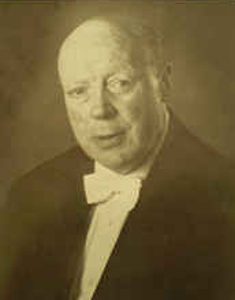
Charles Edgeworth Cagney Lynch, Irish pianist who premiers works by several important 20th-century composers, is born in Parkgariff, County Cork, on October 22, 1906.
Lynch’s father is a British army colonel and his mother comes from a well-known Cork business dynasty, the Suttons. While still a young boy, the family moves to Greenock in western Scotland and it is there, at the Tontine Hotel, that the young pianist gives his first public recital at the age of nine. When he is fifteen, he wins a scholarship to the Royal Academy of Music in London, where he studies under York Bowen and, later, Egon Petri.
Lynch becomes a popular recitalist in London during the 1920s and 1930s. He gives the first performance in England of Sergei Rachmaninoff‘s Piano Sonata No. 2 in B flat minor, having been coached beforehand by the composer. Sir Arnold Bax‘s Fourth Piano Sonata (1932) is dedicated to the 26-year-old Lynch, whom Bax later describes as “Ireland’s most imaginative pianist.” In addition to concert recitals he broadcasts regularly with the BBC and, in 1937, acts as assistant to Sir Thomas Beecham at Covent Garden. Lynch is the Ballet Rambert‘s pianist for many years, having helped Marie Rambert form the company.
A pacifist, Lynch returns to Ireland following the outbreak of World War II, where he becomes the country’s premier concert pianist. During this phase of his career he premiers a number of works by leading Irish composers, including Brian Boydell‘s Sonata for Cello and Piano (1945) and Sean Ó Riada‘s Nomos No. 4 (1959). Lynch also performs in the world première of English composer Ernest John Moeran‘s Cello Sonata in A minor, given in Dublin in May 1947. He is joined by the composer’s wife, cellist Peers Coetmore.
In February 1971 at Trinity College, Dublin, he plays the entire set of Franz Liszt‘s transcriptions of Beethoven’s symphonies over four successive Saturday evenings.
Lynch continues to give public recitals throughout Ireland until shortly before his death at the age of 77. He also lectures in music at University College Cork and gives masterclasses at the Cork School of Music. In 1982, Lynch receives a doctorate in music from the National University of Ireland.
Lynch’s technique is remarkable for the stillness with which he sits, making the most difficult of music seem almost technically unremarkable. His recorded legacy is small, but includes music by Samuel Barber, Ernest John Moeran‘s Violin Sonata (with Geraldine O’Grady, violin) as well as music by Irish composers such as Aloys Fleischmann.
Toward the end of his life he lives in very reduced circumstances. He dies in Cork on September 15, 1984 at St. Finbarr’s Hospital and is buried near Sir Arnold Bax in St. Finbarrs Cemetery, Glasheen Road, Cork.

 seamus dubhghaill