
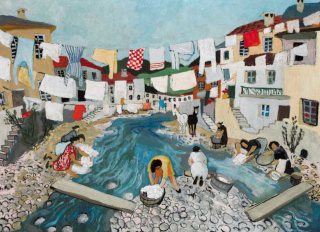
Gerard Dillon, Irish painter and artist, dies following a second stroke on June 14, 1971.
Dillon is born in Belfast in 1915 or 1916. He leaves school at the age of fourteen and for seven years works as a painter and decorator, mostly in London. From an early age he is interested in art, cinema, and theatre. About 1936 he starts out as an artist.
Dillon’s Connemara landscapes provide the viewer with context, portraits of the characters who work the land, atmosphere and idiosyncratic colour interpretations. At the age of 18, Dillon goes to London, initially working as a decorator. With the outbreak of World War II, he returns to Belfast. Over the next five years he develops as a painter in Dublin and Belfast. His works during this period are more than simple depictions of the life and people around him, they are reactions and interactions in paint.
In 1942, Dillon’s first solo exhibition is opened by his friend and fellow artist, Mainie Jellett, at The Country Shop, St. Stephen’s Green, Dublin. “Father, Forgive Them Their Sins” features depicting his concerns about the new war that had broken out. Despite a growing reputation, he has to return to London in 1944 to work on demolition gangs to restore his finances. In the late 1940s and during the 1950s, he finds himself favouring the town of Roundstone, County Galway. In 1951 he is introduced to Noreen Rice by her piano teacher. She has no formal training and she takes Dillon and George Campbell as her mentors for decades and her work is of a similar surrealistic and primitive style.
In 1958, Dillon has the double honour of representing Ireland at the Guggenheim International, and Great Britain at the Pittsburg International Exhibition. He and his sister, Mollie, have a property on Abbey Road in 1958. They let out part of the house to Arthur Armstrong and they let a flat to Noreen Rice and her brother. He and Noreen tour junk yards to find objects like leather and string that they include in their artwork.
Dillon travels widely in Europe and teaches for brief periods in the London art schools.
In 1967, Dillon suffers a stroke and spends six weeks in hospital. From this time his work changes direction. A notion of imminent death sends his work almost into another world, a realm of dreams and paintings intimating his death. In 1968 he is back in Dublin, where he helps to design sets and costumes for Seán O’Casey‘s play Juno and the Paycock. He continues to paint and also to make tapestries, sitting at his Singer sewing machine.
In 1969, Dillon pulls his artworks from the Belfast leg of the Irish Exhibition of Living Art in purported protest during the Troubles against the “arrogance of the Unionist mob.” However, he does send work to Ulster when he donates work to Sheelagh Flanagan who had organised an exhibition for the relief of victims of the Belfast riots, in October 1969. His picture is hanged alongside the donated works of T. P. Flanagan, William Scott, F. E. McWilliam, Deborah Brown and Carolyn Mulholland as well as more than twenty others. Michael Longley retorts in a further letter, “Belfast needed creativity, it needed people like Gerard Dillon.” During his last years, he is invited to be involved in a children’s art workshop in the National Gallery of Ireland.
Dillon dies of a second stroke at the age of 55 on June 14, 1971. His grave, as requested, is unmarked in Belfast’s Milltown Cemetery. Danlann Gerard Dillon/The Gerard Dillon Gallery in Cultúrlann McAdam Ó Fiaich is named in his honour.
In his biography of the artist, James White briefly touches on the artists homosexuality: “such was his religious feeling that although he was drawn to people of that type, if he once had an encounter I believe that it never occurred again.” The artist’s nephew, Martin Dillon, recalls that after his uncle’s death he found a diary entry describing a homosexual encounter with a sense of guilt, but the author Gerard Keenan insists he was “a very well-adjusted homosexual.” Reihill expands on this, pointing to a probably unrequited love for the painter Daniel O’Neill and also highlighted Dillon’s association with Basil Rákóczi and The White Stag Group‘s Kenneth Hall both strong gay connections. Pictures with both overt and covert references are known.
(Pictured: “Washing Day” by Gerard Dillon)

 seamus dubhghaill