
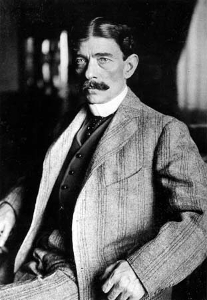
Frank Harris, British editor, novelist, short story writer, journalist and publisher, dies on August 26, 1931. He is friendly with many well-known figures of his day.
Harris is born James Thomas Harris on February 14, 1855, in Galway, County Galway, to Welsh parents. While living with his older brother he is, for a year or more, a pupil at The Royal School, Armagh. At the age of twelve he is sent to Wales to continue his education as a boarder at the Ruabon Grammar School in Denbighshire, a time he is to remember later in My Life and Loves. Harris is unhappy at the school and runs away within a year.
Harris runs away to the United States in late 1869, arriving in New York City virtually penniless. The 13-year-old takes a series of odd jobs to support himself, working first as a shoeshiner, a porter, a general laborer, and a construction worker on the erection of the Brooklyn Bridge. He later turns these early occupational experiences into art, incorporating tales from them into his book The Bomb.
From New York Harris moves to the American Midwest, settling in Chicago, where he takes a job as a hotel clerk and eventually a manager. Owing to Chicago’s central place in the meat packing industry, Harris makes the acquaintance of various cattlemen, who inspire him to leave the big city to take up work as a cowboy. He eventually grows tired of life in the cattle industry and enrolls at the University of Kansas, where he studies law and earns a degree, gaining admission to the Kansas state bar association.
Harris is not cut out to be a lawyer and soon decides to turn his attention to literature. He returns to England in 1882, later traveling to various cities in Germany, Austria, France, and Greece on his literary quest. He works briefly as an American newspaper correspondent before settling down in England to seriously pursue the vocation of journalism.
Harris first comes to general notice as the editor of a series of London papers including The Evening News, The Fortnightly Review and the Saturday Review, the last-named being the high point of his journalistic career, with H. G. Wells and George Bernard Shaw as regular contributors.
From 1908 to 1914 Harris concentrates on working as a novelist, authoring a series of popular books such as The Bomb, The Man Shakespeare, and The Yellow Ticket and Other Stories. With the advent of World War I in the summer of 1914, Harris decides to return to the United States.
From 1916 to 1922 he edits the U.S. edition of Pearson’s Magazine, a popular monthly which combines short story fiction with socialist-tinted features on contemporary news topics. One issue of the publication is banned from the mails by United States Postmaster General Albert S. Burleson during the period of American participation in the Great War. Despite this Harris manages to navigate the delicate situation which faces the left wing press and to keep the Pearson’s Magazine functioning and solvent during the war years.
Harris becomes an American citizen in April 1921. In 1922 he travels to Berlin to publish his best-known work, his autobiography My Life and Loves. It is notorious for its graphic descriptions of Harris’ purported sexual encounters and for its exaggeration of the scope of his adventures and his role in history. Years later, Time Magazine reflects in its March 21, 1960 issue “Had he not been a thundering liar, Frank Harris would have been a great autobiographer….he had the crippling disqualification that he told the truth, as Max Beerbohm remarked, only ‘when his invention flagged’.” A fifth volume, supposedly taken from his notes but of doubtful provenance, is published in 1954, long after his death.
Harris also writes short stories and novels, two books on Shakespeare, a series of biographical sketches in five volumes under the title Contemporary Portraits and biographies of his friends Oscar Wilde and George Bernard Shaw. His attempts at playwriting are less successful. Only Mr. and Mrs. Daventry (1900), which is based on an idea by Oscar Wilde, is produced on the stage.
Married three times, Harris dies of a heart attack in Nice at the age of 75 on August 26, 1931. He is subsequently buried at Cimetière Caucade in the same city. Just after his death a biography written by Hugh Kingsmill (pseudonym of Hugh Kingsmill Lunn) is published.

 seamus dubhghaill