
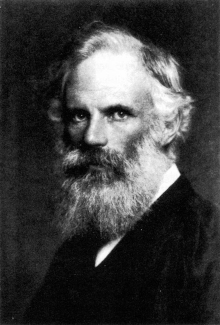
Professor George Francis FitzGerald FRS FRSE, Irish academic and physicist, is born at No. 19, Lower Mount Street in Dublin on August 3, 1851. He is known for his work in electromagnetic theory and for the Lorentz–FitzGerald contraction, which becomes an integral part of Albert Einstein‘s special theory of relativity.
FitzGerald is born to the Reverend William FitzGerald and his wife Anne Frances Stoney. He is the nephew of George Johnstone Stoney, the Irish physicist who coins the term “electron.” After the particles are discovered by J. J. Thomson and Walter Kaufmann in 1896, FitzGerald is the one to propose calling them electrons. He is also the nephew of Bindon Blood Stoney, an eminent Irish engineer. His cousin is Edith Anne Stoney, a pioneer female medical physicist.
Professor of Moral Philosophy at Trinity College Dublin and vicar of St. Anne’s, Dawson Street, at the time of his son’s birth, William FitzGerald is consecrated Bishop of Cork, Cloyne and Ross in 1857 and translates to Killaloe and Clonfert in 1862. George returns to Dublin and enters TCD as a student at the age of sixteen, winning a scholarship in 1870 and graduating in 1871 in Mathematics and Experimental Science. He becomes a Fellow of Trinity in 1877 and spends the rest of his career there, serving as Erasmus Smith’s Professor of Natural and Experimental Philosophy from 1881 to 1901.
Along with Oliver Lodge, Oliver Heaviside and Heinrich Hertz, FitzGerald is a leading figure among the group of “Maxwellians” who revise, extend, clarify, and confirm James Clerk Maxwell‘s mathematical theories of the electromagnetic field during the late 1870s and the 1880s.
In 1883, following from Maxwell’s equations, FitzGerald is the first to suggest a device for producing rapidly oscillating electric currents to generate electromagnetic waves, a phenomenon which is first shown to exist experimentally by the German physicist Heinrich Hertz in 1888.
In 1883, FitzGerald is elected Fellow of the Royal Society. In 1899, he is awarded a Royal Medal for his investigations in theoretical physics. In 1900, he is made an honorary fellow of the Royal Society of Edinburgh.
FitzGerald is better known for his conjecture in his short letter to the editor of Science. “The Ether and the Earth’s Atmosphere” explains that if all moving objects were foreshortened in the direction of their motion, it would account for the curious null-results of the Michelson–Morley experiment. He bases this idea in part on the way electromagnetic forces are known to be affected by motion. In particular, he uses some equations that had been derived a short time before by his friend the electrical engineer Oliver Heaviside. The Dutch physicist Hendrik Lorentz hits on a very similar idea in 1892 and develops it more fully into Lorentz transformations, in connection with his theory of electrons.
The Lorentz–FitzGerald contraction hypothesis becomes an essential part of the Special Theory of Relativity, as Albert Einstein publishes it in 1905. He demonstrates the kinematic nature of this effect, by deriving it from the principle of relativity and the constancy of the speed of light.
FitzGerald suffers from many digestive problems for much of his shortened life. He becomes very ill with stomach problems. He dies on February 22, 1901, at his home, 7 Ely Place in Dublin, the day after an operation on a perforated ulcer. He is buried in Mount Jerome Cemetery.
A crater on the far side of the Moon is named after FitzGerald, as is a building at Trinity College Dublin.
 seamus dubhghaill