
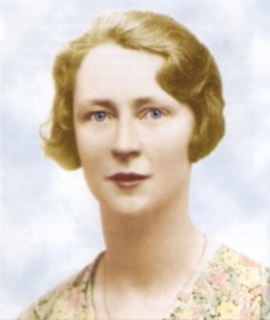
Edel Mary Quinn, Roman Catholic lay missionary and Envoy of the Legion of Mary to East Africa, is born in Castlemagner, County Cork, on September 14, 1907.
Quinn is the eldest child of bank official Charles Quinn and Louisa Burke Browne of County Clare. She is a great-granddaughter of William Quinn, a native of County Tyrone who settled in Tuam to build St. Mary’s Cathedral.
During Quinn’s childhood, her father’s career brought the family to various towns in Ireland, including Tralee, County Kerry, where a plaque is unveiled in May 2009 at Bank of Ireland House in Denny Street commemorating her residence there between 1921 and 1924. She attends the Presentation Convent in the town between 1921-1925.
Quinn feels a call to religious life at a young age. She wishes to join the Poor Clares but is prevented by advanced tuberculosis. After spending eighteen months in a sanatorium, her condition unchanged, she decides to become active in the Legion of Mary, which she joins in Dublin at the age of 20. She gives herself completely to its work in the form of helping the poor in the slums of Dublin.
In 1936, at the age of 29 and dying of tuberculosis, Quinn becomes a Legion of Mary Envoy, a very active missionary to East and Central Africa, departing in December 1936 for Mombasa. She settles in Nairobi having been told by Bishop Heffernan that this is the most convenient base for her work. By the outbreak of World War II, she is working as far off as Dar es Salaam and Mauritius. In 1941, she is admitted to a sanatorium near Johannesburg. Fighting her illness, in seven and a half years she establishes hundreds of Legion branches and councils in today’s Tanzania, Kenya, Uganda, Malawi, and Mauritius. John Joseph “J.J.” McCarthy, later Bishop of Zanzibar and Archbishop of Nairobi, writes of her:
“Miss Quinn is an extraordinary individual; courageous, zealous and optimistic. She wanders around in a dilapidated Ford, having for sole companion an African driver. When she returns home, she will be qualified to speak about the Missions and Missionaries, having really more experience than any single Missionary I know.”
All this time Quinn’s health is never good, and in 1943 she takes a turn for the worse, dying in Nairobi, Kenya of tuberculosis on May 12, 1944. She is buried there in the Missionaries’ Cemetery.
The cause for her beatification is introduced in 1956. She is declared venerable by Pope John Paul II on December 15, 1994, since when the campaign for her beatification has continued.
 seamus dubhghaill