
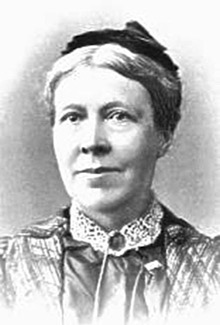
Anna Maria Haslam (née Fisher), a suffragist and a major figure in the 19th and early 20th century women’s movement in Ireland, is born in Youghal, County Cork, on April 6, 1829.
Fisher is the sixteenth of seventeen children to Jane and Abraham Fisher. The Fishers are a Quaker family with a business in Youghal. They are noted for their charitable works, especially during the Great Famine.
Fisher helps in soup kitchens and becomes involved in setting up cottage industries for local girls in lace-making, crocheting and knitting. She is brought up believing in equality for men and women and also supporting the campaign against slavery and for temperance and pacifism. She attends Quaker boarding schools, Newtown School in County Waterford and Castlegate School in York, England, which later becomes The Mount School, York. She then becomes a teaching assistant in Ackworth School, Yorkshire. She meets Thomas Haslam who is teaching there and who is from Mountmellick, County Laois. He is born into a Quaker family in 1825. He is a feminist theorist and from 1868 he write about many topics concerning female rights and issues such as prostitution, birth control and women’s suffrage.
Fisher and Haslam marry on March 20, 1854, in Cork Registry Office. Their marriage is mainly celibate as a result of them not wanting to have children. In later writings Thomas argues in favour of chastity for men. The couple shares a belief in equality for men and women and he supports her campaigns.
Both of the Haslams are expelled from the Society of Friends due to their interests in social reform but both maintain links with the community. Thomas is said to have been disowned for harbouring ideas contrary to Quaker teachings. In 1868, he publishes a pamphlet called “The Marriage Problem,” in which he raises and supports the idea of family limitation and outlines a number of contraceptive methods including the safe period. He dies on January 30, 1917, in his ninety-second year.
Haslam is best remembered today for her work for votes for women. She is a pioneer in every 19th century Irish feminist campaign and fights for votes for women from the year 1866. In 1872, she organises the “General Meeting of the members and friends of the Irish Society for Women’s Suffrage” in Blackrock, Dublin, which is chaired by George Owens and attended by MPs Maurice Brooks (a Home Ruler) and William Johnston (a northern Orangeman) and by the future Liberal Unionist Party MP Thomas Spring Rice, 2nd Baron Monteagle of Brandon. The Haslams are founding members of the Dublin Women’s Suffrage Association (DWSA) in 1876. This marks the start of a remarkable campaign in Dublin for votes for women. Haslam, along with the writing of her husband, continues the campaign and in 1896 women in Ireland win the right to be elected as Poor Law Guardians, members of the official bodies which administer the Poor Law. Ireland’s early women’s rights activists have a close relationship with their English correlatives and share the same discrimination in education, employment, sexual freedom and political participation. The DWSA organises the introduction of a private member’s bill to remove disqualification “by sex or marriage” for election or serving as a poor law guardian. The bill passes in 1896 and the association immediately writes to the newspapers and publishes leaflets explaining the process on how to register to vote and stand for election and encouraged qualified women to go forward as candidate.
By 1900, there are nearly 100 women guardians. Haslam then leads a campaign to encourage qualified women to stand for election in 1898. Women win eligibility to vote in local government elections, and to stand for elections as rural and urban district councillors. In 1913, she steps down as secretary of the Association and is elected life-president.
One of Haslam’s longest campaigns, working alongside the Belfast suffragist Isabella Tod, is for repeal of the Contagious Diseases Acts of 1864. The acts allow for state regulation of prostitutes in areas in which the army is stationed. The act permits compulsory internment of women for up to three months, which is later extended to one year. Medical treatment is also enforced on the women. The act seeks only to reduce the spread of sexually transmitted diseases among the military. She opposes the act as she feels it legitimises prostitution, commoditises women and undermines family life. It is finally repealed following eighteen years of campaigning.
Haslam is involved in the 1866 petition and gathers 1,499 signatures to extend suffrage to women as well as men. In 1867, male suffrage is extended but it is not until 1911 that the Suffrage movement achieves the significant victory of securing the right of women to stand for election as local councillors.
In 1918, a woman of almost ninety, Haslam goes to the polls “surrounded by flowers and flags,” with women who unite in her honour to celebrate the victory of the vote. This display of unity by activist women from all shades of political opinion acknowledge her role in the fight for the right to vote. The same year in which she dies, in 1922, the Irish Free State extends the vote to all men and women over the age of 21.
Haslam dies on November 28, 1922, at her home in Carlton Terrace, Dublin, of “cardiac dropsy” at the age of 93. She is buried next to her husband in the Quaker burying ground at the Friends Burial Ground in Temple Hill, Blackrock, Dublin.
A memorial seat to Anna and Thomas Haslam is erected in 1923 in St. Stephen’s Green, Dublin, with the inscription “in honour of their long years of public service chiefly devoted to the enfranchisement of women.”
Haslam’s name and picture, as well as those of 58 other women’s suffrage supporters, are on the plinth of the statue of Millicent Fawcett in Parliament Square, London, unveiled in 2018.

 seamus dubhghaill