seamus dubhghaill

Promoting Irish Culture and History from Little Rock, Arkansas, USA


Leave a comment

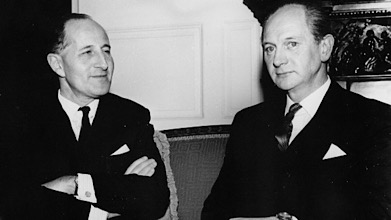
NI Prime Minister Terence O’Neill Meets Taoiseach Jack Lynch

Prime Minister of Northern Ireland Terence O’Neill calls on the Taoiseach Jack Lynch at Iveagh House in Dublin on January 8, 1968. There is no advance publicity, largely to ensure that Ian Paisley is not able to upstage the meeting with his antics. The dozen reporters present are impressed at the friendly informality.

”How are you, Jack?” O’Neill says as he gets out of the car, extending his hand to the Taoiseach.

O’Neill is accompanied by his wife, Jean, and a number of officials. They have lunch in Iveagh House with the Taoiseach and his wife, Maureen, together with a number of official staff, and five of Lynch’s cabinet colleagues and their wives. The ministers are Tánaiste Frank Aiken, Minister for Finance Charles Haughey, Minister for Industry and Commerce George Colley, Minister for Agriculture and Fisheries Neil Blaney, and Minister for Transport and Power Erskine Childers.

The official statement at the end of the four-hour meeting states that progress has been made in “areas of consultation and co-operation.” The Taoiseach says they discussed industry, tourism, electricity supply, and trade, as well as tariff concessions, and “measures taken by both governments to prevent the spread of foot-and-mouth disease from Britain.”

Afterward, O’Neill returns to Northern Ireland by a different route in order to avoid any possible demonstration. Paisley has been developing a high profile for himself with his attacks on O’Neill in recent months. But he misses the opportunity to protest on this occasion. The next day he issues a statement regretting O’Neill’s return home. “I would advise Mr. Lynch to keep him,” Paisley announces.

Five years earlier, in 1963, O’Neill becomes Prime Minister of Northern Ireland. From very early on, he tries to break down sectarian barriers between the two Northern communities. He also seeks to improve relations with the Republic of Ireland by eradicating the impasse in relations that has existed since the 1920s. He invites then-Taoiseach Seán Lemass to meet him at Stormont on January 14, 1965. Lemass courageously accepts the invitation. At their initial meeting, when they are briefly alone, Lemass says to O’Neill, ”I shall get into terrible trouble for this!” The Northern premier replies, ”No, Mr. Lemass, it is I who will get into terrible trouble.”

O’Neill makes his return visit to Dublin on February 9, 1965, and the two leaders agree to co-operate on tourism and electricity. It is Lemass who makes the most significant concessions, because the Constitution of Ireland does not recognise the existence of the North. Article 2 of the Constitution actually claims sovereignty over the whole island. Thus, by formally meeting the Prime Minister of Northern Ireland, O’Neill claims that Lemass accorded him “a de facto recognition.”

The Taoiseach then bolsters this at their follow-up meeting in Iveagh House, Dublin, three weeks later. ”The place card in front of me at Iveagh House bore the inscription, Prime Minister of Northern Ireland,” O’Neill proudly explains. Surely this is tantamount to formal recognition. But many Unionists still have grave reservations about dealing with the Republic of Ireland.

In 1966, Ian Paisley establishes the Protestant Unionist Party (PUP) to oppose O’Neill. He rouses sectarian tension by holding mass demonstrations at which he brands O’Neill as the “Ally of Popery.” Nevertheless, public opinion polls indicate support for O’Neill’s leadership from both communities in the North.

After Jack Lynch replaced Lemass as Taoiseach in late 1966, O’Neill continues with his efforts to improve relations with the Dublin government by inviting Lynch to Stormont Castle. The Taoiseach travels to Belfast by car on December 11, 1967. There is no formal announcement of his visit, but word is leaked to Paisley after the Taoiseach’s car crosses the border.

Paisley arrives at Stormont with his wife and a handful of supporters, just minutes before the Taoiseach. With snow on the ground, two of Paisley’s church ministers, Rev. Ivan Foster and Rev. William McCrea, begin throwing snowballs at Lynch’s car. The Royal Ulster Constabulary (RUC) promptly grabs the two ministers. While they are being bundled into a police car, Paisley is bellowing, “No Pope here!” Lynch asks his traveling companion, T. K. Whitaker, “Which one of us does he think is the Pope?”

Paisley demands to be arrested by the RUC, and actually tries to get into the police car with his two colleagues, but he is pulled away. The two clergymen are taken to an RUC station and quickly released. Lynch ridicules the protest. “It was a seasonal touch,” he says. “It reminds me of what happens when I go through a village at home and the boys come and throw snowballs.”

Paisley says he had come to protest against “the smuggling” of Lynch into Stormont. If he had known about the visit earlier, he says that he would have brought along 10,000 people to protest. Denouncing O’Neill, as a “snake in the grass,” he goes on to accuse Lynch of being “a murderer of our kith and kin.” In an editorial, the Unionist Newsletter proclaims that ”there is no doubt that Capt. O’Neill has the full support of his colleagues and of the country.”

O’Neill’s four formal meetings with Lynch and his predecessor contribute to a thaw in relations at the summit between Belfast and Dublin, but the whole process is exploited by others to fan the flames of Northern sectarianism.

People do not realise it in early 1968, but Northern Ireland is about to explode. On October 5, 1968, people gather in Derry for a civil rights march that has been banned by Stormont. When the march begins, it is viciously attacked by the RUC. This ignites a series of further protests, which ultimately leads to Bloody Sunday, and the eruption of the Troubles for the next quarter of a century.

(From: “Meetings helped thaw relations before the North exploded,” Irish Examiner, http://www.irishexaminer.com, January 8, 2018)

Leave a comment

Sinn Féin Joins Northern Ireland Peace Process

Sinn Féin, the political wing of the Irish Republican Army (IRA), joins the Northern Ireland peace process on September 9, 1997 that aims to determine the future of Northern Ireland, after renouncing violence as a political tool.

The move paves the way for Sinn Féin’s first face-to-face talks with British Cabinet ministers since 1921, when the country was partitioned. Sinn Féin leader Gerry Adams, chief negotiator Martin McGuinness and party secretary Lucilita Bhreatnach agree behind closed doors at Stormont Castle in east Belfast to abide by the guiding principles underlying the Northern Ireland all-party talks.

These principles were set up in January 1996 by former United States Senator George J. Mitchell, former Canadian Chief of the Defence Staff Gen. John de Chastelain and former Prime Minister of Finland Harri Holkeri. They are generally referred to as the “Mitchell Principles,” and require negotiators to affirm their commitment to the tenets listed below:

  • Democratic and peaceful means of resolving political issues. Total disarmament of all paramilitary organizations. The disarmament must be verifiable to the satisfaction of an independent commission.
  • Renounce for themselves and oppose any effort by others to use force or threaten to use force to influence the course or outcome of all-party negotiations.
  • Abide by the terms of any agreement reached in all-party negotiations and to resort to democratic and exclusively peaceful methods in trying to alter any aspect of that outcome with which they may disagree.
  • Urge that “punishment” killings and beatings stop, and take effective steps to prevent such actions.

Sinn Féin pledges to honor the Mitchell Principles exactly 51 days after the IRA stopped its decades-old violent campaign against British rule of Northern Ireland. “This is a watershed. There is an expectation and understanding out there of the importance of this moment,” Adams says.

Paul Murphy, minister for political development in the province, says the Sinn Féin pledge marks a new phase in the peace process. “The significance I am sure is that we are now entering a new era … in the sense that the gun is going out of politics in Northern Ireland and that here Sinn Féin is ascribing to those principles of nonviolence, of democratic government.”

“I believe people outside these buildings, outside Stormont, are of the view that enough is enough, and that change must come,” Murphy adds. “But that change must be change which encompasses everybody’s aspirations and which will last for generations.”

The pledge to honor the Mitchell Principles means that the ten parties involved can proceed with round-table talks on the future of Northern Ireland on Monday, September 15, as planned.

However, two mainstream Protestant parties that favor continued British rule of Northern Ireland, the Democratic Unionist Party (DUP) and the UK Unionist Party (UKUP), plan to boycott the talks. In addition, the powerful Ulster Unionist Party (UUP), is expected to decide on Saturday, September 13, whether to attend the crucial new round of negotiations.

In a statement, the Ulster Unionists call Sinn Féin’s commitment “a charade.” “The subscription of Sinn Féin to the Mitchell Principles will completely lack credibility. Actions matter much more than words,” the statement says.

The London and Dublin governments agree that sovereignty in Northern Ireland can only be changed through the ballot box. While Protestants generally are determined to remain British, most Catholics favor making Northern Ireland part of Ireland.

(From: “Sinn Fein gains access to Northern Ireland talks” on CNN.com, http://www.cnn.com, September 9, 1997)


Leave a comment

Trimble Rejects Power Sharing Compromise

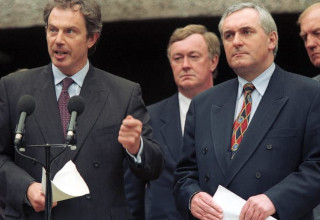
blair-ahern-stormont-castle-1999On July 14, 1999, Ulster Unionists under David Trimble reject a compromise for the creation of a power sharing government placing the Northern Ireland peace process in grave trouble. The proposals would have seen inclusive self-government introduced in Northern Ireland on Sunday, July 18, 1999.

Early in the day the government rushes legislation through the House of Commons providing for the suspension of the Executive if the Irish Republican Army (IRA) fails to decommission all its arms by May 2000 in line with a timetable, yet to be drawn up. It refuses to accept any Ulster Unionist amendments. But within 12 hours, British Prime Minister Tony Blair signals that three new amendments will be included to tighten the so-called failsafe mechanism when the bill is debated in the House of Lords in the evening.

The first amendment makes clear that decommissioning must proceed in line with a timetable to be drawn up by General John de Chastelain. The second provides for the automatic suspension of the Executive, while the third provides for the party in default to be clearly identified.

They fail to sway Trimble, who criticises The Way Forward as a hastily concocted scheme. However, he does leave the door open for further negotiations to save the agreement. “If there was a clear watertight scheme, in which there was at the outset an unequivocal commitment to change and a process that genuinely guaranteed to deliver that change, we would have to consider whether a scruple over a period of days could be justified.”

Sinn Féin is furious with party president Gerry Adams saying, “Those who may genuinely want to deal with the issue of guns are going about it in absolutely the worst and wrong way.” The party wants the assembly to be wound up immediately, and all members’ wages to be stopped. It wants the British and Irish governments to continue to implement all aspects of the agreement which are within their control. Adams is enraged by Blair’s move to amend the failsafe legislation. His party says it will consider applying for judicial review of the amended bill, believing it to compromise the International Commission on Decommissioning and unlawfully conflict with the agreement.

Blair and Taoiseach Bertie Ahern announce on the following day that the 15-month-old and ailing Good Friday Agreement will go into a review procedure involving all the political parties and be effectively parked over the summer.

Trimble, leader of the Ulster Unionists, resists intense government pressure as he refuses to back the British and Irish governments’ blueprint providing for a power-sharing executive the following week and IRA decommissioning in the summer. He repeats his party’s view that Sinn Féin can only join his cabinet once the IRA has started to hand over its weapons.

The outcome is a bitter personal setback for Blair. In a last-minute televised appeal to the Unionists not to “close the door’ on an agreement, he appears to acknowledge that they will have to try to find another way forward. “I believe in the end we will get an agreement on this. Whether we manage it by tomorrow morning, that is more difficult,” he says.

Trimble complains he had too little time to secure backing within his split party for The Way Forward, which the governments issued twelve days earlier after a week of intense negotiations at Stormont Castle. Blair’s handling of the affair is questioned.

Trimble’s problem with the legislative failsafe is that it punishes all parties for an IRA transgression of a decommissioning timetable, yet to be drawn up. It provides for the executive to be suspended, rather than carry on with Sinn Féin’s two ministerial posts allocated to other parties. The nationalist Social Democratic and Labour Party (SDLP), which could have given Trimble cover on the issue of expulsion, declines to say whether it will vote for Sinn Féin’s expulsion, which infuriates Ulster Unionists.

Negotiations to save the Good Friday Agreement have gone through four deadlines during the year. There are fears that the latest delay might lead to Sinn Féin withdrawing its declaration on IRA arms.

(Pictured: British Prime Minister Tony Blair and Taoiseach Bertie Ahern present a joint British-Irish blueprint for implementation of the Good Friday Agreement at Stormont Castle in Belfast, June 2, 1999 | Sean Gallup | Getty Images)