seamus dubhghaill

Promoting Irish Culture and History from Little Rock, Arkansas, USA


Leave a comment

Death of Pat McDonald, Irish American Track & Field Athlete

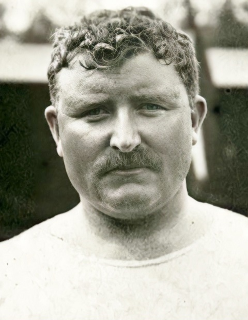
Patrick Joseph McDonald, Irish American track and field athlete, dies in New York City on May 16, 1954. He is a member of the Irish American Athletic Club and of the New York City Police Department, working as a traffic cop in Times Square for many years. He is also part of a group of Irish American athletes known as the “Irish Whales.”

McDonald was born Patrick Joseph McDonnell in Killard, County Clare, on July 29, 1878. When his sister lands at Ellis Island after her sea voyage from Ireland, immigration officials pin a name tag on her with her name spelled “McDonald.” Taking no chances of being deported, she and all the McDonnells who come after her, accept the name McDonald.

Inspired by the feats of his countrymen John Flanagan, Matt McGrath, and Martin Sheridan, McDonald initially has aspirations of becoming a hammer thrower but shows more aptitude as a shot putter. After placing second to Ralph Rose at the USA Outdoor Track and Field Championships in 1909 and 1910, he takes the title in Rose’s absence in 1911 and defeats Rose at the 1912 championships.

McDonald competes for the United States in the 1912 Summer Olympics held in Stockholm, Sweden, in the shot put where he once again defeats Rose and wins the gold medal. He also takes part in the shot put competition where the distance thrown with each hand is added together. This is the only time this event is held in the Olympic program, and he finishes second behind Rose.

McDonald returns eight years later, after World War I, to compete in the 1920 Summer Olympics in Antwerp, Belgium. Here he wins the gold medal in the 56-lb. weight throw in the second and final time this competition is held in the Olympic program.

McDonald continues to be a nationally competitive athlete well into his 50s. At the age of 54, he beats his old rival Matt McGrath to win the weight throw for distance at the 1933 USA Outdoor Track and Field Championships. It is his 26th senior national championship meet, and the Omaha World-Herald notes that he has gray hair at the time of his last victory.

McDonald dies in New York City at the age of 75 on May 16, 1954. He is interred at Gate of Heaven Cemetery in Hawthorne, New York.

McDonald is inducted into the National Track and Field Hall of Fame in 2012.

Leave a comment

Birth of George M. Cohan

george-m-cohan

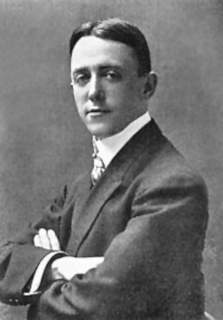
George Michael Cohan, legendary song and dance man, is born to Irish Catholic parents in Providence, Rhode Island on July 3, 1878.

A baptismal certificate from St. Joseph’s Roman Catholic Church indicates that Cohan was born on July 3, but Cohan and his family always insist that he had been “born on the Fourth of July!” His parents are traveling vaudeville performers, and he joins them on stage while still an infant, first as a prop, learning to dance and sing soon after he could walk and talk. As a child, he and his family tour most of the year and spend summer vacations from the vaudeville circuit at his grandmother’s home in North Brookfield, Massachusetts.

In 1904 Cohan produces his first successful musical play, Little Johnny Jones, in which he plays the character The Yankee Doodle Boy. As a songwriter, he is a charter member of the American Society of Composers, Authors and Publishers (ASCAP). His popular song catalog includes “The Yankee Doodle Boy,” “Venus, My Shining Love,” “I Guess I’ll Have to Telegraph My Baby,” “My Musical Comedy Maid,” “Revolutionary Rag,” “Give My Regards to Broadway,” “You Remind Me of My Mother,” “Life’s a Funny Proposition After All,” “Mary’s a Grand Old Name,” “So Long, Mary,” “Forty-Five Minutes from Broadway,” “I Was Born in Virginia,” “Harrigan,” “Over There” (the song of World War I which earns Cohan the Congressional Medal of Honor), “In the Kingdom of Our Own,” “Nellie Kelly, I Love You,” “When June Comes Along With a Song,” “Molly Malone,” “Where Were You, Where Was I?,” “The Song and Dance Man,” “Billie” and the patriotic theme song and 2002 Towering Song Award winner, “You’re a Grand Old Flag.”

The more than 40 musical dramas Cohan writes, produces, directs and stars in on Broadway include The Governor’s Son, Forty-Five Minutes from Broadway, Little Johnny, George Washington, Jr., The Honeymooners, The Yankee Prince, The Little Millionaire, Hello, Broadway, The Talk of New York, Fifty Miles From Boston, The American Idea, The Man Who Owns Broadway, The Cohan Revue (1916, 1918), The Royal Vagabond, The Merry Malones, Little Nellie Kelly, The Rise of Rosie O’Reilly, Get-Rich-Quick Wallingford, Seven Keys to Baldpate, The Miracle Man, Hit the Trail Hailday, Broadway Jones, A Prince There Was, The Song and Dance Man, American Born, Gambling, Dear Old Darling, The Return of the Vagabond, The Tavern, Elmer the Great, The O’Brien Girl, Ah, Wilderness! and I’d Rather Be Right.

In 1942, Cohan’s life is documented in the film Yankee Doodle Dandy.

George M. Cohan dies of cancer at his Manhattan apartment on Fifth Avenue on November 5, 1942, surrounded by family and friends. His funeral is held at St. Patrick’s Cathedral in New York and is attended by thousands of people, including five governors of New York, two mayors of New York City and the Postmaster General. The honorary pallbearers included Irving Berlin, Eddie Cantor, Frank Crowninshield, Sol Bloom, Brooks Atkinson, Rube Goldberg, Walter Huston, George Jessel, Connie Mack, Joseph McCarthy, Eugene O’Neill, Sigmund Romberg, Lee Shubert and Fred Waring. He is interred at Woodlawn Cemetery in The Bronx, New York City, in a private family mausoleum he had erected a quarter century earlier for his sister and parents.

On September 11, 1959, Oscar Hammerstein II presents an eight-foot high, bronze statue of Cohan in the heart of Times Square on Broadway.


Leave a comment

Death of Patrick Sarsfield Gilmore, Composer & Bandmaster

patrick-sarsfield-gilmore

Patrick Sarsfield Gilmore, Irish-born American composer and bandmaster, dies in St. Louis, Missouri, on September 24, 1892. He lives and works in the United States after 1848. While serving in the Union Army during the American Civil War, Gilmore writes the lyrics to the song When Johnny Comes Marching Home, the tune taken from the old Irish antiwar folk song, Johnny I Hardly Knew Ye. This is published under the name Louis Lambert.

Gilmore is born in Ballygar, County Galway, on December 25, 1829. He starts his music career at age fifteen and spends time in Canada with an English band. Already a fine cornet player, he settles in Boston, Massachusetts in 1848, becoming leader of the Suffolk, Boston Brigade, and Salem bands in swift succession. He also works in the Boston music store of John P. Ordway and founds Ordway’s Aeolians, a group of blackface minstrels. With the Salem Band, Gilmore performs at the 1857 inauguration of President James Buchanan.

In 1858, Gilmore founds “Gilmore’s Band,” and at the outset of the American Civil War the band enlists with the 24th Massachusetts Volunteers, accompanying General Ambrose Burnside to North Carolina. After the temporary discharge of bands from the field, Governor John Albion Andrew of Massachusetts entrusts Gilmore with the task of re-organizing military music-making. General Nathaniel P. Banks creates him Bandmaster-general.

When the war ends, Gilmore is asked to organize a celebration, which takes place in New Orleans. That success emboldens him to undertake two major music festivals in Boston, the National Peace Jubilee in 1869 and the World’s Peace Jubilee and International Musical Festival in 1872. These feature monster orchestras of massed bands with the finest singers and instrumentalists, including the only American appearance by “waltz king” Johann Strauss II, and cements Gilmore’s reputation as the leading musical figure of the age. Coliseums are erected for the occasions, holding 60- and 120,000 persons. Grateful Bostonians present Gilmore with medals and cash, but in 1873 he moves to New York City, as bandmaster of the 22nd Regiment. Gilmore takes this band on acclaimed tours of Europe.

On September 24, 1892, back in the United States preparing an 1892 musical celebration of the quadricentennial anniversary of Christopher Columbus‘ voyage of discovery, Gilmore collapses and dies in St. Louis. He is buried in Calvary Cemetery, Queens, New York, where his wife is later interred.

In many ways Gilmore can be seen as the principal figure in 19th-century American music. He holds the first “Promenade Concert in America” in 1855, the forerunner to today’s Boston Pops. He sets up “Gilmore’s Concert Garden,” which becomes Madison Square Garden. He is the Musical Director of the Nation in effect, leading the festivities for the 1876 Centennial celebrations in Philadelphia and the dedication of the Statue of Liberty in 1886. In 1888 he starts the tradition of seeing in the New Year in Times Square.

Patrick Sarsfield Gilmore is inducted into the Songwriters Hall of Fame in 1970.