seamus dubhghaill

Promoting Irish Culture and History from Little Rock, Arkansas, USA


Leave a comment

Death of Francis McCloskey, First Fatality of “The Troubles”

the-troubles

Francis McCloskey, a 67-year-old Catholic civilian, dies on July 14, 1969, one day after being hit on the head with a baton by an officer of the Royal Ulster Constabulary (RUC) during street disturbances in Dungiven, County Derry. McCloskey is sometimes considered to be the first fatality of The Troubles.

McCloskey is found unconscious on July 13 near the Dungiven Orange Hall following a police baton charge against a crowd who had been throwing stones at the hall. Witnesses later say they had seen police beating a figure with batons in the doorway where McCloskey is found, although police claim he had been unconscious before the baton charge and may have been hit with a stone.

The Troubles is the common name for the ethno-nationalist conflict in Northern Ireland that begins in the late 1960s and is deemed by most to end with the Good Friday Agreement of 1998. Although the Troubles mainly take place in Northern Ireland, violence spills over at times into parts of the Republic of Ireland, England, and mainland Europe.

The conflict is primarily political, but it also has an ethnic or sectarian dimension, although it is not a religious conflict. A key issue is the constitutional status of Northern Ireland. Unionists and loyalists, who are mostly Protestants and consider themselves British, generally want Northern Ireland to remain within the United Kingdom. Irish nationalists and republicans, who are mostly Catholic and consider themselves Irish, generally want it to leave the United Kingdom and join a united Ireland. The conflict begins amid a campaign to end discrimination against the Catholic/nationalist minority by the Protestant/unionist government and police force in 1968. The campaign is met with violence, eventually leading to the deployment of British troops and subsequent warfare.

The main participants in the Troubles are republican paramilitaries such as the Provisional Irish Republican Army (IRA) and Irish National Liberation Army (INLA), loyalist paramilitaries such as the Ulster Volunteer Force (UVF) and Ulster Defence Association (UDA), the British Army and Royal Ulster Constabulary (RUC), and political activists and politicians. The security forces of the Republic of Ireland play a smaller role. More than 3,500 people are killed in the conflict, of whom 52% were civilians, 32% are members of the British security forces, and 16% are members of paramilitary groups. There has been sporadic violence since the signing of the Good Friday Agreement, including a campaign by anti-ceasefire republicans.


Leave a comment

Twelfth of July

the-twelfth

The Orange Order holds its first “Twelfth of July” marches in Portadown, Lurgan and Waringstown on July 12, 1796. The Twelfth marches celebrate the Glorious Revolution (1688) and victory of Protestant king William of Orange over Catholic king James II at the Battle of the Boyne (1690), which begins the Protestant Ascendancy in Ireland.

On and around the Twelfth, large parades are held by the Orange Order and Ulster loyalist marching bands, streets are bedecked with British flags and bunting, and large, towering bonfires are lit. Today the Twelfth is mainly celebrated in Northern Ireland, where it is a public holiday, but smaller celebrations are held in other parts of the world where Orange lodges have been set up, including the Canadian province of Newfoundland where it is a provincial holiday. The Twelfth involves thousands of participants and spectators, although not all Protestants celebrate it.

In Northern Ireland, where almost half the population is from an Irish Catholic background, The Twelfth is a tense time. Orange marches through Irish Catholic and Irish nationalist neighbourhoods are usually met with opposition from residents, sometimes leading to violence. Public disorder during The Twelfth parades of the early 19th century led to them being banned in the 1830s and 1840s.

Many Catholics and Irish nationalists see the Orange Order and its marches as sectarian, triumphalist, and supremacist. The Order is also politically a unionist/loyalist organization. Violence related to the Twelfth in Northern Ireland worsens during the 30-year ethno-political conflict known as The Troubles. The Drumcree conflict is the most well-known dispute involving Orange marches.

Attempts have recently been made to downplay the political aspects of the marches and present the Twelfth as a cultural, family-friendly event at which tourists are welcome. Although most events pass off peacefully, some continue to result in violence.


Leave a comment

The Springhill Massacre

springhill-massacre

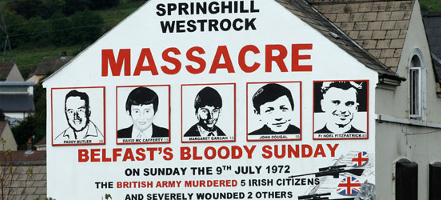
The Springhill Massacre, a shooting incident which claims five lives in the Springhill estate in west Belfast, takes place on July 9, 1972. Three civilians, including a Catholic priest, and two members of Fianna Éireann are shot dead by British Army snipers firing from a timber yard.

The Northern Ireland Troubles have been raging for three years and hundreds have already been killed by the two warring factions in Northern Ireland, unionists, including Ulster loyalists and the British Army, and Irish republicans wanting unification with the Republic of Ireland. Violence has been taking place all day and the five dead are part of ten people killed on that day.

According to a Provisional Irish Republican Army (IRA) statement on July 10, British Army snipers take up sniping positions in Corry’s timber yard and reinforced them with sandbags. Two cars pull into Springhill and the snipers fire two shots at them. One of the cars flees while the other drives a short distance and stops. The occupants get out and the snipers open fire again, seriously wounding one with a shot in the back of the head. A resident rushes to help the injured man but is immediately shot in the arm. This man’s brother and a friend run to the downed occupant, but both are shot by the snipers. At some point during this time a 13-year-old girl is fatally shot by the snipers. The parish priest, waving a white cloth, and a passer-by rush to her but a sniper kills both with a single bullet that passes through both their heads. All of the victims are unarmed.

The British Army disputes the IRA’s version of events and claims its troops were fired on first by the IRA, ending a temporary IRA ceasefire. A British Army spokesman states, “There has been a heavy exchange of fire between the IRA and troops. Some of the dead and wounded were undoubtedly caught in the crossfire.” On July 10, the British Army claims that it has killed terrorists. An open verdict is recorded at the inquest into the events.

No British soldier has been held accountable for these murders.