seamus dubhghaill

Promoting Irish Culture and History from Little Rock, Arkansas, USA


Leave a comment

Birth of William Edward Hartpole Lecky, Historian & Theorist

William Edward Hartpole Lecky, Irish historian and political theorist, is born at Newtown Park, near Dublin, on March 26, 1838. His major work is an eight-volume History of England during the Eighteenth Century.

Lecky is educated at Kingstown, Armagh, at Cheltenham College, and at Trinity College, Dublin, where he graduates BA in 1859 and MA in 1863, and where he studies divinity with a view of becoming a priest in the Church of Ireland.

In 1860, Lecky publishes anonymously a small book entitled The Religious Tendencies of the Age, but upon leaving college he turns to historiography. In 1861 he publishes Leaders of Public Opinion in Ireland, containing brief sketches of Jonathan SwiftHenry FloodHenry Grattan, and Daniel O’Connell, originally anonymous and republished in 1871. The essay on Swift, rewritten and amplified, appears again in 1897 as an introduction to an edition of Swift’s works. Two surveys follow: A History of the Rise and Influence of Rationalism in Europe (2 vols., 1865), and A History of European Morals from Augustus to Charlemagne (2 vols., 1869). The latter arouses criticism, with its opening dissertation on “the natural history of morals.”

Lecky then concentrates on his major work, A History of England during the Eighteenth Century, Vols. i. and ii. which appear in 1878, and Vols. vii. and viii., which complete the work, in 1890. In the “cabinet” edition of 1892, in twelve volumes, A History of Ireland in the Eighteenth Century is separated out.

A volume of Poems (1891) is less successful. In 1896, he publishes two volumes entitled Democracy and Liberty, in which he considers modern democracy. The pessimistic conclusions at which he arrives provoked criticism both in the UK and the United States, which is renewed when he publishes in a new edition (1899) his low estimate of William Ewart Gladstone, then recently dead.

In The Map of Life (1899) Lecky discusses in a popular style ethical problems of everyday life. In 1903 he publishes a revised and enlarged edition of Leaders of Public Opinion in Ireland, in two volumes, with the essay on Swift omitted and that on O’Connell expanded into a complete biography. A critic of the methods by which the Act of Union is passed, Lecky, who grew up as a moderate Liberal, is opposed to Gladstone’s policy of Home Rule and, in 1895, he is returned to parliament as Unionist member for University of Dublin constituency in a by-election. In 1897, he is made a privy councillor, and among the coronation honours in 1902, he is nominated an original member of the new Order of Merit.

William Edward Hartpole Lecky dies in London on October 22, 1903.

Leave a comment

Dáil Éireann Approves the Anglo-Irish Treaty

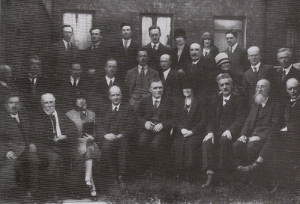
second-all-ireland-dail

Dáil Éireann votes to approve the Anglo-Irish Treaty on January 7, 1922, following a debate through late December 1921 and into January 1922. The vote is 64 in favour, 57 against, with the Ceann Comhairle and three others not voting. The Sinn Féin party splits into opposing sides in the aftermath of the Treaty vote, which leads to the Irish Civil War from June 1922 until May 1923. The treaty is signed in London on December 6, 1921.

Two elections take place in Ireland in 1921, as a result of the Government of Ireland Act 1920 to establish the House of Commons of Northern Ireland and the House of Commons of Southern Ireland. The election is used by the Irish Republic as the basis of membership of the Second Dáil. The general election to the Northern Ireland House of Commons occurs on May 24, 1921. Of 52 seats, forty are won by unionists, six by moderate Irish nationalists, and six by Sinn Féin. No actual polling takes place in the Southern Ireland constituencies, as all 128 candidates are returned unopposed. Given the backdrop of the increasingly violent War of Independence, any candidates opposed to Sinn Féin, and their supporters can expect to be harassed by the Irish Republican Army (IRA). Supporters of the Irish Labour Party stand aside to allow the constitutional situation to run its course. Of these 128, 124 are won by Sinn Féin, and four by independent unionists representing the University of Dublin constituency. Only the Sinn Féin candidates recognise the Second Dáil and five of these have been elected in two constituencies, one in each part of Ireland, so the total number of members who assemble in the Second Dáil is 125.

During the Second Dáil, the government of the Irish Republic and the British government of David Lloyd George agree to hold peace negotiations. On September 14, 1921, the Dáil ratifies the appointment of Arthur Griffith, Michael Collins, Robert Barton, Eamonn Duggan, and George Gavan Duffy as envoys plenipotentiary for the peace conference in England. These envoys eventually sign the Anglo-Irish Treaty on December 6. After almost a month of acrimonious debate the treaty is formally ratified by Dáil Éireann on January 7, 1922.

To satisfy the requirements of the British constitution, the treaty also has to be ratified by the House of Commons of Southern Ireland. Thus, Irish nationalists end their boycott of the home rule parliament to attend the southern House of Commons as MPs. This they do alongside the four Unionist MPs who had refused to recognise the Dáil. In this way the treaty is ratified a second time in Dublin, this time unanimously as the anti-Treaty TDs refuse to attend.

Under the terms of the Anglo-Irish Treaty a provisional parliament, considered by nationalists to be the Third Dáil, is elected in the 1922 general election on June 16. Collins and Éamon de Valera agree a pact between the pro- and anti-Treaty wings of Sinn Féin, and this pact and the elections are endorsed by the Second Dáil. The new assembly is recognised both by nationalists and the British Government and so replaces both the Parliament of Southern Ireland and the Second Dáil with a single body. The anti-Treaty groups of IRA members, TDs, and their supporters are still bitterly opposed the settlement, despite the election result, and this leads to the Irish Civil War.

(Pictured: Second All-Ireland Dáil Éireann, elected in 1921)