While at West Ham, Cantwell features in the London XI side that competes in the 1955–58 Inter-Cities Fairs Cup final on May 1, 1958. He captains the Hammers to winning the Division Two championship in the 1957–58 season thereby leading the club into the topflight for the first time since 1932.
In November 1960, Cantwell joins Manchester United for £29,500 which at the time is a record for a full-back. He helps the club win the 1965 and 1967 league titles and captains United when winning the 1963 FA Cup Final – just as his fellow countryman Johnny Carey had done in United’s previous FA Cup win fifteen years earlier.
During his International career (1953-67), Cantwell wins 36 full International caps for the Republic of Ireland, typically playing at left full-back and on several occasions at centre-forward. He makes his debut against Luxembourg in October 1953, with his final appearance coming away to Turkey in February 1967. He scores fourteen goals including five from penalties and also captains the Republic on several occasions including a match against England at Wembley Stadium.
In his first managerial role at Coventry City, Cantwell has the onerous task of following Jimmy Hill who had taken the club into the First Division for the first time in their history. He narrowly keeps the Sky Blues in the top in his first two seasons before taking them to a sixth-place finish in 1969–70, earning them qualification for the Inter-Cities Fairs Cup (a year before it is replaced by the UEFA Cup).
Cantwell returns to Peterborough on November 19, 1986, for a second stint as manager, remaining in this role until he becomes general manager on July 12, 1988. He is general manager at London Road for a year until he quits football to become licensee of the New Inn at Peterborough, where he remains for ten years until he retires in 1999. He also is landlord of the Bull and Swan in Stamford, Lincolnshire.
Cantwell also plays cricket for Cork Bohemians Cricket Club and Ireland as a left-handed batsman and a right-arm medium bowler. He plays five times for Ireland, making his debut in what is his sole first-class match versus Scotland at Edinburgh in 1956, scoring 31 and 17. His last match for Ireland is against Lancashire in July 1959.
Cantwell dies from cancer at Addenbrooke’s Hospital, Cambridge, not far from his home in Peterborough, on September 8, 2005. He is survived by his wife Maggie, a native of Belfast, and two daughters, Liz and Kate. A 22-year-old son, John Robert, is killed in a car crash thirteen years earlier.
Cantwell’s former teams each hold a moment of silence for him before their next matches.
Heighway’s early education takes place in Sheffield, South Yorkshire, where he attends Ecclesall Junior School until 1959, followed by High Storrs School and latterly Moseley Hall Grammar School for Boys in Cheadle, near Stockport.
Heighway’s early promise as a winger is not spotted by professionals. Instead, he concentrates on his studies in economics and politics at the University of Warwick in Coventry achieving a 2:1.
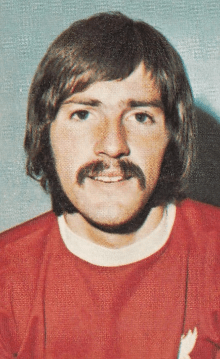
In 1970, Heighway is studying for his final exams and playing for Skelmersdale United F.C. when he is spotted by Liverpool’s scouting system. With manager Bill Shankly keen to rebuild his ageing, underachieving team of the 1960s, Heighway is signed up swiftly in May of that year. It is due to his academic achievements that he gets his nickname “Big Bamber,” while teammate and fellow university graduate Brian Hall is dubbed “Little Bamber” – both after the television programme University Challenge host Bamber Gascoigne.
A strong and fast left winger with two good feet, Heighway settles into topflight football after making his debut on September 22, 1970, in a League Cup 2nd round replay at Anfield against Mansfield Town F.C. (3-2). He opens his goalscoring account in the 51st minute of a 2–0 home league win over Burnley F.C. on October 1, 1970.
A month later, Heighway scores against Merseyside rivals Everton F.C. in a hard-fought 3–2 win, after his team had found themselves down 2–0 early in the second half. He stays in the side for the rest of the season as Liverpool’s new charges finish the league campaign strongly and also defeat Everton in the semi-finals of the FA Cup to reach the final at Wembley Stadium.
Their opponents are Arsenal F.C., who are after a coveted “double” having won the Football League First Division championship. Heighway plays confidently in a match that is goalless after 90 minutes and therefore needs a period of extra-time. Just two minutes into the added half-hour, he receives the ball wide on his left flank from substitute Peter Thompson and starts a run toward the Arsenal penalty area, with Gunners full back Pat Rice tracking his run but unwilling to put in a tackle. With a swift turn outside, he gains a yard on Rice and hits a low drive into the net past Arsenal goalkeeperBob Wilson, who had committed the cardinal goalkeeping sin of coming out too far from his near post to anticipate a cross, thereby leaving a gap that Heighway exploits. Sadly, for Heighway and Liverpool, their opponents scored two goals in response.
Heighway settles into the Liverpool team for the next decade, winning the first of four League titles in 1973, along with the UEFA Cup. He returns to Wembley for another FA Cup final a year later as Liverpool faces Newcastle United F.C. He scores again with 16 minutes remaining in the match to make the score 2–0, latching on to a flick from John Toshack after a long clearance from goalkeeper Ray Clemence to slot a right-footed shot into the far corner. The game ends 3–0.
By now, Heighway is a regular for the Republic of Ireland national football team, making his debut on September 23, 1970, against the Poland national football team. He remains so for the whole of the 1970s, winning a total of 34 caps but never managing to score. He does have a goal disallowed in a qualifier for the 1978 FIFA World Cup against the Bulgaria national football team in Sofia. On the domestic front, he attains another League and UEFA Cup double with Liverpool in 1976 and then forms part of the side which comes so close to the “treble” of League, FA Cup and European Cup.
Liverpool wins the League by a single point and again defeats rivals Everton in the semi-final to reach the FA Cup final, this time to face bitter rival Manchester United F.C. at Wembley. Liverpool loses 2–1 and the “treble” dream is dead.
Heighway scores his first goal of the 1977 European Cup in a 5–0 first round second leg win over Crusaders F.C. He then scores in a 3–0 second round win against Trabzonspor and in the 3–1 semi-final first leg win over FC Zürich. Liverpool beats Borussia Mönchengladbach 3–1 to win their first European Cup, with Heighway setting up both outfield goals for Terry McDermott, a defence-splitting pass, and Tommy Smith, a corner.
In 1978, Heighway is on the bench as Liverpool retains the European Cup with a 1–0 victory over Club Brugge KV at Wembley, coming on as a substitute for Jimmy Case. The following year he is again in the side frequently as Liverpool wins another League title, but from 1980 onward his opportunities in the side diminish.
Heighway stays for two more seasons, appearing only occasionally in the team and missing out on two more League title medals, another European Cup triumph and a first EFL Cup medal, which is successfully defended a year later. He leaves Anfield in 1982 after 444 matches and 76 goals.
Heighway then prolongs his career with a move to the United States, joining the Minnesota Kicks for the 1981 season. He plays 26 games, scoring four goals. He then joins the coaching staff of Umbro, which leads to a position with the Clearwater Chargers where he pioneers the role of director of coaching in the United States. In 1989 he is asked to rejoin Liverpool to run their youth academy, bringing promising youngsters up through the system until they were ready for the professional game. Among his successes are Steve McManaman, Robbie Fowler, Steven Gerrard, Jamie Carragher, Dominic Matteo, David Thompson and Michael Owen.
On September 4, 2006, a poll on Liverpool’s official web site names Heighway 23rd out of 100 Players Who Shook the Kop.
Heighway announces his retirement from Liverpool on April 26, 2007, immediately after the side he manages won the FA Youth Cup for the second year running. He comments, “I don’t know what the future holds just yet, we’ll have to wait and see.”
Heighway returns to working at Liverpool’s Academy part-time in 2015, at the request of Academy Director Alex Inglethorpe, before taking up a full-time consultancy role later that year. After seven years in this position, he retires for a second time in December 2022.
Heighway also features in the popular Liverpool chant, The Fields of Anfield Road, which is frequently sung by Liverpool fans during matches.
The last time England had played Ireland at Lansdowne Road was a UEFA Euro 1992 qualifying Group 7 match on November 14, 1990. After that match, there were clashes between some Irish and English fans and the Gardaí on O’Connell Street in Dublin. Before the 1995 friendly match, the Football Association of Ireland (FAI) holds talks with The Football Association (The FA) to review security arrangements to avoid a similar episode. The FA is offered 4,000 out of approximately 40,000 tickets, for English fans.
In pubs near Lansdowne Road stadium some English fans chant “No surrender to the IRA,” “Fuck the Pope” and “Clegg is innocent.” Irish fans are goaded, spat on and attacked. Pub staff find British National Party (BNP) literature left behind and, in some cases, pro-Loyalist graffiti in toilets.
The match begins at 6:15 p.m., and after 22 minutes, David Kelly scores a goal for Ireland. When a David Platt goal is disallowed for England in the 26th minute due to Platt being offside, some of the English fans begin throwing debris down into the lower stands, including parts of benches which they had ripped out earlier in the match. When this happens, the referee immediately stops the game, and brings the players off the pitch. When Jack Charlton, the Irish manager and former England player, walks off the pitch, the mobs “Judas, Judas.” The fans in the lower stands then spill out onto the pitch to escape the missiles from the English fans. Some Irish fans had mistakenly been put into the area where the English fans are when the FA returned a number of tickets to the FAI.
After the teams leave the pitch, the frequency of missiles intensifies, and after 12 minutes, the game is called off, and the fans are evacuated, with the exception of 4,500 English fans, who are kept in the stadium until the Garda Public Order Unit attempts to escort them out, at which time more violence breaks out. The Gardaí are slow to reach the area where the rioters are, and there is some confusion as to the exact location of the English fans between the Gardaí and the stewards. Twenty people are injured during the rioting, and forty are arrested.
The rioting is condemned on both sides of the Irish Sea. England manager Terry Venables says, “It was terrible. I have no words strong enough to describe how we feel about this. There could be repercussions.” Jack Charlton says, “I have seen a lot in football but nothing like this. It is a disaster for Irish football, but I didn’t want the game abandoned because what do you do with 2,000 English fans running around the town? The English fans were being bombarded by some of their own. And they brought out the worst in some of ours.” The rioting brings into question England’s hosting of UEFA Euro 1996, with Ireland’s Minister of State for Youth and Sport, Bernard Allen asking, “How can people from Ireland and from other countries go to England and expect to be safe watching matches in the presence of people like those who were here tonight?” The Garda handling of the match is criticised in the press when it is revealed that the Gardaí had been informed of the plans of some of the English fans to cause trouble by the British National Criminal Intelligence Service (NCIS). The decision to seat the English fans in an upper tier is also questioned in the press.
After questions are raised about the conduct of the Gardaí, former Chief Justice of Ireland, Thomas Finlay, is appointed to investigate the events. He finds that the rioting was entirely caused by the English fans without any provocation. The investigation finds that the head of the NCIS had offered help to the Gardaí in dealing with the hooligans, an offer which the Gardaí refused. Gardaí failed to act on a warning that 20 supporters of the England team who wore insignia of Combat 18 were travelling to the match. The segregation of the fans was also found to be insufficient, and this was found to be a contributory factor to the incident.
The next meeting between the two sides does not take place until Wednesday, May 29, 2013, a friendly at Wembley Stadium, and the next meeting in the Republic of Ireland is on Sunday, June 7, 2015, at Dublin’s Aviva Stadium. Both games pass without major disturbances.
McIlroy moves to English club Manchester United in 1969 becoming Sir Matt Busby‘s final signing. He makes his debut on November 6, 1971, in the Manchester derby against Manchester City, scoring in a 3–3 draw. He drifts in and out of the side and plays in 31 matches in 1973–74 as Manchester United suffers a rare relegation. He is an ever-present in 1974–75 playing in all of the club’s 51 fixtures as they gain an instant return to the First Division. On their return they finish in third place and also reach the 1976 FA Cup Final where they lose 1–0 to Southampton.
A year later, McIlroy picks up a winner’s medal as United triumphs 2–1 against Liverpool. A runners-up medal in the FA Cup follows two years after that as Manchester United are defeated 3–2 by Arsenal, with McIlroy equalising for United having been 2–0 down, only for Alan Sunderland to dramatically win it for Arsenal minutes afterwards. After spending ten seasons at Old Trafford, making 419 appearances and scoring 71 goals, he leaves for Stoke City in February 1982.
Stoke City pays Manchester United a club record fee of £350,000 for McIlroy on February 2, 1982. He arrives at Stoke with the club in deep relegation trouble in 1981–82 and he plays in 18 matches as Stoke avoids the drop by two points. In 1982–83 Stoke has a solid midfield with McIlroy playing alongside former Manchester United teammate Mickey Thomas, Mark Chamberlain and Paul Bracewell and the side finishes in a mid-table position of 13th in 1982–83. However the 1983–84 season sees Stoke struggle again and McIlroy and the returning Alan Hudson help Stoke stage a revival which sees they stay up by two points. In 1984–85 Stoke suffers an embarrassing relegation going down with a then record low points tally of 17 with McIlroy winning the Stoke City F.C. Player of the Year award. He is handed a free transfer in the summer of 1985 and goes on to play at Manchester City in the 1985–86 season, Swedish club Örgryte IS in 1986, Bury from 1986 to 1989 and Preston North End from 1989 to 1991. McIlroy’s last club as a player is with Northwich Victoria from 1991 to 1993.
As a player for the Northern Ireland national team, McIlroy wins 88 caps and scores 5 goals. He plays in all of the country’s matches during both the 1982 FIFA World Cup, where Northern Ireland defeats the host nation Spain and advances to the second round, and the 1986 FIFA World Cup in which he captains the team. He is also part of the Northern Ireland side which wins the 1983-84 British Home Championship.
McIlroy arrives at the Moss Rose in 1993 replacing Peter Wragg who had narrowly avoided relegation the previous season. His first season at the Moss Rose sees a very creditable seventh-place finish and the Bob Lord Trophy. His second season surpasses all expectations as his skilful and flowing football brings the Silkmen a conference title, only to be denied promotion to the English Football League thanks to ground regulations. The following season the Silkmen beat Northwich Victoria 3–1 at Wembley to win the club’s second FA Trophy. In the red letter season of 1996-97 the Silkmen secure promotion to the English Football League for the first time in 120 years. The success continues the following year beginning with a home win over Torquay United. The Silkmen finish the season unbeaten at home and are promoted into the Football League Second Division in second place. But the promotion is a bridge too far for the rapidly rising club as the Silkmen finish at the bottom of the division. McIlroy leaves the Moss Rose in 1999 to take up the position at his own national team.
McIlroy manages Northern Ireland for nearly three years, but the team wins only five times in 29 matches, with all of the wins occurring in his first year. The side fails to score even a single goal in 8 qualifying matches for UEFA Euro 2004, but does achieve a respectable 0–0 draw against Spain. Upon completion of the qualifying matches, he resigns to re-enter club management with Stockport County. He spends just over a year at Edgeley Park which sees him win 14 matches.
On November 17, 2005, McIlroy takes over as caretaker manager of Conference side Morecambe, stepping in for incumbent manager Jim Harvey who had suffered a heart attack. Having guided Morecambe into the Conference play-offs, where they lose 4–3 on aggregate to Hereford United, he is appointed permanent manager in May 2006. In his first full season, Morecambe again reaches the play-offs where they defeat Exeter City to win promotion to the English Football League in one of the first games played at the new Wembley Stadium.
McIlroy guides Morecambe to a respectable 11th-place finish in 2007–08, the club’s inaugural season in the English Football League, as well as leading the side to League Cup scalps against Preston North End and Wolverhampton Wanderers. In 2008–09, he again secures an 11th-place finish League Two. Morecambe’s third season in the English Football League sees them surpass their highest ever finishes of the previous two seasons, with McIlroy steering the Shrimps to a 4th-place finish, and participation in the League Two playoff semi-finals. However, a 6–0 capitulation away at eventual winners Dagenham & Redbridge in the first leg renders the second leg virtually irrelevant, although McIlroy motivates his team to secure a 2–1 victory, in what is the final match to be played at Christie Park, Morecambe’s home for 89 years. On May 9, 2011, McIlroy leaves Morecambe by mutual consent after a 20th-place finish in the league.
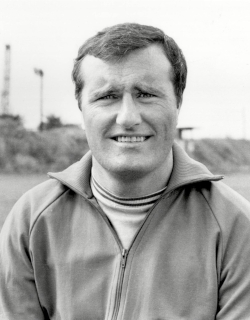
Cantwell plays as a full-back for Western Rovers, Cork Athletic F.C., West Ham United F.C. and Manchester United F.C. While at West Ham, he features in the London XI side that competes in the 1955–58 Inter-Cities Fairs Cup final on May 1, 1958. He captains the Hammers to winning the Division Two championship in the 1957–58 season and thereby leads the club into the topflight for the first time since 1932.
In November 1960, Cantwell joins Manchester United for £29,500 which at the time is a record for a full-back. He helps the club win the 1965 and 1967 league titles and captains United when winning the 1963 FA Cup Final, just as his fellow countryman Johnny Carey had done in United’s previous FA Cup win 15 years earlier. He also serves as Chairman of the Professional Footballers’ Association.
Cantwell wins 36 full International caps for the Republic of Ireland national football team, typically playing at left full-back and on several occasions at centre-forward. He makes his debut against Luxembourg in October 1953 with his final appearance coming away to Turkey in February 1967. He scores 14 goals including 5 from penalties and also captains the Republic on several occasions including a match against England at Wembley Stadium.
In his first managerial role at Coventry City F.C. he has the onerous task of following Jimmy Hill who had taken the club into the Football League First Division for the first time in their history. He narrowly keeps the Sky Blues in the top in his first two seasons before taking them to a sixth-place finish in 1969–70, earning them qualification for the Inter-Cities Fairs Cup, a year before it was replaced by the UEFA Cup.
Cantwell departs from Highfield Road on March 12, 1972, to take charge of the New England Tea Men in the United States, but within seven months is back in English football as manager of Peterborough United F.C. He helps Peterborough win the Football League Fourth Division title in his first full season as manager, before leaving on May 10, 1977, for a second spell with the Tea Men. This time he spends a year in the United States.
Cantwell returns to Peterborough on November 19, 1986, for a second spell as manager, remaining in this role until he becomes general manager on July 12, 1988. He is general manager at London Road for a year until he quits football to become licensee of the New Inn at Peterborough, where he remains for 10 years until he retires in 1999. He also is landlord of the Bull and Swan in Stamford, Lincolnshire.
Cantwell also plays cricket for Cork Bohemians Cricket Club and Ireland as a left-handed batsman and a right-arm medium bowler. He plays five times for Ireland making his debut in what is his sole first-class match versus Scotland at Edinburgh in 1956, scoring 31 and 17. His last match for Ireland is against Lancashire in July 1959.
Cantwell dies on September 8, 2005, from cancer at the age of 73, leaving a widow and two children. His former teams each hold a minute of silence for him before their next matches.
Aiming to raise awareness of world poverty, The Corrs and chartered accountants KPMG jointly launch the NetAid web site on October 7, 1999. NetAid is an anti-poverty initiative started as a joint venture between the United Nations Development Programme and Cisco Systems. It becomes an independent nonprofit organization in 2001 and becomes a part of Mercy Corps in 2007.
NetAid begins with a concert event on October 9, 1999 with simultaneous activities meant to harness the Internet to raise money and awareness for the Jubilee 2000 campaign. Concerts take place at Wembley Stadium in London, Giants Stadium in New Jersey and the Palais des Nations in Geneva. While the Wembley show is at capacity, the U.S. show suffers from very poor ticket sales.
The NetAid website, originally at http://www.netaid.org, receives over 2.4 million hits and raises $830,000 from eight countries. Cisco sponsors the concerts and the web site. Along with Kofi Annan, Keyur Patel, MD of KPMG Consulting spearhead the technology architecture development of the web site and Anaal Udaybabu (Gigabaud Studios, San Francisco) designs the user experience.
Following the concerts, NetAid is spun out of Cisco as an independent entity and tries various approaches to raising awareness of extreme poverty and raising money for anti-poverty projects undertaken by other organizations, through a variety of different NetAid campaigns.
By 2006, NetAid has narrowed its focus to raising awareness among high school students in the United States regarding poverty in developing countries.
On the same day, concerts inspired by the initiative take place in other countries, such as the Soviet Union, Canada, Japan, Yugoslavia, Austria, Australia and West Germany. It was one of the largest-scale satellite link-ups and television broadcasts of all time. An estimated global audience of 1.9 billion, across 150 nations, watch the live broadcast. If accurate, this would be nearly 40% of the world population at the time.
In October 1984, images of millions of people starving to death in Ethiopia were shown in the UK in Michael Buerk‘s BBC News reports on the 1984 famine. The report shocks Britain, motivating its citizens to inundate relief agencies, such as Save the Children, with donations, and to bring the world’s attention to the crisis in Ethiopia. Bob Geldof also sees the report, and calls Midge Ure from Ultravox, and together they quickly co-write the song, “Do They Know It’s Christmas?” in the hope of raising money for famine relief. Geldof then contacts colleagues in the music industry and persuades them to record the single under the title “Band Aid” for free. On November 25, 1984, the song is recorded at SARM West Studios in Notting Hill, London and is released four days later. It stays at number-one on the UK Singles Chart for five weeks, is Christmas number one, and becomes the fastest-selling single ever in Britain and raises £8 million, rather than the £70,000 Geldof and Ure had initially expected.
The 1985 Live Aid concert is conceived as a follow-up to the successful charity single. The idea to stage a charity concert to raise more funds for Ethiopia originally comes from Boy George, the lead singer of Culture Club. On Saturday, December 22, 1984, an impromptu gathering of some of the other artists from Band Aid join Culture Club on stage at the end of their concert at Wembley Stadium for an encore of “Do They Know It’s Christmas?” George is so overcome by the occasion he tells Geldof that they should consider organising a benefit concert.
The concert begins at noon at Wembley Stadium in London. It continues at John F. Kennedy Stadium in the United States, starting at 8:51 EDT. The overall concert continues for just over 16 hours, but since many artists’ performances are conducted simultaneously in Wembley and JFK, the total concert’s length is much longer.
Throughout the concerts, viewers are urged to donate money to the Live Aid cause. Three hundred phone lines are manned by the BBC, so that members of the public can make donations using their credit cards. The phone number and an address that viewers can send cheques to are repeated every twenty minutes.
The following day, news reports state that between £40 and £50 million had been raised. It is now estimated that around £150m has been raised for famine relief as a direct result of the concerts. Geldof mentions during the concert that the Republic of Ireland had given the most donations per capita, despite being in the threat of a serious economic recession at the time. The single largest donation comes from the Al Maktoum, who is part of the ruling family of Dubai, who donates £1M during a phone conversation with Geldof.
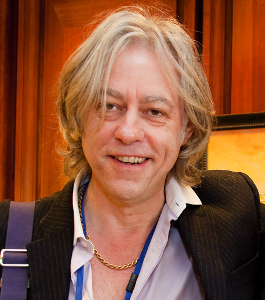
Geldof attends Blackrock College, though he later says he did not enjoy his time there because of its Catholic ethos and bullying for his lack of rugby prowess and for his middle name, Zenon. After leaving school he gains certain odd jobs but is not inspired by any of them. He then goes to Vancouver, British Columbia, Canada to work as a music journalist.
Returning to Ireland in 1975, Bob Geldof becomes the lead singer of The Boomtown Rats, a rock group closely linked with the punk movement. He famously states the reason for joining a pop band is “to get rich, to get famous, and to get laid.”
By 1978, The Boomtown Rats achieve their first U.K. hit single with Rat Trap and later achieve a second hit with I Don’t Like Mondays.
In 1981, Geldof is invited to take part in a concert for Amnesty International and this sows a seed of future ideas.
In 1984, Geldof moves from being a rock start to international celebrity for raising awareness of humanitarian charities. During that year, Ethiopia and other African countries experience a severe famine which leads to death by starvation for thousands of people. The plight of starving children is widely seen on television and Geldof, along with Midge Ure, decide to do something about it, releasing the single Do They Know It’s Christmas?. It is a spontaneous event with many of the best-known names in pop music invited. It becomes an instant best seller selling a record 3 million copies.
In the summer of 1985, Geldof is one of the main organisers behind the Live Aid concert at Wembley Stadium. It is a sixteen-hour rock extravaganza aimed at raising money and awareness for Africa. It is a unique musical event capturing the imagination and attention of the world. Following this concert, he becomes more involved in work for non-governmental organisations in Africa and becomes one of the leading spokespersons on Third World debt and relief.
In 2005, he organises a Live 8 concert, coinciding with the Make Poverty History campaign. He seeks the co-operation of leading G8 leaders such as Tony Blair to write off Third World debt. Some criticise him for becoming too close to politicians and some argue his presence in the Third World campaign issue does more harm than good.
However, Geldof remains a powerful figurehead for motivating Western attitudes to pay more attention to the problems and challenges of the poorest parts of the world. He feels a passion for improving conditions in Africa.
Geldof is knighted in 1986 and is often affectionately known as “Sir Bob.”



 seamus dubhghaill