seamus dubhghaill

Promoting Irish Culture and History from Little Rock, Arkansas, USA


Leave a comment

Death of Oliver St. John Gogarty, Poet, Author, Athlete & Politician

Oliver Joseph St. John Gogarty, Irish poet, authorotolaryngologist, athlete, politician, and well-known conversationalist, dies in New York City on September 22, 1957. He serves as the inspiration for Buck Mulligan in James Joyce‘s novel Ulysses.

Gogarty is born on August 17, 1878, in Rutland SquareDublin. In 1887, his father dies of a burst appendix, and he is sent to Mungret College, a boarding school near Limerick. He is unhappy in his new school, and the following year he transfers to Stonyhurst College in LancashireEngland, which he likes little better, later referring to it as “a religious jail.” He returns to Ireland in 1896 and boards at Clongowes Wood College while studying for examinations with the Royal University of Ireland. In 1898, he switches to the medical school at Trinity College Dublin (TCD), having failed eight of his ten examinations at the Royal.

A serious interest in poetry and literature begins to manifest itself during his years at TCD. In 1900, he makes the acquaintance of W. B. Yeats and George Moore and begins to frequent Dublin literary circles. In 1904 and 1905 he publishes several short poems in the London publication The Venture and in John Eglinton‘s journal Dana. His name also appears in print as the renegade priest Fr. Oliver Gogarty in George Moore’s 1905 novel The Lake.

In 1905, Gogarty becomes one of the founding members of Arthur Griffith‘s Sinn Féin, a non-violent political movement with a plan for Irish autonomy modeled after the Austro-Hungarian dual monarchy.

In July 1907, his first son, Oliver Duane Odysseus Gogarty, is born, and in autumn of that year he leaves for Vienna to finish the practical phase of his medical training. Returning to Dublin in 1908, he secures a post at Richmond Hospital, and shortly afterward purchases a house in Ely Place opposite George Moore. Three years later, he joins the staff of the Meath Hospital and remains there for the remainder of his medical career.

As a Sinn Féiner during the Irish War of Independence, Gogarty participates in a variety of anti-Black and Tan schemes, allowing his home to be used as a safe house and transporting disguised Irish Republican Army (IRA) volunteers in his car. Following the ratification of the Anglo-Irish Treaty, he sides with the pro-Treaty government and is made a Free State Senator. He remains a senator until the abolition of the Seanad in 1936, during which time he identifies with none of the existing political parties and votes according to his own whims.

Gogarty maintains close friendships with many of the Dublin literati and continues to write poetry in the midst of his political and professional duties. He also tries his hand at playwriting, producing a slum drama in 1917 under the pseudonym “Alpha and Omega,” and two comedies in 1919 under the pseudonym “Gideon Ouseley,” all three of which are performed at the Abbey Theatre. He devotes less energy to his medical practice and more to his writing during the twenties and thirties.

With the onset of World War II, Gogarty attempts to enlist in the Royal Air Force (RAF) and the Royal Army Medical Corps (RAMC) as a doctor. He is denied on grounds of age. He then departs in September 1939 for an extended lecture tour in the United States, leaving his wife to manage Renvyle House, which has since been rebuilt as a hotel. When his return to Ireland is delayed by the war, he applies for American citizenship and eventually decides to reside permanently in the United States. Though he regularly sends letters, funds, and care-packages to his family and returns home for occasional holiday visits, he never again lives in Ireland for any extended length of time.

Gogarty suffers from heart complaints during the last few years of his life, and in September 1957 he collapses in the street on his way to dinner. He dies on September 22, 1957. His body is flown home to Ireland and buried in Cartron Church, Moyard, near Renvyle, County Galway.

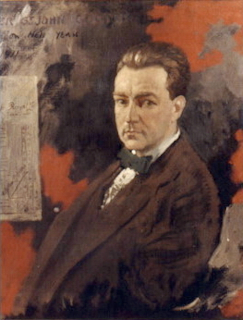
(Pictured: 1911 portrait of Oliver St. John Gogarty painted by Sir William Orpen, currently housed at the Royal College of Surgeons in Ireland)


Leave a comment

Death of George William Russell, Writer, Critic & Poet

George William Russell, Irish writer, editor, critic, poet, painter and Irish nationalist, dies of cancer in Bournemouth, England, on July 17, 1935.

Russell is born on April 10, 1867, in Lurgan, County Armagh, in what is now Northern Ireland. He writes with the pseudonym Æ (often written AE or A.E.). He is also a writer on mysticism, and a central figure in the group of devotees of theosophy which meets in Dublin for many years. He takes his pseudonym from a proofreader’s query about his earlier pseudonym, “AEon.”

Russell is the second son of Thomas Russell and Mary Armstrong. His father, the son of a small farmer, becomes an employee of Thomas Bell and Co., a prosperous firm of linen drapers. The family relocates to Dublin, where his father has a new offer of employment, when he is eleven years old.

Russell is educated at Rathmines School and the Metropolitan School of Art, where he begins a lifelong, if sometimes contentious, friendship with W. B. Yeats. In the 1880s, he lives at the Theosophical Society lodge at 3 Upper Ely Place, sharing rooms with Hamilton Malcolm Magee, the brother of William Kirkpatrick Magee.

Following his time at the Metropolitan School of Art, Russell becomes an accounts clerk in a drapery store but leaves in 1897 to organize agricultural cooperatives. Eventually he becomes editor of the periodicals Irish Homestead (1905–23) and The Irish Statesman (1923–30). In 1894 he publishes the first of many books of verse, Homeward: Songs by the Way, which establishes him in what is known as the Irish Literary Revival. His first volume of Collected Poems appears in 1913 and a second in 1926. He maintains a lifelong interest in theosophy, the origins of religion, and mystical experience. Candle of Vision: Autobiography of a Mystic (1918) is the best guide to his religious beliefs.

At the turn of the 20th century, Russell is considered by many to be the equal of Yeats, but he does not continue to grow and develop as Yeats does. He is prolific and versatile, but many critics find his poetry facile, vague, and monotonous, with “rather too much of the Celtic Twilight” in it.

Russell designs the famous Starry Plough flag for the Irish Citizen Army, which is unveiled on April 5, 1914, and flown during the Easter Rising in April 1916.

Russell, who had become increasingly unhappy in the Irish Free State which, according to Yeats, he called “a country given over to the Devil,” moves to England soon after his wife’s death in 1932. Despite his failing health he goes on a final lecture tour in the United States but returns home utterly exhausted. He dies of cancer in Bournemouth, England, on July 17, 1935. His body is brought back to Ireland, and he is interred in Mount Jerome Cemetery, Dublin.


Leave a comment

Birth of George William Russell, Writer, Poet & Nationalist

George William Russell, Irish writer, editor, critic, poet, painter and Irish nationalist, is born on April 10, 1867, in Lurgan, County Armagh, in what is now Northern Ireland. He writes with the pseudonym Æ (often written AE or A.E.). He is also a writer on mysticism, and a central figure in the group of devotees of theosophy which meets in Dublin for many years. He takes his pseudonym from a proofreader’s query about his earlier pseudonym, “AEon.”

Russell is the second son of Thomas Russell and Mary Armstrong. His father, the son of a small farmer, becomes an employee of Thomas Bell and Co., a prosperous firm of linen drapers. The family relocates to Dublin, where his father has a new offer of employment, when he is eleven years old.

Russell is educated at Rathmines School and the Metropolitan School of Art, where he begins a lifelong, if sometimes contentious, friendship with W. B. Yeats. In the 1880s, he lives at the Theosophical Society lodge at 3 Upper Ely Place, sharing rooms with Hamilton Malcolm Magee, the brother of William Kirkpatrick Magee.

Following his time at the Metropolitan School of Art, Russell becomes an accounts clerk in a drapery store but leaves in 1897 to organize agricultural cooperatives. Eventually he becomes editor of the periodicals Irish Homestead (1905–23) and The Irish Statesman (1923–30). In 1894 he publishes the first of many books of verse, Homeward: Songs by the Way, which establishes him in what is known as the Irish Literary Revival. His first volume of Collected Poems appears in 1913 and a second in 1926. He maintains a lifelong interest in theosophy, the origins of religion, and mystical experience. Candle of Vision: Autobiography of a Mystic (1918) is the best guide to his religious beliefs.

At the turn of the 20th century, Russell is considered by many to be the equal of Yeats, but he does not continue to grow and develop as Yeats does. He is prolific and versatile, but many critics find his poetry facile, vague, and monotonous, with “rather too much of the Celtic Twilight” in it.

Russell designs the famous Starry Plough flag for the Irish Citizen Army, which is unveiled on April 5, 1914, and flown during the Easter Rising in April 1916.

Russell, who had become increasingly unhappy in the Irish Free State which, according to Yeats, he called “a country given over to the Devil,” moves to England soon after his wife’s death in 1932. Despite his failing health he goes on a final lecture tour in the United States but returns home utterly exhausted. He dies of cancer in Bournemouth, England, on July 17, 1935. His body is brought back to Ireland, and he is interred in Mount Jerome Cemetery, Dublin.