seamus dubhghaill

Promoting Irish Culture and History from Little Rock, Arkansas, USA


Leave a comment

The Kilmainham Treaty Signed by Parnell and Gladstone

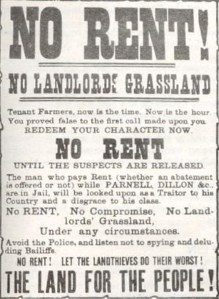
land-league-posterThe Kilmainham Treaty, an informal agreement between Liberal British Prime Minister William Ewart Gladstone and the Irish nationalist leader Charles Stewart Parnell, is signed on April 25, 1882.

The agreement extends the terms of the Second Land Act of 1881, with which Gladstone intends to make broad concessions to Irish tenant farmers. But the Act has many weaknesses and fails to satisfy Parnell and the Irish Land League because it does not provide a regulation for rent-arrears or rent-adjustments in the case of poor harvests or deteriorated economic conditions.

After the Second Land Act becomes law on August 22, 1881, Parnell, in a series of speeches in September and October, launches violent attacks on Chief Secretary for Ireland William Forster and even on Gladstone. Gladstone warns him not to frustrate the Act, but Parnell repeats his contempt for the Prime Minister. On October 12, the Cabinet, fully convinced that Parnell is bent on ruining the Act, takes action to have him arrested in Dublin the next day.

Parnell is conveyed to Kilmainham Gaol, where he joins several other prominent members of the Land League who have also protested against the Act and been jailed. There, together with William O’Brien, he enacts the No Rent Manifesto campaign. He is well aware that some in the Liberal Cabinet, in particular Joseph Chamberlain, are opposed to the mass internment of suspects then taking place across Ireland under the Protection of Person and Property Act 1881. The repressions do not have the desired effect, with the result that Forster becomes isolated within the Cabinet, and coercion becomes increasingly unpopular with the Liberal Party.

In gaol Parnell begins to turn over in his mind the possibility of coming to an arrangement with the Government. He has been corresponding with Katharine O’Shea who engages her husband, Captain William O’Shea, in April 1882 to act as a go-between for negotiations on behalf of Parnell. O’Shea contacts Gladstone on May 5 having been informed by Parnell that should the Government settle the rent-arrears problem on the terms he proposes, he is confident that he can curtail outrages. He further urges for the quick release of the League’s organizers in the West who will then work for pacification. This shocks Forster but impresses Gladstone.

Accordingly on May 2, Gladstone informs the House of Commons of the release of Parnell and the resignation of Forster. Gladstone always denies there has been a “Kilmainham Treaty,” merely accepting that he “had received informations.” He keeps his side of the arrangement by subsequently having the Arrears of Rent Act 1882 enacted. The government pays the landlords £800,000 in back rent owed by 130,000 tenant farmers.

Calling the agreement a “treaty” shows how Parnell manages to place a spin on the agreement in a way that strengthens Irish nationalism, since he manages to force concessions from the British while in gaol. Since real treaties are usually signed between two states, it leads to the idea that Ireland could become independent from Britain. After the “treaty” is agreed, those imprisoned with Parnell are released from gaol. This transforms Parnell from a respected leader to a national hero.

The Phoenix Park Murders, in which two top British officials in Ireland are assassinated, take place four days later and undo much of the goodwill generated by it in Britain. Though strongly condemned by Parnell, the murders show that he cannot control nationalist “outrages” as he has undertaken to do.


Leave a comment

John Redmond Elected Leader of the Irish Parliamentary Party

john-redmond-1917

John Edward Redmond, Irish nationalist politician, barrister, and Member of Parliament (MP) in the British House of Commons, is elected leader of the Irish Parliamentary Party on February 6, 1900.

Redmond is born at Ballytrent House, his grandfather’s old family mansion, in Kilrane, County Wexford. As a student at Clongowes Wood College, he exhibits the seriousness that many soon come to associate with him. After finishing at Clongowes, Redmond attends Trinity College, Dublin to study law, but his father’s ill health leads him to abandon his studies before taking a degree and, in 1876, goes to live with him in London. As a clerk in the House of Commons he increasingly identifies himself with the fortunes of Charles Stewart Parnell, one of the founders of the Irish Land League.

Redmond first attends political meetings with Parnell in 1879. Upon the death of his father, a Member of Parliament for Wexford, in 1880, Redmond writes to Parnell asking for adoption as the Nationalist Party, which becomes the Irish Parliamentary Party in 1882, candidate in the by-election to fill the open seat, but is disappointed to learn that Parnell has already promised the next vacancy to his secretary Timothy Healy. When a vacancy arises in New Ross, he wins election unopposed as the Parnellite candidate for the seat. He served as MP for New Ross from 1881 to 1885, for North Wexford from 1885 to 1891 and finally for Waterford City from 1891 until his death in 1918.

In 1890, the Irish Parliamentary Party splits over Parnell’s leadership when his long-standing adultery with Katharine O’Shea is revealed in a spectacular divorce case. Redmond stands by Parnell and works to keep the minority faction active. When Parnell dies in 1891, Redmond takes over leadership of the Parnellite faction of the split party, called the Irish National League (INL). The larger anti-Parnellite group forms the Irish National Federation (INF) under John Dillon.

Through the initiative of William O’Brien and his United Irish League (UIL), the INL and the INF re-unite on February 6, 1900, within the Irish Parliamentary Party. Redmond is elected its chairman, a position he holds until his death in 1918, a longer period than any other nationalist leader with the exceptions of Éamon de Valera and Daniel O’Connell.

The achievement of Home Rule is his life’s goal, having strongly supported William Gladstone’s Home Rule bills of 1886 and 1893. His best opportunity arises when the Irish Parliamentary Party holds the balance of power under H. H. Asquith in the period from 1910 onwards.  Opposition by the Ulster Unionists frustrates his plans, his main worry being that Home Rule will result in the permanent exclusion of at least some of the Ulster counties. He also fears that the activities of the Irish Volunteers might hinder the enactment of Home Rule. To guard against this eventuality, he secures the control of the organisation in June 1914.  He welcomes the Government of Ireland Act, 1914 as the only measure of Home Rule then possible. Its suspension for the duration of the war postpones addressing the issue of partition.

To ensure the success of the war effort and the speedier implementation of Home Rule, Redmond offers the services of the Irish Volunteers for the defence of the country, an offer rejected by the government. By encouraging the Volunteers to join the British army, he splits the organisation. The vast majority, totaling 170,000 and thereafter known as the National Volunteers, follow Redmond, many of them enlisting in the British army.  Those who aspire to an Irish republic or who have lost faith in Home Rule remain as the Irish Volunteers, their numbers now reduced to about 10,000.

Consequently, the 1916 Easter Rising takes him completely by surprise. Committed to keeping Ireland within the Union, he regards the Rising as treason and a “German intrigue.”  He has no sympathy with the leaders or their objective of a republic.  Nevertheless, he pleads for leniency in the House of Commons.

An operation in March 1918 to remove an intestinal obstruction appears to progress well at first, but then he suffers heart failure. He dies a few hours later at a London nursing home on March 6, 1918. One of the last things he says to the Jesuit Father who is with him to the end is, “Father, I am a broken-hearted man.”