seamus dubhghaill

Promoting Irish Culture and History from Little Rock, Arkansas, USA


Leave a comment

Birth of Noreen Rice, Northern Irish Artist

Noreen Rice, Irish artist, is born in Belfast, Northern Ireland, on February 19, 1936. She exhibits for fifty years and works in the United States, France and Switzerland. Her work is included in the United Nations collection.

Rice is born to Johnny Rice and his wife Nell (née Hayes). Her mother can sing, and her father is a master mason. Her mother’s singing brings in extra money after her father is posted overseas during World War II. She goes to Methodist College Belfast and by the age of fourteen is living in the family home with lodgers as her parents are in Africa where her father is working. She is not academic and takes only a passing interest in becoming a secretary. A school friend says that all she wants to do is draw.

The artist Gerard Dillon comes from Belfast. He helps Rice after they are introduced to each other by her piano teacher in 1951. He is friends with the painter George Campbell. They both share “an interest in bohemian characters.” She regards both Dillon and Campbell as her mentors for decades and her work is of a similar surrealistic and primitive style.

In 1956, Rice completes her first solo exhibition at the British Council in Hong Kong. She had been there since 1954 doing typing and practicing her painting. Her father is working there, and she stays in Hong Kong until the following year. When she returns, she earns money working night shifts in the BBC newsroom.

Gerard Dillon and his sister, Mollie, have a property on London‘s Abbey Road in 1958. They rent part of the house to artist Arthur Armstrong, and they rent a flat to Rice and her brother. Dillon and Rice would tour junk yards to find objects like leather and string that they include in their artwork. The house is known for its ex-pat Irish artists which also include Aidan Higgins and Gerry Keenan.

In 1963, Rice goes to the United States to exhibit, and she has to be persuaded to find time to meet President Kennedy. This is three weeks before he is killed in Dallas. In 1967, she is in Paris learning lithography and marries the German contemporary artist Haim Kern. Their child Tristran is born, and the marriage soon ends, and she leaves for Switzerland.

Rice marries again after she returns to Ireland to live in County Fermanagh. They have a daughter who is named Trasna. She exhibits twice in Belfast. In 1997, a large collaboration with Felix Anaut results in images of Adam and Eve which is prepared for a Spanish arts festival near Zaragoza. Another large commission is to decorate the shutters of Pushkin House at Baronscourt for Alexandra Hamilton, Duchess of Abercorn, in 2005.

Rice dies in County Monaghan on March 23, 2015, where she had lived for twenty years. She completes her last exhibition in 2009, over fifty years after her first in Hong Kong. She has exhibited and had her work in notable collections including the United Nations. She is noted for only creating art when she wanted to, she had never conformed, Aeneas Bonner says in her obituary “Normality was a not a close acquaintance.”

Leave a comment

Irish Regiments Fight at the Battle of Saragossa

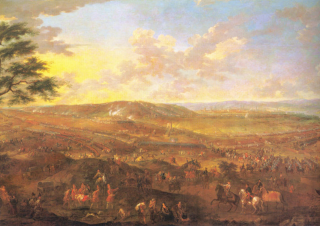
Irish regiments in service of Spain fight at the Battle of Saragossa, also known as the Battle of Zaragoza, on August 20, 1710, during the War of the Spanish Succession.

A Spanish Bourbon army loyal to Philip V of Spain and commanded by Alexandre Maître, Marquis de Bay, is defeated by a Grand Alliance force under Guido Starhemberg. Despite this victory, which allows Philip’s rival Archduke Charles to enter the Spanish capital of Madrid, the allies are unable to consolidate their gains. Forced to retreat, they suffer successive defeats at Brihuega in November and Villaviciosa in December, which effectively end their chances of installing Archduke Charles on the Spanish throne.

The 1710 Spanish campaign opens on May 15 when the Spanish Bourbon army commanded by Philip V in person and Francisco Castillo Fajardo, Marquis of Villadarias, advance on the town of Balaguer. Guido Starhemberg, commander of the Allied forces in Catalonia, halts this attempt by preventing the Spanish from fording the Segre River, a success in which the officers of the British contingent have a leading role.

Having received reinforcements, in June Philip makes another attempt upon Balaguer with 20,000 infantry and 6,000 cavalry but is defeated at Almenar on July 27. The allied troops take up a strong defensive position and repel the Spanish attacks until the British commander, James Stanhope, leading their vanguard, breaks the Spanish lines. Philip is forced to withdraw to Zaragoza, capital of Aragon, while Villadarias is replaced by the French general Alexandre Maître, Marquis de Bay.

On August 9, the Spanish army reaches Zaragoza and de Bay positions his troops with the river Ebro on his left and the Torrero heights to the right. On August 15, an Allied cavalry attack is repulsed, followed by five days of minor skirmishes before the Allies cross the Ebro in force on August 19 and are allowed to deploy during the night.

The two forces are roughly equal in strength, the allies having thirty-seven battalions of infantry and forty-three squadrons opposed to the Spanish-Bourbon army of thirty-eight battalions and fifty-four squadrons. The Allied left, composed of Catalonian and Dutch troops, is led by Pedro Manuel de Ataíde, 5th Count of Atalaia, the right by Stanhope, made up of British, Portuguese and Austrian cavalry, with Starhemberg in charge of the centre, mainly German, Austrian and Spanish infantry.

On August 20 at 8:00 a.m., an artillery-duel starts which lasts four hours before Stanhope charges the Bourbon-Spanish left. At first the Spanish and Walloon troops of the Bourbon army seem to gain the advantage, having defeated a body of eight Portuguese squadrons, which they chased from the field. This opens a gap in the Bourbon lines, which opens a gap for Stanhope who scatters the disorganized Spanish soldiers, while at the centre and the right their attacks are repulsed.

The battle follows the same pattern as at Almenar, with the allies repulsing fierce Bourbon cavalry charges before counter-attacked with their infantry and pushing the Spanish back. In less than three hours, the Allies army wins a comprehensive victory, capturing the Bourbon artillery along with 73 standards. Between 5,000 and 6,000 Spanish soldiers are killed or wounded, and another 7,000 captured, with Allied losses estimated as 1,500 men dead or wounded.

Archduke Charles enters Zaragoza the next day. The defeat of the army of Philip V of Spain is severe, the way to Madrid is open. Philip V abandons Madrid on September 9 and goes to Valladolid. Archduke Charles enters a very hostile and almost empty Madrid on September 28. Charles comments, “This city is a desert!” In the winter of 1710, Archduke Charles and the allied troops have to abandon Madrid, due to the great opposition of the people of Madrid and the dangerous strategic situation. After this, the British army suffers a defeat at the Battle of Brihuega, and the rest of the allied army is defeated at the Battle of Villaviciosa.