seamus dubhghaill

Promoting Irish Culture and History from Little Rock, Arkansas, USA


Leave a comment

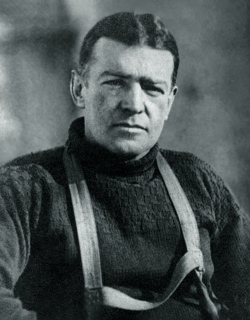
Death of Antarctic Explorer Ernest Shackleton

Sir Ernest Henry Shackleton, Anglo-Irish Antarctic explorer who led three British expeditions to the Antarctic, dies of a heart attack in Grytviken, South Georgia on January 5, 1922. He is one of the principal figures of the period known as the Heroic Age of Antarctic Exploration.

Born in Kilkea, County Kildare, Shackleton and his Anglo-Irish family move to Sydenham, London when he is ten. His first experience of the polar regions is as third officer on Captain Robert Falcon Scott‘s Discovery Expedition of 1901–04, from which he is sent home early on health grounds, after he and his companions Scott and Edward Adrian Wilson set a new southern record by marching to latitude 82°S. During the Nimrod Expedition of 1907–09, he and three companions establish a new record Farthest South latitude at 88°S, only 97 geographical miles from the South Pole, the largest advance to the pole in exploration history. Also, members of his team climb Mount Erebus, the most active Antarctic volcano. For these achievements, he is knighted by King Edward VII on his return home.

After the race to the South Pole ends in December 1911, with Roald Amundsen‘s conquest, Shackleton turns his attention to the crossing of Antarctica from sea to sea, via the pole. To this end, he makes preparations for what becomes the Imperial Trans-Antarctic Expedition, 1914–17. Disaster strikes this expedition when its ship, Endurance, becomes trapped in pack ice and is slowly crushed before the shore parties can be landed. The crew escapes by camping on the sea ice until it disintegrates, then by launching the lifeboats to reach Elephant Island and ultimately South Georgia Island, a stormy ocean voyage of 720 nautical miles and Shackleton’s most famous exploit.

In 1921, Shackleton returns to the Antarctic with the Shackleton–Rowett Expedition on a 125-ton Norwegian sealer, named Foca I, which he renames Quest. When the party arrives in Rio de Janeiro, he suffers a suspected heart attack. He refuses a proper medical examination, so Quest continues south, and on January 4, 1922, arrives at South Georgia. In the early hours of the next morning, Shackleton summons the expedition’s physician, Alexander Macklin, to his cabin, complaining of back pains and other discomfort. According to Macklin’s own account, he tells Shackleton he has been overdoing things and should try to “lead a more regular life,” to which Shackleton answers, “You are always wanting me to give up things, what is it I ought to give up?” “Chiefly alcohol, Boss,” replies Macklin. A few moments later, at 2:50 AM on January 5, 1922, he suffers a fatal heart attack. At his wife’s request, he is buried there.

Away from his expeditions, Shackleton’s life is generally restless and unfulfilled. In his search for rapid pathways to wealth and security, he launches business ventures which fail to prosper, and he dies heavily in debt. Upon his death, he is lauded in the press but is thereafter largely forgotten, while the heroic reputation of his rival Scott is sustained for many decades. Later in the 20th century, Shackleton is “rediscovered”. He rapidly becomes a role model for leadership as one who, in extreme circumstances, kept his team together in a survival story described by cultural historian Stephanie Barczewski as “incredible.”

In his 1956 address to the British Science Association, Sir Raymond Priestley, one of his contemporaries, says “Scott for scientific method, Amundsen for speed and efficiency but when disaster strikes and all hope is gone, get down on your knees and pray for Shackleton,” paraphrasing what Apsley Cherry-Garrard had written in a preface to his 1922 memoir The Worst Journey in the World. In 2002, Shackleton is voted eleventh in a BBC poll of the 100 Greatest Britons.

Leave a comment

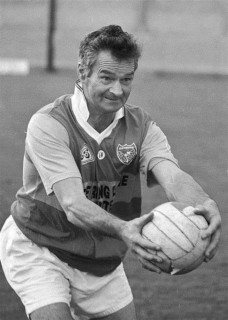
Birth of Gaelic Footballer Mick O’Connell

Michael “Mick” O’Connell, retired Gaelic footballer, is born on Valentia Island, County Kerry, on January 4, 1937. His league and championship career with the Kerry senior team spans nineteen seasons from 1956 to 1974. He is widely regarded as one of the greatest players in the history of the game.

O’Connell is raised in a family that has no real link to Gaelic football. His father is a fisherman who also works on the family’s small farm on the island. From an early age O’Connell shows his footballing talent and “inimitable signs of excellence.” He excels at the game in his youth and also at Cahersiveen CBS.

O’Connell begins his club football career with neighbouring Waterville. When a football club, Valentia Young Islanders, is founded on Valentia Island, as per GAA rules he switches allegiance to his local parish team. He wins three Kerry Senior Football Championship medals with the South Kerry divisional side.

O’Connell’s career with Kerry begins in 1955 when he lines out in the Munster Minor Championship. Kerry loses the replayed Munster final to Tipperary.

O’Connell quickly joins the Kerry senior football team, making his debut in 1956 against Tipperary in the Munster Championship. He later lines out in the Munster final against Cork, but loses out in a replay. In 1958 he wins the first of eight consecutive Munster Senior Football Championship titles, however, Kerry suffers a shocking defeat by Derry in the All-Ireland semi-final. In 1959 he is captain when Kerry wins the National Football League. He later guides his native-county to another Munster title, however, he has to retire due to injury in Kerry’s All-Ireland victory over Galway.

Following a second National League victory in 1961, O’Connell captures his second All-Ireland medal in 1962 when Kerry defeats Roscommon in the final. A third National League victory quickly follows at the start of 1963. After two All-Ireland defeats by Galway in 1964 and 1965 Kerry surrenders their provincial crown to Cork in 1966 and 1967. He wins a ninth Munster title in 1968, however, Kerry loses out to Down in the All-Ireland final. This defeat is followed by a great year of success in 1969 as he adds a fourth National League medal to his collection before winning a tenth Munster title. He later wins a third All-Ireland medal following a victory over Offaly.

In 1970 O’Connell enters the third decade of his inter-county football career, winning an eleventh Munster title in the process. A fourth All-Ireland medal quickly follows after a victory over Meath in the first 80-minute All-Ireland final. He claims two more National league medals in 1971 and 1972, before winning his twelfth and final provincial medal in 1972. That year Offaly later defeats Kerry in O’Connell’s last All-Ireland final appearance. In spite of this loss he is still presented with an GAA GPA All Star award. He retires from inter-county football in 1973.

In 1972 O’Connell marries his wife Rosaleen. They have three children, Máire, Mícheál and Diarmuid. Mícheál marries Emma, daughter of then President of Ireland Mary McAleese in December 2009.

In retirement from playing O’Connell publishes his autobiography, A Kerry Footballer, in 1974. Ten years later in 1984, the GAA’s centenary year, his reputation as one of the all-time greats is recognised when he is named in the midfield position on the GAA Football Team of the Century. In 2000 he is also named on the associations Football Team of the Millennium.


Leave a comment

Death of Michael Butler Yeats, Barrister & Politician

Michael Butler Yeats, barrister, Fianna Fáil politician and only son of the poet William Butler Yeats, dies on January 3, 2007, in Dún Laoghaire, County Dublin. He serves two periods as a member of Seanad Éireann.

Yeats is born on August 22, 1921, in Thame, Oxfordshire, England to W. B. Yeats, who also served in the Seanad, and his mother, Georgie Hyde-Lees. His sister Anne Yeats is a painter and designer, as is his uncle Jack Butler Yeats. He is educated at Trinity College, Dublin and is an officer in the College Historical Society. He unsuccessfully stands for election to Dáil Éireann at the 1948 Irish general election and the 1951 Irish general election for the Dublin South-East constituency.

Following the 1951 election, Yeats is nominated to the 7th Seanad by the Taoiseach Éamon de Valera. He stands at the subsequent 1954 Irish general election for the 8th Seanad but is not elected.

From 1961 to 1980 Yeats is a member of Seanad Éireann. In 1961 he is elected to the 10th Seanad by the Labour Panel. In 1965 he is nominated by the Taoiseach Seán Lemass to the 11th Seanad. In 1969 he is elected to the 12th Seanad by the Cultural and Educational Panel where he serves as Cathaoirleach (chair) until 1973. He is re-elected to the 13th Seanad in 1973. In 1977, he is nominated by the Taoiseach Jack Lynch to the 14th Seanad. He resigns from the Seanad on March 12, 1980.

While a senator, Yeats serves as a Member of the European Parliament from 1973 to 1979, being appointed to Ireland’s first, second and third delegations. He stands at the first direct elections in 1979 for the Dublin constituency but is not elected.

Yeats is married to Gráinne Ni hEigeartaigh, a singer and Irish harpist. They have four children: daughters Caitríona (a concert harpist), Siobhán (a patents professional) and Síle (a broadcaster with RTÉ who also dies in 2007), and a son, Pádraig (an engineer).

Yeats dies on January 3, 2007, in St. Michael’s Hospital in Dún Laoghaire. His funeral service takes place in St. Patrick’s Church, Harbour Road, Dalkey, on January 8, 2007, followed by burial in Shanganagh Cemetery.


Leave a comment

Death of Margaret Emmeline Dobbs, Scholar & Playwright

Margaret Emmeline Dobbs, Irish scholar and playwright best known for her work to preserve the Irish language, dies in Cushendall, County Antrim, Northern Ireland on January 2, 1962.

Dobbs is born in County Antrim on November 19, 1871 to barrister Conway Edward Dobbs who is Justice of the Peace for County Antrim, High Sheriff for Carrickfergus in 1875 and High Sheriff for County Louth in 1882. Her mother is Sarah Mulholland, daughter of St. Clair Kelvin Mulholland of Eglantine, County Down. The family spends time living in Dublin where Dobbs is born. She attempts to learn Irish, however, when her father dies in 1898 her mother moves the family back to Glenariff.

Dobbs is interested in learning Irish and finds it easier to learn in County Donegal where it is still spoken. Her first teacher is Hugh Flaitile. She attends the Irish College at Cloughaneely in the Donegal Gaeltacht. She brings the idea of promoting the language to the Glens of Antrim and her circle of friends. She is one of the small number of Protestant women interested in the Gaelic revival.

The year 1904 sees the “Great Feis” in Antrim and Dobbs is a founder member of the Feis na nGleann committee and later a tireless literary secretary. In 1946, the Feis committee decides to honour her by presenting her with an illuminated address. It can be seen today at Portnagolan House with its stained glass windows commemorating a great Irishwoman. During her speech she says, “Ireland is a closed book to those who do not know her language. No one can know Ireland properly until one knows the language. Her treasures are hidden as a book unopened. Open the book and learn to love your language.”

Dobbs writes seven plays, published by Dundalgan Press in 1920, though only three are actually performed. The Doctor and Mrs. McAuley wins the Warden trophy for one-act plays at the Belfast festival in 1913. Her plays, however, are generally not a success and after 1920 she never writes another. She continues to work on historical and archaeological studies and her articles are published in the Ulster Journal of Archaeology, in a German magazine for Celtic studies, in the French Revue Celtique and in the Irish magazine Ériu.

Roger Casement is a good friend and although Dobbs never makes her political opinions known she contributes to his defence costs when he is accused of treason. Although her political views are not clearly known, Dobbs has been a member of the Gaelic League and in the executive of Cumann na mBan.

Dobbs dies at her home, Portnagolan House, Cushendall, on January 2, 1962.


Leave a comment

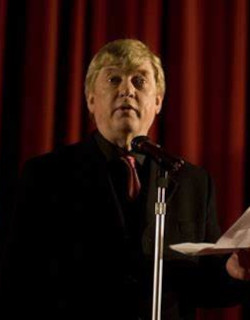
Death of Michael Dwyer, Journalist & Film Critic

Michael Dwyer, journalist and film critic who writes for The Irish Times for more than 20 years, dies following a lengthy illness on January 1, 2010. He previously fills this role for the Sunday Tribune, The Sunday Press and the magazine In Dublin.

Born on May 2, 1951, Dwyer is originally from Saint John’s Park in Tralee, County Kerry. His mother, Mary, outlives him. He has two sisters, Anne and Maria. As a young man in the early 1970s he takes part in the Tralee Film Society, for which he provides notes to The Kerryman. At this time, he is employed by the County Library in Tralee. He begins working for In Dublin followed by the Sunday Tribune and The Sunday Press.

Dwyer first travels to the Cannes Film Festival in 1982 and attends every one until 2009, months before his death. In 1985, he co-founds the Dublin Film Festival and directs it until the mid-1990s. In 2002, he co-founds the Dublin International Film Festival, of which he is the chairman. In later life he serves on the board of the Irish Museum of Modern Art.

In the 1990s, Dwyer presents the film show Freeze Frame for public service broadcaster RTÉ. The show results from a friendship he had formed with Alan Gilsenan and Martin Mahon of Yellow Asylum Films. He is also known for his appearances on the radio shows Morning Ireland and The Marian Finucane Show. The editor of The Irish Times, Geraldine Kennedy, speaking after Dwyer’s death, says he was an “enthusiastic advocate” of both national and international cinema and had once said he was “one of those lucky people in life who was able to pursue his interests and call them work.”

Dwyer becomes unwell following a trip to the Cannes Film Festival in May 2009. He takes a break from writing for The Irish Times, returning in December 2009 to contribute his first, and what is to be his last ever, piece in six months to weekly entertainment supplement The Ticket. The article is a review of cinema in 2009 and of the 2000s, and in his contribution, he references the ill health which had haunted him for much of the previous year and which had prevented him from viewing any cinema releases between June and September.

Dwyer dies at the age of 58 on January 1, 2010. His partner of 24 years, Brian Jennings, survives him. Irish Minister for Arts, Sport and Tourism Martin Cullen says Dwyer was “the most singular, significant influence on cinema in Ireland for more than three decades.” President of the Labour Party Michael D. Higgins says his work was “incalculable […] he was an activist in promoting a knowledge and appreciation of film in all its forms.” Ireland’s former Director of Film Classification at the Irish Film Classification Office John Kelleher says it was “a huge loss for the world of Irish film.” There are tributes from Gabriel Byrne, Daniel Day-Lewis, Brendan Gleeson, Jonathan Rhys Meyers, Cillian Murphy and Jim Sheridan. The Irish Times publishes tribute pieces on his life.

A ceremony takes place at the Church of the Holy Name in Ranelagh where Dwyer lived. The event is attended by notable politicians, journalists, artists, actors, writers and musicians. RTÉ newsreader Aengus Mac Grianna, a colleague of Jennings, reads a tribute to Dwyer. Daniel Day-Lewis gives a very special tribute at the church service to his dear friend of over 20 years, calling for the Jameson International Dublin Film Festival to be renamed in Dwyer’s honour.

Dwyer is cremated after the funeral on January 5, 2010.