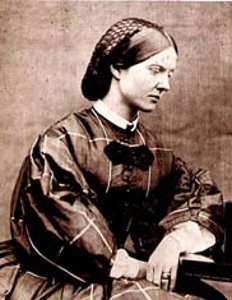
Mary Ward, Anglo-Irish amateur scientist, is killed on August 31, 1869, when she falls under the wheels of an experimental steam car built by her cousins. As the event occurs in 1869, she is the world’s first person known to be killed by a motor vehicle.
During the 19th century, when most women have little encouragement for a science education, Mary is unusual. She is born Mary King in present-day Ferbane, County Offaly on April 27, 1827, the youngest child of Henry and Harriett King. She and her sisters are educated at home, as are most girls at the time. However, her education is slightly different from the norm because she is of a renowned scientific family. She is interested in nature from an early age, and by the time she is three years old she is collecting insects.
Universities and most societies do not accept women, but Mary obtains information any way she can. She writes frequently to scientists, asking them about papers they have published. During 1848, her cousin William Parsons, 3rd Earl of Rosse, is made President of the Royal Society, enabling her to meet many scientists during visits to his home.
Parsons’ sons build a steam-powered car. It is thought at the time that steam transport will be developed greatly during the near future. This becomes true for trains but does not become true for cars due to the development of internal combustion engine. Steam cars are heavy, and they do too much damage to the already uneven roads. In 1865, the Red Flag Acts imposes a speed limit of four miles per hour for the countryside and two miles per hour in towns. This effectively ends the popularity of motorcars, but some enthusiasts still have one, often homemade, like the Parsons’ vehicle.
On August 31, 1869, Mary and her husband, Henry, are travelling in it with the Parsons boys, Richard Clare Parsons and the future steam turbine pioneer Charles Algernon Parsons, and their tutor, Richard Biggs. She is thrown from the car on a bend in the road at Parsonstown, County Offaly. She falls under its wheel and dies almost instantly. A doctor who lives near the scene arrives within moments and finds her cut, bruised, and bleeding from the ears. The fatal injury is a broken neck.
The Cork Examiner, now known as the Irish Examiner, an Irish national daily newspaper, hits the streets for the first time on August 30, 1841. Today the newspaper primarily circulates in the Munster region surrounding its base in Cork, though it is available throughout Ireland. Its primary national rivals are The Irish Times and the Irish Independent.
The paper is founded by John Francis Maguire under the title The Cork Examiner in 1841 in support of the Catholic Emancipation and tenant rights work of Daniel O’Connell. The newspaper is originally published three times a week on Mondays, Wednesdays, and Fridays. In July 1861, it becomes a daily newspaper with editions Monday through Saturday.
In August 1922, during the Irish Civil War, The Cork Examiner’s printing presses are destroyed by Republican forces before the Free State army can arrive in Cork. During the Spanish Civil War, The Cork Examiner takes a strongly pro-Franco tone in its coverage of the conflict.
Though originally appearing under The Cork Examiner title, it has re-branded in recent years to The Examiner, and subsequently The Irish Examiner to appeal to a more national readership.
The newspaper was part of the Thomas Crosbie Holdings group. Thomas Crosbie Holdings went into receivership in March 2013. The newspaper has since been acquired by Landmark Media Investments. The newspaper is based on Academy Street in Cork for over a century before moving to new offices at Lapp’s Quay, Cork in early November 2006.
Historical copies of The Cork Examiner, dating back to 1841, are available to search and view in digitised form at The British Newspaper Archive.
Éamon de Valera, prominent politician in twentieth-century Ireland, dies at the age of 92 in Linden Convalescent Home, Blackrock, County Dublin on August 29, 1975. His wife, Sinéad de Valera, four years his senior, had died the previous January, on the eve of their 65th wedding anniversary.
De Valera’s political career spans over half a century, from 1917 to 1973. He serves several terms as head of government and head of state. He also leads the introduction of the Constitution of Ireland.
Assessments of de Valera’s career are varied. He has often been characterised as a stern, unbending, devious, and divisive Irish politician. Biographer Tim Pat Coogan sees his time in power as being characterised by economic and cultural stagnation, while Diarmaid Ferriter argues that the stereotype of de Valera as an austere, cold and even backward figure is largely manufactured in the 1960s and is misguided.
On September 2, 1975, Éamon de Valera makes his final journey through the streets of Dublin to his final resting place at Glasnevin Cemetery. De Valera’s body is taken from St. Patrick’s Hall in Dublin Castle, where it has lain in state, to the the St. Mary’s Pro-Cathedral, where a requiem Mass is celebrated by his grandson, Father Seán Ó Cuív, and then on to Glasnevin Cemetery.
On a day of national mourning, over 200,000 people pay tribute to the statesman along the three-mile funeral route from Dublin city centre to Glasnevin. The Army No. 1 Band plays Wrap the Green Flag Round Me as de Valera is carried into Glasnevin Cemetery.
In attendance at the funeral are family, friends, colleagues, politicians, dignitaries, diplomats, veterans of the 1916 Easter Rising, and citizens who want to pay their respect. The final prayers are recited at the graveside by Father Ó Cuív. The firing party of young cadets from the Curragh fire a final volley in tribute over the grave.
At the age of twelve, O’Flaherty goes to Rockwell College and later University College Dublin and the Dublin Diocesan teacher training college Holy Cross College. It is intended he enter the priesthood, but he joins the Irish Guards in 1917 under the name Bill Ganly. Serving on the Western Front, he finds trench life devastatingly monotonous and is badly injured in September 1917 during the Battle of Langemarck. It is speculated that shell shock is responsible for the mental illness which becomes apparent in 1933.
He returns from the front a socialist. Having become interested in Marxism as a schoolboy, atheistic and communistic beliefs evolve in his 20s and he is a founding member of the Communist Party of Ireland. Two days after the establishment of the Irish Free State, O’Flaherty and other unemployed Dublin workers seize the Rotunda Concert Hall in Dublin and hold it for four days in protest at “the apathy of the authorities.” Free State troops force their surrender.
O’Flaherty then leaves Ireland and moves first to England where, destitute and jobless, he takes to writing. In 1925 he scores immediate success with his best-selling novel The Informer about a rebel with confused ideals in the Irish War of Independence, which wins him the 1925 James Tait Black Memorial Prize for fiction. Four years later his next short novel Return of the Brute, set in the World War I trenches, proves another success. He then travels to the United States, where he lives in Hollywood for a short time. The well-known director John Ford, a cousin, later makes a film of O’Flaherty’ first novel. The novel is also the source of a 1929 film of the same name directed by Arthur Robison.
Many of his works have the common theme of nature and Ireland. He is a distinguished short story writer, and some of his best work in that genre is in Irish. The collection Dúil, published towards the end of his life, contains Irish language versions of a number of stories published elsewhere in English. This collection, now widely admired, has a poor reception at the time, and this seems to discourage him from proceeding with an Irish language novel he has in hand.
In a letter written to The Sunday Times in later years he confesses to a certain ambivalence regarding his work in Irish and speaks of other Irish writers who receive little praise for their work in the language. This gives rise to some controversy. His First Flight, a short story which symbolizes the nervousness one experiences before doing something new, is regarded as one of his most famous works. In 1923, O’Flaherty publishes his first novel, Thy Neighbour’s Wife, thought to be one of his best. Over the next couple of years, he publishes other novels and short stories. In 1933 he suffers the first of two mental breakdowns.
He travels in the United States and Europe, and the letters he writes while travelling have now been published. He has a love of French and Russian culture. Before his death he leaves the Communist Party and returns to the Roman Catholic faith. O’Flaherty dies in Dublin on September 7, 1984, and many of his works are subsequently republished. He is remembered today as a powerful writer and a strong voice in Irish culture.
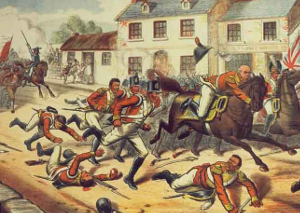
The Battle of Castlebar occurs on August 27, 1798, near the town of Castlebar, County Mayo, during the Irish Rebellion of 1798. A combined force of 2,000 French troops and Irish rebels rout a force of 6,000 British militia in what later becomes known as the “Castlebar Races” or “Races of Castlebar.”
The long-awaited French landing to assist the Irish revolution begun by Theobald Wolfe Tone‘s Society of United Irishmen takes place five days previously on August 22, when almost 1,100 troops under the command of General Jean Joseph Amable Humbert land at Cill Chuimín Strand, County Mayo. The nearby town of Killala is quickly captured after a brief resistance by local yeomen. Following the news of the French landing, Irish volunteers began to trickle into the French camp from all over Mayo.
On August 26, leaving about 200 French regulars behind in Killala to cover his rear and line of withdrawal, Humbert takes a combined force of about 2,000 French and Irish to march on and take Castlebar. In order to avoid a head-on attack, locals advise the French of an alternative route to Castlebar through the wilds along the west of Lough Conn, which the British believe to be impassable for a modern army with attendant artillery train. When General Gerald Lake’s scouts spot the approaching enemy, the surprised British have to hurriedly change the deployment of their entire force to face the threat from this unanticipated direction.
The British have barely completed their new deployment when the Franco-Irish army appears outside the town at about 6:00 AM. The newly sited British artillery opens up on the advancing French and Irish and cut them down in droves. French officers, however, quickly identify an area of scrub and undergrowth in a defile facing the centre of the artillery line which provides some cover from the British line of fire. The French launch a bayonet charge, the ferocity and determination of which unnerve the units stationed behind the artillery. The British units begin to waver before the French reach their lines and eventually turn in panic and flee the battlefield, abandoning the gunners and artillery. A unit of cavalry and British regular infantry attempt to stand and stem the tide of panic but are quickly overwhelmed.
In the headlong flight of thousands of British militias, large quantities of guns and equipment are abandoned, among which is General Lake’s personal luggage. Although not pursued a mile or two beyond Castlebar, the British do not stop until they reach Tuam, with some units fleeing as far as Athlone in the panic. The panic is such that only the arrival of Cornwallis at Athlone prevents further flight across the River Shannon.
Although achieving a decisive victory, the losses of the French and Irish are high, with about 150 men killed, mostly to the cannonade at the start of the battle. About 80 British are killed and some 270 wounded, captured, or deserted. Following the victory, thousands of volunteers flock to join the French who also send a request to France for reinforcements and formally declare a Republic of Connacht, which lasts 3 days and collapses when the French depart.
On September 5, the British forces are again defeated at Collooney however, after that, the rebellion quickly folds. More troops gather and by the Battle of Ballinamuck on September 8, their strength is over 15,000. Ballinamuck is the end for General Humbert, who hands in his surrender. The Irish rebels fight on briefly until scattered. Killala is re-taken on September 12. More French warships sail for Ireland but are decisively defeated by the Royal Navy near Tory Island. With that the 1798 rebellion ends. The captured French soldiers are transferred to England and eventually repatriated. The French officers of Irish origin are hanged in Dublin with the Irish rebels.
The Great Dublin Lockout, a major industrial dispute between approximately 20,000 workers and 300 employers, begins in Dublin on August 26, 1913, and lasts until January 18, 1914. It is often viewed as the most severe and significant industrial dispute in Irish history.
Irish workers live in terrible conditions in tenements. The infant mortality rate among the poor is 142 per 1,000 births, extraordinarily high for a European city. Poverty is perpetuated in Dublin by the lack of work for unskilled workers, who lack any form of representation before trade unions are founded.
James Larkin, the main protagonist on the side of the workers in the dispute, is a docker in Liverpool and a union organiser. In 1907 he is sent to Belfast as local organiser of the British-based National Union of Dock Labourers (NUDL). His tactic of the sympathetic strike is deemed highly controversial and as a result Larkin is transferred to Dublin.
Larkin sets about organising the unskilled workers of Dublin, which is a cause of concern for the NUDL, who are reluctant to engage in a full-scale industrial dispute with the powerful Dublin employers. They suspended Larkin from the NUDL in 1908. Larkin then leaves the NUDL and sets up the Irish Transport and General Workers’ Union (ITGWU), the first Irish trade union to cater for both skilled and unskilled workers.
Another important figure in the rise of an organised workers’ movement in Ireland at this time is James Connolly, an Edinburgh-born Marxist of Irish parentage. In 1911, Connolly is appointed the ITGWU’s Belfast organiser. In 1912, Connolly and Larkin form the Irish Labour Party to represent workers in the imminent Home Rule Bill debate in Parliament.
Foremost among employers opposed to trade unionism in Ireland is William Martin Murphy, Ireland’s most prominent capitalist, born in Castletownbere, County Cork. In 1913, Murphy is chairman of the Dublin United Tramway Company and owns Clery’s department store. Murphy is vehemently opposed to trade unions, which he sees as an attempt to interfere with his business. In particular, he is opposed to Larkin, whom he sees as a dangerous revolutionary.
The resulting industrial dispute is the most severe in Ireland’s history. Employers in Dublin lock out their workers and employ blackleg labour from Britain and elsewhere in Ireland. Dublin’s workers apply for help and are sent £150,000 by the British Trades Union Congress (TUC) and other sources in Ireland, doled out dutifully by the ITGWU.
The “Kiddies’ Scheme,” allowing for the starving children of Irish strikers to be temporarily looked after by British trade unionists, is blocked by the Roman Catholic Church and especially the Ancient Order of Hibernians, who claim that Catholic children will be subject to Protestant or atheist influences when in Britain. The Church supports the employers during the dispute, condemning Larkin as a socialist revolutionary.
Guinness, the largest employer and biggest exporter in Dublin, refuses to lock out its workforce. It has a policy against sympathetic strikes and expects its workers, whose conditions are far better than the norm in Ireland, not to strike in sympathy. Six who do strike are dismissed.
Strikers use mass pickets and intimidation against strike breakers, who are also violent towards strikers. The Dublin Metropolitan Policebaton charge worker’s rallies, including a rally on Sackville Street which results in two deaths and over 300 injuries. James Connolly, Larkin, and ex-British Army Captain Jack White form a worker’s militia, the Irish Citizen Army, to protect workers’ demonstrations.
For seven months, the lockout affects tens of thousands of Dublin families. The lock-out eventually concludes in January 1914, when the Trades Union Congress (TUC) in Britain rejects Larkin and Connolly’s request for a sympathetic strike. Most workers, many of whom are on the brink of starvation, go back to work and sign pledges not to join a union. The ITGWU is badly damaged by its defeat in the Lockout and is further hit by the departure of Larkin to the United States in 1914 and the execution of Connolly, one of the leaders of the Easter Rising in 1916.
Although the actions of the ITGWU are unsuccessful in achieving substantially better pay and conditions for workers, they mark a watershed in Irish labour history. The principle of union action and workers’ solidarity has been firmly established. No future employer would ever try to “break” a union in the way that Murphy attempted with the ITGWU.
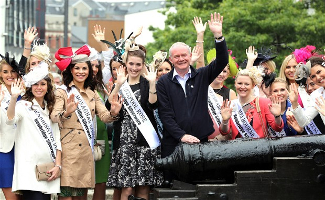
The Rose of Tralee festival is held every August in Tralee to choose a young woman to be crowned the Rose. The winner is the woman deemed to best match the attributes “lovely and fair” relayed in the song. She is selected based on her personality and should be a good role model for the festival and ambassador for Ireland during her travels around the world. It is not a beauty pageant, and the participants are not judged on their appearance but on their personality and suitability to serve as ambassadors for the festival. The festival bills itself as a celebration of the “aspirations, ambitions, intellect, social responsibility, and Irish heritage” of modern young women.
The festival has its origins in the local Carnival Queen, once an annual town event, fallen by the wayside due to post-war emigration. In 1957, the Race Week Carnival is resurrected in Tralee and it features a Carnival Queen. The idea for the Rose of Tralee International Festival comes when a group of local business people meet in Harty’s bar in Tralee to come up with ideas to bring more tourists to the town during the horse racing meeting and to encourage expats back to their native Tralee. Led by Dan Nolan, then Managing Director of The Kerryman newspaper, they hit on the idea of the Rose of Tralee Festival. The event starts in 1959 on a budget of just £750.
The founders of the organisation are Billy Clifford, an accountant with the Rank Organisation, who is one of the first recipients of the Golden Rose award, Dan Nolan, involved with the Tralee Races, Jo Hussey, a shopkeeper in Tralee, and Ted Keane, Sr., a local restaurateur.
Originally, only women from Tralee are eligible to take part. In the early 1960s it is extended to include any women from Kerry and, in 1967, it is further extended to include any women of Irish birth or ancestry. In 2004 Regional Finals are introduced to offer more people an opportunity to participate in the Rose of Tralee International Festival. It is held every year until 2015 in Portlaoise, County Laois, on the June Bank Holiday weekend. In 2014 it is announced that the 2015 Regional Finals will be the last, in favour of a revamped selection process held in Tralee.
Her debut album, The Water is Wide, is released in Europe in 2000 and in North America in 2006. In 2005, she is featured on The Duggans album Rubicon along with peers Moya Brennan and other members of Clannad.
In 2004, Fallon sends a demo offer to composer David Downes, who is then working on the concept of Celtic Woman. Due to her unique vocal abilities, Downes contacts Fallon and asks if she would like to be a part of Celtic Woman, at the time envisaged to be only a one-night show. Fallon agrees, and becomes one of the founding members of the group. In some songs, such as Isle of Innisfree and Carrickfergus, Fallon plays the harp as well as sings. She also plays the harp in fellow Celtic Woman member Chloë Agnew‘s performance of Guun’s Ave Maria.
Fallon is featured in the self-titled debut album Celtic Woman, Celtic Woman: A Christmas Celebration, and Celtic Woman: A New Journey, as well as in the tie-in PBS television specials and DVDs filmed in 2004, 2007, and 2006 respectively. She also tours with the group in 2005 on the inaugural North American Tour, the 2006-2007 A New Journey tour, and again in 2007-2008 on the second A New Journey tour.
In 2009, Fallon announces that she is leaving Celtic Woman to have a full break and spend time with her family. She is replaced by actress and vocalist Alex Sharpe.
In 2009, Fallon appears as a guest vocalist on Jim Brickman‘s It’s a Beautiful World tour and PBS special, and releases her second album Distant Shore in September of that year. This is followed in March 2010 with her third album Music of Ireland: Welcome Home. Fallon’s first Christmas album, Winter, Fire & Snow: A Celtic Christmas Collection, is released in September 2010. In December 2010, Fallon releases a PBS Celtic Christmas special and tie-in CD, titled Órla Fallon’s Celtic Christmas, the first time any former Celtic Woman member has starred in their own PBS special.
In March 2011, Fallon releases another album, Órla Fallon: My Land, which ties in with another PBS special. Another solo album, Lullaby Time, is released in 2012.
Burgh is the son of Ignatius Hussey of Donore House, near Naas, and his wife Elizabeth Burgh. Elizabeth is the daughter of the leading statesman and architect Colonel Thomas de Burgh, who designs some of the most notable Irish buildings of his era, including Trinity College Library. Walter adopts the surname Burgh as a condition for inheriting the Burgh estate at Drumkeen, County Limerick, from his uncle Richard Burgh.
Burgh is educated at Mr. Young’s school at Abbey Street in Dublin, and then at the University of Dublin, where he graduates Bachelor of Arts in 1762. He is an accomplished classical scholar and has some reputation a poet. After studying at the Temple, he is called to the Bar in 1769 and within a few years becomes one of its leaders. He enters the Irish House of Commons in the same year, sitting first for Athy, later for the University of Dublin.
In Parliament he is a close associate of Henry Grattan and a supporter of his “free trade” programme. He becomes legendary for his oratory in support of the Irish Patriot Party. At the same time he prides himself on his independence of mind, preferring not to pledge support for any particular policy until he has examined its merits. He acquires as his patron Philip Tisdall, the immensely influential Attorney-General for Ireland, who calls him “the most promising of the rising young men.” At Tisdall’s request Burgh is appointed Prime Serjeant in 1776. He resigns the office in 1779, in protest at the continuing restrictions on free trade, after making the celebrated “England has sown her laws as dragon’s teeth” speech. After the removal of the restrictions, he agrees to accept office again and is re-appointed Prime Serjeant in 1782. A month later he is appointed Chief Baron of the Irish Exchequer, but he dies the following year at the assizes in Armagh, reportedly from gaol fever.
Michael Collins, soldier and politician who is a leading figure in the struggle for Irish independence in the early 20th century, is shot and killed in ambush at Béal na Bláth, County Cork, on August 22, 1922.
In August 1922, the Irish Civil War seems to be winding down. The Irish Free State has regained control of most of the country and Collins is making frequent trips to inspect areas recently recovered from anti-Treaty forces.
His plan to travel to his native Cork on August 20 is considered particularly dangerous and he is strenuously advised against it by several trusted associates. County Cork is an Irish Republican Army (IRA) stronghold, much of it still held by anti-Treaty forces. Yet he seems determined to make the trip without delay. He has fended off a number of attempts on his life in the preceding weeks and has acknowledged more than once, in private conversation, that the Civil War might end his life at any moment. On several occasions Collins assures his advisors that they will not shoot him in his own county.
On August 22, 1922, Collins sets out from Cork City on a circuitous tour of West Cork. He passes first through Macroom then takes the Bandon road via Crookstown. This leads through Béal na Bláth, an isolated crossroads. There they stop at a local pub, now known as the The Diamond Bar, to ask a question of a man standing at the crossroad. The man turns out to be an anti-Treaty sentry. He and an associate recognise Collins in the back of the open-top car. As a result, an ambush is laid by an anti-Treaty column at that point, on the chance that the convoy might come through again on their return journey.
Shortly before 8:00 PM, Collins’ convoy approaches Béal na Bláth for the second time. By that time most of the ambush party has dispersed and gone for the day, leaving just five or six men on the scene. Two are disarming a mine in the road, while three on a laneway overlooking them, provide cover. A dray cart, placed across the road, remains at the far end of the ambush site.
Shots are exchanged. Collins, who suffers a head wound, is the only fatality. Almost every other detail of what happens is uncertain, due to conflicting reports from participants and other flaws in the record.
Some of the most disputed details include how the shooting starts, what kind of fire the convoy comes under, where the ambushers’ first shots strike, where Collins is and what he is doing when he is hit, whether anyone else is wounded, whether the armoured car’s machine gun is fully functional throughout the engagement, who moves Collins’ body, and who is nearby when Collins falls.
Many questions have been raised concerning the handling of Collins’s remains immediately following his death. Among them are the inordinately long time the convoy takes to cover the twenty miles back to Cork City, who searched his clothes, and what became of documents he is known to have been carrying on his person.
Collins’s body is transported by sea from Cork to Dublin. He lay in state for three days in Dublin City Hall where tens of thousands of mourners file past his coffin to pay their respects, including many British soldiers departing Ireland who had fought against him. His funeral mass takes place at Dublin’s Pro Cathedral where a number of foreign and Irish dignitaries are in attendance. Some 500,000 people attend his funeral, almost one fifth of the country’s population at that time.
No official inquiry is ever undertaken into Collins’s death and consequently there is no official version of what happened, nor are there any authoritative, detailed contemporary records.
An annual commemoration ceremony takes place each year in August at the ambush site at Béal na Bláth, County Cork, organised by The Béal na mBláth Commemoration Committee. There is also a remembrance ceremony in Dublin’s Glasnevin Cemetery at Collins’s grave on the anniversary of his death.