seamus dubhghaill

Promoting Irish Culture and History from Little Rock, Arkansas, USA


Leave a comment

Death of Brendan the Navigator

brendan-the-navigator

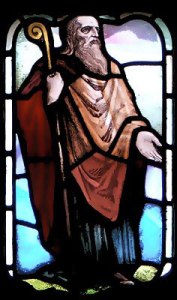
Saint Brendan of Clonfert, called “the Navigator” and one of the early Irish monastic saints, dies on May 16, 577, in Annaghdown, County Galway.

In 484, Brendan is born in Tralee, County Kerry, in the province of Munster. He is born among the Altraige, a tribe originally centred around Tralee Bay, to parents called Finnlug and Cara. He is baptised at Tubrid, near Ardfert by Saint Erc, and is originally to be called “Mobhí” but signs and portents attending his birth and baptism lead to him being christened “Broen-finn” or “fair-drop.” For five years he is educated under Saint Ita, “the Brigid of Munster.” When he is six, he is sent to Saint Jarlath‘s monastery school at Tuam to further his education. Brendan is one of the “Twelve Apostles of Ireland,” one of those said to have been tutored by the great teacher, Finnian of Clonard.

At the age of twenty-six, Brendan is ordained a priest by Saint Erc. Afterwards, he founds a number of monasteries. Brendan’s first voyage takes him to the Aran Islands, where he founds a monastery. He also visits Hinba, an island off Scotland where he is said to meet Columcille. On the same voyage he travels to Wales, and finally to Brittany, on the northern coast of France. Between the years 512 and 530 Brendan builds monastic cells at Ardfert and, at the foot of Mount Brandon, Shanakeel— Seana Cill, usually translated as “the old church.” From here he supposedly sets out on his famous seven-year voyage for Paradise.

St. Brendan is chiefly renowned for his legendary journey to the Isle of the Blessed as described in the ninth century Voyage of St. Brendan the Navigator. Many versions exist that tell of how he sets out onto the Atlantic Ocean with sixteen pilgrims searching for the Garden of Eden. One of these companions is said to be Saint Malo, the namesake of Saint-Malo. This occurs sometime between 512 and 530 AD, before his travel to the island of Great Britain. On the trip, Brendan supposedly sees Saint Brendan’s Island, a blessed island covered with vegetation. He also encounters a sea monster, an adventure he shares with his contemporary, Saint Columba. The most commonly illustrated adventure is his landing on an island which turns out to be a giant sea monster called Jasconius or Jascon. This too, has its parallels in other stories, not only in Irish mythology but in other traditions, from Sinbad the Sailor to Pinocchio.

Brendan travels to Wales and the holy island of Iona, off the west coast of Scotland. Returning to Ireland, he founds a monastery at Annaghdown, where he spends the rest of his days. He also founds a convent at Annaghdown for his sister Briga. Having established the bishopric of Ardfert, St. Brendan proceeds to Thomond and founds a monastery at Inis-da-druim, in the present parish of Killadysert, County Clare, about the year 550. He then journeys to Wales and studies under Saint Gildas at Llancarfan, and then to Iona, for it is said that he leaves traces of his apostolic zeal at Kil-brandon and Kil-brennan Sound. After a three years’ mission in Britain, he returns to Ireland, and does more proselytising in various parts of Leinster, especially at Dysart, Killiney, and Brandon Hill. He establishes churches at Inchiquin, County Clare and at Inishglora, County Mayo, and founds Clonfert in County Galway around 557 AD.

Brendan dies on May 16, 577 at Annaghdown, while visiting his sister Briga. Fearing that after his death his devotees might take his remains as relics, Brendan arranges before his death to have his body secretly carried back to the monastery he founded at Clonfert concealed in a luggage cart. He is buried in Clonfert Cathedral.


Leave a comment

Death of Saint Mo Chutu mac Fínaill

sts-carthage-catherine-patrick

Saint Mo Chutu mac Fínaill, also known as Carthach or Carthach the Younger (a name Latinized as Carthagus and Anglicized as Carthage), dies on May 14, 637. Mo Chutu is abbot of Rahan, County Offaly and subsequently, founder and first abbot of Lismore, County Waterford.

Through his father, Fínall Fíngein, Mo Chutu belongs to the Ciarraige Luachra, while his mother, Finmed, is of the Corco Duibne. Notes added to the Félire Óengusso, the Martyrology of Óengus, claim that his foster father is Carthach mac Fianáin, also known as Carthach the Elder, whose period of activity can be assigned to the late 6th century.

Mo Chutu first becomes abbot of Rahan, a monastery which lays in the territory of the southern Uí Néill. He composes a rule for his monks, an Irish metrical poem of 580 lines, divided into nine separate sections, a notable literary relic of the early Irish Church.

According to the Annals of Ulster, he is expelled from the monastery during the Easter season of 637. The incident is connected with the Easter controversy in which Irish churches are involved during the 7th century. Through his training in Munster, Mo Chutu is possibly a supporter of the Roman system of calculation, which likely brought him into conflict with adherents of the “Celtic” reckoning in Leinster.

Following his expulsion, Mo Chutu journeys to the Déisi, where he founds the great monastery of Lismore in modern day County Waterford. The Latin and Irish lives make very little of Mo Chutu’s earlier misfortune and focus instead on the saint’s resistance to the oppressive Uí Néill rulers and his joyous reception among the Déisi. He is portrayed in a heroic light in Indarba Mo Chutu a r-Raithin (The expulsion of Mo Chutu from Rahan).

His foundation at Lismore flourishes after his lifetime, eclipsing the reputation of the saint’s earlier church. It is able to withstand the Viking depredations which plague the area and benefit from the generosity of Munster kings, notably the Mac Carthaig of Desmond. In the 12th century, St. Déclán‘s foundation of Ardmore aspires to the status of episcopal see in the new diocese, but the privilege goes instead to Lismore.

His feast day in the Irish martyrologies is May 14, as well as in the Great Synaxaristes of the Orthodox Church. In the present calendar of the Catholic Church in Ireland, in which May 14 is the feast of Saint Matthias, the memorial of Saint Carthage is celebrated on May 15.

The photograph above is from an altar tomb of 1543 in St. Carthage’s cathedral in Lismore and depicts Mo Chutu along with St. Catherine and St. Patrick.


Leave a comment

St. Patrick Returns to Ireland

st-patrick

St. Patrick returns to Ireland as a missionary bishop on April 5, 456.

Patrick is born in Britain of a Romanized family. At age 16, he is taken from his family by Irish raiders and carried into slavery in Ireland. During six bleak years spent as a herdsman, he turns with fervour to his faith. Hearing at last in a dream that the ship in which he is to escape is ready, he flees his master and finds passage to Britain. There he is reunited with his family.

The best-known passage in the Confessio, his spiritual autobiography, tells of a dream where he is told to walk once more among the Irish. He is reluctant to respond to the call for a long time. Even on the eve of re-embarkation for Ireland he is beset by doubts of his fitness for the task. Once in the field, however, his hesitations vanish. Utterly confident in the Lord, he journeys far and wide, baptizing and confirming with untiring zeal. On at least one occasion, he is cast into chains. On another, he addresses with lyrical pathos a last farewell to his converts who have been slain or kidnapped by the soldiers of Coroticus.

Careful to deal fairly with the non-Christian Irish, he nevertheless lives in constant danger of martyrdom. The evocation of such incidents of what he calls his “laborious episcopate” is his reply to a charge that he originally sought office for the sake of office. In point of fact, he is a most humble-minded man, pouring forth a continuous paean of thanks to his Maker for having chosen him as the instrument whereby multitudes who have worshiped “idols and unclean things” have become “the people of God.”

The phenomenal success of Patrick’s mission is not, however, the full measure of his personality. Since his writings have come to be better understood, it is increasingly recognized that, despite their occasional incoherence, they mirror a truth and a simplicity of the rarest quality. Not since St. Augustine of Hippo has any religious diarist bared his inmost soul as Patrick does in his writings.

It is not possible to say with any assurance when Patrick was born. There are, however, a number of pointers to his missionary career having lain within the second half of the 5th century. In the Coroticus letter, his mention of the Franks as still “heathen” indicates that the letter must have been written between 451, the date generally accepted as that of the Franks’ irruption into Gaul as far as the Somme River, and 496, when they are baptized en masse. Patrick, who speaks of himself as having evangelized heathen Ireland, is not to be confused with Palladius, sent by Pope Celestine I in 431 as “first bishop to the Irish believers in Christ.”

St. Patrick is said to be buried at Down Cathedral in Downpatrick, County Down, alongside St. Brigid and St. Columba, although this has never been proven. Saint Patrick Visitor Centre is a modern exhibition complex located in Downpatrick and is a permanent interpretative exhibition centre featuring interactive displays on the life and story of Saint Patrick. It provides the only permanent exhibition centre in the world devoted to Saint Patrick.