seamus dubhghaill

Promoting Irish Culture and History from Little Rock, Arkansas, USA


Leave a comment

Birth of Michael “Mouse” Morris, Racehorse Trainer & Jockey

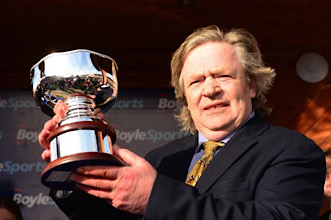
Michael Francis Leo Morris, Irish racehorse trainer and former amateur and professional jockey informally known as “Mouse” Morris, is born on April 4, 1951, in Spiddal, County Galway. As a trainer, he has won the Grand National and the Cheltenham Gold Cup, and has won the Irish Grand National twice. In 2016, he wins both the Grand National and Irish Grand National. He is formally known as the Honourable Michael Morris.

Morris is the third son of Michael Morris, 3rd Baron Killanin, who is president of the International Olympic Committee from 1972 to 1980 and Chairman of Ballybrit Racecourse from 1970 to 1985. His mother, Sheila, is the daughter of Canon Douglas Dunlop, Rector of Oughterard and the granddaughter of Henry Dunlop who is involved in the construction of  Lansdowne Road in 1872. During World War II his mother is a cryptographer at Bletchley Park. According to Morris, “she was in Hut 6, but she wouldn’t ever talk about it. Neither of them would talk about the war. She was bound by the Official Secrets Act, but whatever she did, she got an MBE for it.”

Morris’s twin brother John (Johnny) becomes a photographer and marries Thelma Mansfield. Their elder brother, George Redmond, follows in the footsteps of their father, Lord Killanin, by becoming a film producer. His credits include The Reader. They also have one sister, Monica Deborah.

At the age of fifteen Morris’s formal education ends following his diagnosis with dyslexia. He then begins working at racing stables. He earns the nickname “Mouse” when he is an amateur rider.

Initially, Morris comes to prominence as an amateur jockey. In 1974 he rides  Mr. Midland to victory at  Cheltenham Racecourse giving Edward O’Grady his first Festival winner. In 1975 he turns professional. He rides Skymas in his successive victories in the 1976 and 1977 Queen Mother Champion Chase at Cheltenham. He rides Billycan to victory in the 1977 Irish Grand National, a race he is subsequently to win twice as a trainer. His career as a rider ends after a fall in South Carolina‘s Colonial Cup.

Morris is based in Fethard, County Tipperary. In 1981, he takes out a licence and begins his National Hunt training career. Hus first major breakthrough comes when Buck House wins the 1983 Supreme Novices’ Hurdle, giving him his first winner at Cheltenham.

The 1990s start brightly for the “Mouse” Morris yard when Trapper John, ridden by jockey Charlie Swan, wins the Stayers’ Hurdle at the 1990 Cheltenham Festival. The following year, Cahervillahow is beaten by a short head in the Irish Grand National and merely three weeks later in the Whitbread Gold Cup he is controversially judged to have interfered with runner-up Docklands Express in the closing stages. As a result, Docklands Express is awarded the race. He finishes second in the 1993 Grand National which is voided after a false start. He trains His Song who is one of the best novice hurdlers of the period. His Song finishes second behind the J. P. McManus owned Istabraq in the 1998 AIG Irish Champion Hurdle on his fourth race outing before again finishing second in the Supreme Novice Hurdle at Leopardstown Racecourse. One of his most important wins as a trainer comes in 2006 when he sends out the seven-year-old gelding War Of Attrition to win the 2006 Cheltenham Gold Cup, beating another Irish challenger, Hedgehunter, on Saint Patrick’s Day. In 2008, he trains Hear The Echo to victory in the Irish Grand National. In 2011, he trains the winner of the Grade 1 Neptune Investment Management Novices’ Hurdle at Cheltenham, First Lieutenant, ridden by Davy Russell. In 2016, he wins the Irish Grand National again this time with Rogue Angel. Also in 2016, he wins the Grand National for the first time with Rule The World.

Morris is married to Susanna Felicity Clark. They have two sons, James (Jamie) born in 1983 and Christopher (Tiffer) born in 1985. Tiffer dies at the age of 30 in June 2015 of carbon monoxide poisoning while traveling in Argentina.


Leave a comment

Birth of Sir Peter O’Sullevan, Horse Racing Commentator

Sir Peter O’Sullevan, Irish-British horse racing commentator for the BBC, and a correspondent for the Press Association, the Daily Express, and Today, is born Newcastle, County Down on March 3, 1918. He is the BBC’s leading horse racing commentator from 1947 to 1997, during which time he describes some of the greatest moments in the history of the Grand National.

O’Sullevan is the son of Colonel John Joseph O’Sullevan DSO, resident magistrate at Killarney, and Vera (née Henry). As an infant, the family returns to his parents’ home at Kenmare, County Kerry and he is raised in Surrey, England. He is educated at Hawtreys Preparatory School, Charterhouse School, and later at Collège Alpin International Beau Soleil in Switzerland.

In the late 1940s O’Sullevan is involved in some of the earliest television commentaries on any sport and makes many radio commentaries in his earlier years (including the Grand National before it is televised for the first time in 1960). On television, he commentates on many of the major events of the racing year, including the Cheltenham Festival until 1994, The Derby until 1979, and the Grand National, Royal Ascot and Glorious Goodwood until he retires in 1997. During his career, he commentates on around 30 runnings of the Prix de l’Arc de Triomphe in Paris and racing from the United States and Ireland as well as trotting from Rome during the 1960s.

During his 50 years of commentating on the Grand National, O’Sullevan commentates on numerous historic victories. These include Bob Champion‘s run on Aldaniti in 1981 after recovering from cancer, 100/1 outsider Foinavon‘s win in 1967, and the three-times winner Red Rum in 1973, 1974 and 1977. He also commentates on the 1993 Grand National, which is declared void after 30 of the 39 runners fail to realise there had been a false start, and seven go on to complete the course. As the runners approach the second-last fence in the so-called “race that never was,” O’Sullevan declares it “the greatest disaster in the history of the Grand National.”

O’Sullevan becomes known as the “Voice of Racing.” In a television interview before his 50th and last Grand National in 1997, he reveals that his commentary binoculars came from a German submarine. He is knighted the same year – the only sports broadcaster at the time to have been bestowed that honour. He is also a racehorse owner, including of Be Friendly, who wins the King’s Stand Stakes at Ascot, and Prix de l’Abbaye de Longchamp. He is twice successful in the Haydock Sprint Cup (then Vernons Sprint) in 1966 and 1967. Another horse he owns is Attivo, whose victory in the 1974 Triumph Hurdle at the Cheltenham Festival is described by O’Sullevan as the most difficult race to call.

Attivo also wins the Chester Cup and the Northumberland Plate during the 1970s. O’Sullevan’s final race commentary comes at Newbury Racecourse for the 1997 Hennessy Gold Cup, and he visits the winners’ enclosure as a winning owner in the race which follows courtesy of Sounds Fyne’s victory in the Fulke Walwyn Chase. He is succeeded as the BBC’s lead commentator by Jim McGrath.

After his retirement, O’Sullevan is actively involved in charity work, fundraising for causes which revolve around the protection of horses and farm animals, including the International League for the Protection of Horses (ILPH), the Thoroughbred Rehabilitation Centre and Compassion in World Farming. The National Hunt Challenge Chase Cup (run at the Cheltenham Festival) is named after him in 2008 to celebrate his 90th birthday. In 2010, Aintree Racecourse names O’Sullevan as one of the eight inaugural “Grand National Legends.” His name is inscribed on a commemorative plaque at the course, alongside the likes of Ginger McCain and Captain Martin Becher.

O’Sullevan meets his wife Patricia, daughter of Frank Duckworth of Manitoba, Canada, at a ball in Manchester in 1947. She dies of Alzheimer’s disease in 2010.

O’Sullevan dies of cancer at his home in London on July 29, 2015.