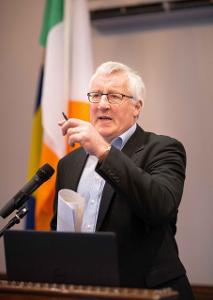
O’Rourke makes his debut on the inter-county scene when he is picked for the Meath minor team. He later joins the under-21 side but enjoys little success in these grades. He makes his senior debut during the 1975-1976 league. Over the course of the next twenty years he is a regular member of the starting fifteen and wins back-to-back All-Ireland medals in 1987 and 1988. He also wins five Leinster Senior Football Championship medals, three National Football League titles and is named Texaco Footballer of the Year in 1991. He plays his last game for Meath in July 1995.
In retirement from playing O’Rourke combines his teaching career with a new position as a sports broadcaster. His media career begins with RTÉ where he has worked as a studio analyst with the flagship programme The Sunday Game for over twenty-five years. He also writes a weekly column for the Sunday Independent.
Sheehy makes his debut on the inter-county scene at the age of sixteen when he is picked on the Kerry minor team. He enjoys two championship seasons with the minors, however, he is a Munster Minor Football Championship runner-up on both occasions. He subsequently joins the Kerry under-21 team, winning two GAA Football Under-20 All-Ireland Championship medals in 1973 and 1975. By this stage he has also joined the Kerry senior team, making his debut during the 1973-1974 league. Over the course of the next fifteen seasons, he wins eight All-Ireland medals, beginning with a lone triumph in 1975, a record-equalling four championships in-a-row from 1978 to 1981 and three championships in-a-row from 1984 to 1986. He also wins eleven Munster medals, three National Football League medals and is named Texaco Footballer of the Year in 1979. He plays his last game for Kerry in July 1987.
After being chosen on the Munster inter-provincial team for the first time in 1976, Sheehy is an automatic choice on the starting fifteen for the following seven years. During that time he wins five Railway Cup medals.
In retirement from playing Sheehy becomes involved in team management and coaching. In 2012 he is appointed as a selector with the Kerry senior team. Since then he has helped steer the team to one All-Ireland title and four successive Munster titles.
Even during his playing days Sheehy comes to be recognised as one of the greatest players of all time. He is named in the right corner-forward position on the Football Team of the Century in 1984. He is one of only two players from the modern era to be named on that team. He switches to the left-corner forward position when he is named on the Football Team of the Millennium in 1999. He also wins seven All-Stars, while his tally of eight All-Ireland medals, albeit one as a non-playing substitute, is also a record which he shares with fellow Kerry players Páidí Ó Sé, Pat Spillane and Denis “Ógie” Moran. His scoring tally of 29-205 is a record which stands for 25 years.
In 1990 Wilson challenges Brian Lenihan for the Fianna Fáil nomination for the 1990 presidential election. Lenihan wins the nomination but fails to be elected President and is also sacked from the government. Wilson is then appointed Tánaiste. He remains in the cabinet until retirement in 1993. Although the 26th Dáil Éireann is dissolved in December 1992, he serves in Government until the new government takes office.
John Wilson dies at St. James Hospital, Dublin on July 9, 2007, one day after his 84th birthday. His funeral takes place at the Good Shepherd Church at Churchtown, Dublin. President Mary McAleese is one of a number of prominent figures among the mourners, while Taoiseach Bertie Ahern is represented by his Aide-de-Camp.
Keaveney’s first sporting interest is in soccer, however, he is later introduced to Gaelic games by his Belfast-born father. He is educated at St. Joseph’s Secondary School in Fairview, Dublin where he favours hurling over Gaelic football.
Keaveney makes his debut on the inter-county scene when he is selected for the Dublin minor and under-21 teams, however, he ends his underage career without success. He makes his senior debut during the 1964-1965 league. Over the course of the following sixteen seasons, he wins three All-Ireland medals, beginning with a lone triumph in 1974, followed by back-to-back championships in 1976 and 1977. He also wins seven Leinster medals, two National Football League medals and is named Footballer of the Year in 1976 and 1977. He plays his last game for Dublin in February 1980.
Patrick Gerard Spillane, retired Gaelic footballer and current sports broadcaster better known as Pat Spillane, is born in Templenoe, County Kerry, on December 1, 1955. His league and championship career with the Kerry GAA senior team spans seventeen years from 1974 to 1991. Spillane is widely regarded as one of the greatest players in the history of the game.
Spillane is born into a strong Gaelic football family. His father, Tom, and his uncle, Jerome, both play with Kerry and win All-Ireland Junior Football Championship medals. His maternal uncles, Jackie, Dinny, Mickey, and Teddy Lyne, all win All-Ireland medals at various grades with Kerry throughout the 1940s and 1950s.
Spillane makes his debut on the inter-county scene at the age of sixteen when he is picked on the Kerry minor team. He enjoys two championship seasons with the minor team, however, he is a Munster Minor Football Championship runner-up on both occasions. He subsequently joins the Kerry under-21 team, winning back-to-back All-Ireland Under-21 Football Championship medals in 1975 and 1976. By this stage he has also joined the Kerry senior team, making his debut during the 1973-74 league. Over the course of the next seventeen years, he wins eight All-Ireland Senior Football Championship medals, beginning with a lone triumph in 1975, a record-equalling four championships in-a-row from 1978 to 1981 and three championships in-a-row from 1984 to 1986. He also wins twelve Munster medals, two National Football League medals and is named Footballer of the Year in 1978 and 1986. He plays his last game for Kerry in August 1991. He is joined on the Kerry team by his two brothers, Mick and Tom, and together win a total of 19 All-Ireland medals, a record for a set of brothers.
After being chosen on the Munster GAA inter-provincial team for the first time in 1976, Spillane is an automatic choice on the starting fifteen for the following six years. During that time he wins four Railway Cup medals.
In retirement from playing Spillane combines his teaching career with a new position as a sports broadcaster. His media career begins with RTÉ in 1992, where he starts as a co-commentator before progressing to the role of studio analyst with the flagship programme The Sunday Game. He also enjoys a four-year tenure as host of the evening highlights edition of the programme. He also writes a weekly column for the Sunday World.
Even during his playing days Spillane comes to be recognised as one of the greatest players of all time. After fighting his way back from a potentially career-ending anterior cruciate ligament injury, he is named in the right wing-forward position on the Football Team of the Century in 1984. He is one of only two players from the modern era to be named on that team. He switches to the left-wing forward position when he is named on the Football Team of the Millennium in 1999. His collection of nine GAA GPA All Stars Awards is a record for a Gaelic footballer, while his tally of eight All-Ireland medals is also a record which he shares with fellow Kerry players Páidí Ó Sé, Mikey Sheehy, Denis “Ógie” Moran and Ger Power.
Con Houlihan, Irish sportswriter, dies in Dublin on August 4, 2012. Despite only progressing to national journalism at the age of 46, he becomes “the greatest and the best-loved Irish sports journalist of all.”
Houlihan is born on December 6, 1925, in Castleisland, County Kerry. Over a lengthy career, Houlihan covers many Irish and international sporting events, from Gaelic football and hurling finals, to soccer and rugby World Cups, the Olympic Games and numberless race meetings inside and outside Ireland.
Houlihan is a journalist with the Irish Press group writing for The Irish Press, Evening Press and sometimes The Sunday Press, until the group’s demise in 1995. He writes the “Tributaries” column and Evening Press back sports page “Con Houlihan” column.
Houlihan dies on the morning of August 4, 2012 in St. James’s Hospital in Dublin. Often considered one of Ireland’s finest writers, he leaves behind a legacy of immense sports journalism that spans over 60 years. A minute’s silence is observed in his memory ahead of Kerry GAA‘s All-Ireland Senior Football Championship quarter-final defeat to Donegal GAA at Croke Park the following day. His last column, in which he wishes Irish Olympic boxer Katie Taylor well, is published the day after his death. His funeral takes place on August 8, 2012.
Ireland’s president, Michael D. Higgins, leads the tributes to Houlihan, describing him as a “most original writer, with a unique style based on his extensive knowledge of literature, politics, life and sport.” He adds, “He had that special quality and ability to identify with the passion, pain and celebration of Irish community life.”
A bronze bust of Houlihan is unveiled in his hometown of Castleisland in 2004. In 2011, another sculpture is erected outside The Palace bar in Dublin.