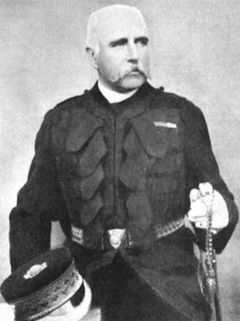
Reed is the son of John Reed of Galway and Mary Adamson of County Meath. He is educated at Queen’s University Belfast (QUB) and called to the Bar in 1873. He enters the Royal Irish Constabulary and is appointed District Inspector in 1859; becoming Inspector-General in 1885. He retires 1900.
Aside from being the only RIC cadet officer to be promoted to Inspector General, Reed changes the rules for promotion in the Royal Irish Constabulary. Up until his tenure, Catholics had little success in attaining promotions. Even though most of the force is Catholic, almost all the officers are non-Catholic. He institutes a rule that each year, sixty men who are Catholic and pass the Sergeant’s exam will be promoted.
Reed is appointed a Knight Bachelor in 1889, a Companion of the Order of the Bath (CB) in 1892, a Commander of the Royal Victorian Order (CVO) in 1900 and a Knight Commander of the Order of the Bath (KCB) in 1897.
Reed dies in Dublin on November 7, 1914, and is buried in Dean’s Grange Cemetery. His epitaph reads: – “I have no greater joy than to hear that my children walk in truth.” (3 John 4.)
The DSWA is formally founded at a meeting on January 26, 1876, in the Exhibition Palace, Earlsfort Terrace (now the National Concert Hall). After the Poor Law Guardians (Ireland) (Women) Act 1896 allows women to be elected to the boards of guardians of poor law unions, it renames itself the Dublin Women’s Suffrage and Poor Law Guardians’ Association. After the Local Government (Ireland) Act 1898 allows women to serve on local councils, it becomes the Dublin Women’s Suffrage and Local Government Association. It establishes branches outside Dublin in the 1890s and becomes the IWSLGA in 1901.
In 1919, after the Representation of the People Act 1918 provides full franchise at local elections and partial franchise at parliamentary elections, the IWSLGA merges with the Irish Women’s Association of Citizenship to become the Irish Women Citizens’ and Local Government Association, later renamed the Irish Women’s Citizens Association, which in 1949 merges into the Irish Housewives Association.
The association confines itself to constitutional, nonsectarian and peaceful methods, and attracts support from both unionist and nationalist suffragists. Its tactics include making friends in parliament, hosting meetings with important speakers, and issuing pamphlets and periodicals. Its first secretaries are Anna Haslam and Miss McDowell. Haslam serves as secretary until 1913. In regards to membership, Haslam suggests an annual subscription of one shilling per annum as membership in the association. Other goals include appointing women to positions “such as rate collectors and sanitary inspectors, while always pursuing the association’s main objective of the parliamentary vote.” Prominent members of the association in the 20th century are Lady Margaret Dockrell, Mary Hayden, and Bridget Dudley Edwards (mother of Robert Dudley Edwards). Prominent supporters include Charles Cameron, Sir Andrew Reed, Willie RedmondMP, and William Field MP. Following the Sex Disqualification (Removal) Act 1919, Lady Dockrell is one of the first women appointed Justice of the Peace.
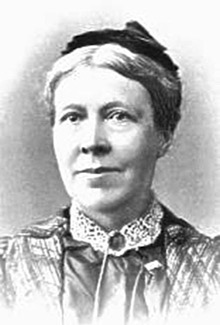
(Pictured: Anna Haslam, co-founder of the DWSA along with her husband, Thomas)