seamus dubhghaill

Promoting Irish Culture and History from Little Rock, Arkansas, USA


Leave a comment

The Irish Army Mutiny

The Army Mutiny is an Irish Army crisis that begins on March 7, 1924, provoked by a proposed reduction in army numbers in the immediate post-Civil War period. A second grievance concerns the handling of the Northern Boundary problem. As the prelude to a coup d’état, the decisions made by influential politicians and soldiers at the time have continuing significance for the Government of Ireland.

In the early weeks of the Irish Civil War, the National Army is comprised of 7,000 men. These come mainly from pro-Treaty Irish Republican Army (IRA) brigades, especially the Dublin Guard, whose members have personal ties to Michael Collins. They face around 15,000 anti-Treaty IRA men and Collins recruits experienced soldiers from wherever he can. The army’s size mushrooms to 55,000 men, many of whom are Irishmen with combat experience in World War I – 20,000 National Volunteers had joined the British Army on the urgings of Nationalist leader John Redmond.

Likewise, Irishmen who had served in the British forces account for over half of the 3,500 officers. W. R. E. Murphy, second-in-command (January–May 1923), had been a lieutenant colonel in the British Army, as had Emmet Dalton. Two more of the senior generals, John T. Prout and J. J. “Ginger” O’Connell, had served in the United States Army. Collins promotes fellow members of the Irish Republican Brotherhood (IRB) but is slow to put Squad members in high positions.

In December 1922, following Collins’s death, Liam Tobin forms the Irish Republican Army Organisation (IRAO), taking in Dublin Guard and other Irish Army officers who share his view that “higher command…was not sufficiently patriotic.” President of the Executive Council of the Irish Free State W. T. Cosgrave, head of the government, attempts to appease the IRAO. He meets with them several times before the 1923 Irish general election and persuades the opposing IRB faction of generals under Richard Mulcahy to keep quiet.

With the election over, Mulcahy now ignores the IRAO as he starts the process of demobilising 37,000 men. In November, sixty IRA officers mutiny and are dismissed without pay. The IRAO now pressures the Government into establishing a committee to supervise future demobilisation. The committee, consisting of Eoin MacNeill, Ernest Blythe, and IRAO sympathiser Joseph McGrath, effectively undermines the authority of the Army Council.

On March 7, 1924, a representative of the IRAO hands a demand to end demobilisation to W. T. Cosgrave. The ultimatum is signed by senior Army officers, Major-General Liam Tobin and Colonel Charles Dalton. Tobin knows his own position is to be scrapped in the demobilisation. Frank Thornton and Tom Cullen are also involved. That morning 35 men of the 36th Infantry Battalion refuse to parade, and the preceding week officers had absconded with arms from the McCan Barracks in Templemore, Gormanston Camp in County Meath, Baldonnel Aerodrome in Baldonnel, Dublin, and Roscommon. The immediate response is an order for the arrest of the two men on a charge of mutiny. This causes alarm throughout Dublin when announced.

On March 8, General Mulcahy makes an announcement to the Army:

“Two Army officers have attempted to involve the Army in a challenge to the authority of the Government. This is an outrageous departure from the spirit of the Army. It will not be tolerated…officers and men…will stand over their posts and do their duty today in this new threat of danger in the same wonderful, determined spirit that has always been the spirit of the Army.”

Leader of the Opposition, Thomas Johnson, issues a statement of support for the Government. In contrast, Minister for Industry and Commerce, Joseph McGrath, whose home Mulcahy orders to be searched, resigns because of dissatisfaction with the government’s attitude to the IRAO officers and support for their perception that the Irish Army treats former British officers better than former IRA officers. Fearing an incendiary speech by McGrath, Cosgrave first offers the IRAO an inquiry and an amnesty before then taking sick leave thus making Minister for Justice, Kevin O’Higgins, de facto head of the Government.

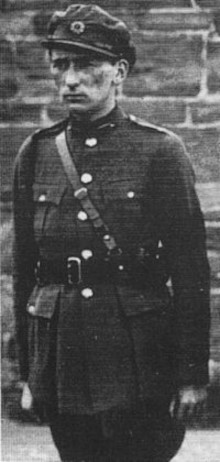
(Pictured: Major General Liam Tobin, a leading figure in the Army Mutiny)


Leave a comment

Founding of Aer Lingus, the National Airline of the Republic of Ireland

Aer Lingus (Irish: Aer Loingeas) is founded by the Irish government as the national airline of the Republic of Ireland on April 15, 1936.

Aer Lingus is founded with a capital of £100,000. Its first chairman is Seán Ó hUadhaigh. Pending legislation for Government investment through a parent company, Aer Lingus is associated with Blackpool and West Coast Air Services which advances the money for the first aircraft and operates with Aer Lingus under the common title “Irish Sea Airways.” Aer Lingus Teoranta is registered as an airline on May 22, 1936. The name Aer Lingus is proposed by Richard F. O’Connor, who is County Cork Surveyor, as well as an aviation enthusiast.

On May 27, 1936, five days after being registered as an airline, Aer Lingus’s first service begins between Baldonnel Aerodrome in Dublin and Bristol (Whitchurch) Airport in Bristol, England, using a six-seater de Havilland DH.84 Dragon biplane (registration EI-ABI), named Iolar (Eagle).

Later that year, the airline acquires its second aircraft, a four-engined biplane de Havilland DH.86 Express named Éire, with a capacity of 14 passengers. This aircraft provides the first air link between Dublin and London by extending the Bristol service to Croydon. At the same time, the DH.84 Dragon is used to inaugurate an Aer Lingus service on the Dublin-Liverpool route.

Aer Lingus is established as the national carrier under the Air Navigation and Transport Act (1936). In 1937, the Irish government creates Aer Rianta, now called Dublin Airport Authority (DAA), a company to assume financial responsibility for the new airline and the entire country’s civil aviation infrastructure. In April 1937, Aer Lingus becomes wholly owned by the Irish government via Aer Rianta.

Aer Lingus is privatised between 2006 and 2015. It is a former member of the Oneworld airline alliance, which it leaves on March 31, 2007.

Ryanair owns over 29% of Aer Lingus stock and the Irish state owns over 25% before being bought out by International Airlines Group (IAG) in 2015. The state had previously held an 85% shareholding until the Government’s decision to float the company on the Dublin and London stock exchanges on October 2, 2006. The principal group companies include Aer Lingus Limited, Aer Lingus Beachey Limited, Aer Lingus (Ireland) Limited and Dirnan Insurance Company Limited, all of which are wholly owned.

On May 26, 2015, after months of negotiations on a possible IAG takeover, the Irish government agrees to sell its stake in Aer Lingus. Ryanair retains a 30% stake in the company which it agrees to sell to IAG on July 10, 2015, for €2.55 per share. In August 2015, Aer Lingus’ shareholders officially accept IAG’s takeover offer. IAG subsequently assumed control of Aer Lingus on September 2, 2015.

After the takeover by IAG, it is expected that Aer Lingus would re-enter Oneworld, however, at a press briefing on November 15, 2017, the airline’s then CEO Stephen Kavanagh states that the airline has “no plans to join Oneworld.” The airline is now a wholly owned subsidiary of IAG.

Aer Lingus has codeshare agreements with Oneworld, Star Alliance and SkyTeam members, as well as interline agreements with Etihad Airways, JetBlue and United Airlines. The airline has a hybrid business model, operating a mixed fare service on its European routes and full service, two-class flights on transatlantic routes.

Aer Lingus’s head office is on the grounds of Dublin Airport in Collinstown, County Dublin.


Leave a comment

Death of Fighter Pilot “Paddy” Finucane

brendan-finucane

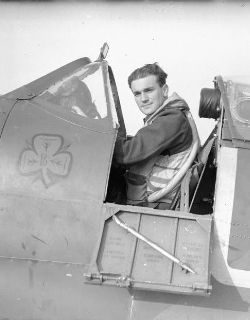
Wing Commander Brendan Eamonn Fergus Finucane, World War II Royal Air Force (RAF) fighter pilot and flying ace known as Paddy Finucane amongst his colleagues, dies on July 15, 1942 when he is forced to ditch his aircraft in the English Channel. He is also noted for being the youngest person to ever become wing leader of a fighter wing.

Finucane, born on October 16, 1920 in Rathmines, Dublin, is credited with 28 aerial victories, five probably destroyed, six shared destroyed, one shared probable victory, and eight damaged. Included in his total are twenty-three Messerschmitt Bf 109s, four Focke-Wulf Fw 190s and one Messerschmitt Bf 110. Official records differ over the exact total. After the war, two of Finucane’s victories that had been credited as probables had, in fact, been destroyed, but are not officially included. His total victory count could be as high as 32.

On July 15, Finucane is killed at the age of 21 while leading the Hornchurch Wing in a fighter “Ramrod” operation targeting a German Army camp at Étaples, France. He takes off with his wing at 11:50 AM. The attack is timed to hit the Germans at lunchtime. Crossing the beach at Le Touquet, they target machine gun positions. His plane is hit in the radiator at 12:22 PM. His wingman, Alan Aikman, notifies him of the white plume of smoke and Finucane acknowledges it with a thumbs up. Standard regulations insist the wing carry on the mission even if the leader is in trouble. Radio silence is maintained so the enemy radio-interception services do not become aware that a person of importance has been hit.

Finucane flies slowly out to sea, talking calmly to Aikman as he glides along in his stricken fighter. Finally, some 8 miles off Le Touquet on the French coast, he breaks radio silence and sends his last message. Aikman, flying alongside Finucane, sees him pull back the canopy, and before taking off his helmet, say “This is it Butch.” It is a well–executed landing, but the waves are difficult to predict and the Spitfire‘s nose strikes the water and disappears in a wall of spray. Before he hits the water, witnesses Aikman and Keith Chisholm of 452 Squadron see him release, or perhaps tighten, his parachute release harness and straps. If Finucane did release them, it is possible he could have been thrown forward onto the gun-sight and killed, or knocked unconscious and drowned. The exact circumstances remain unknown.

Over 2,500 people attend his memorial at Westminster Cathedral. A rose is planted in the memorial garden in Baldonnel Aerodrome in Dublin, home of the Irish Air Corps. Finucane’s name is also inscribed on the Air Forces Memorial at Runnymede. The memorial commemorates airmen who were lost in World War II and who have no known grave. The Battle of Britain Monument on London‘s Victoria Embankment also includes his name as one of The Few. His flying logbook can be viewed in the Soldiers and Chief’s exhibition in the National Museum of Ireland at Collins Barracks. The Finucane family donated Brendan Finucane’s uniform to the Royal Air Force Museum London.


Leave a comment

Transatlantic Flight of “Wrong Way” Corrigan

Douglas Corrigan, an American aviator born in Galveston, Texas, earns the nickname “Wrong Way” Corrigan on July 17, 1938. After a transcontinental flight from Long Beach, California, to New York City, he flies from Floyd Bennett Field in Brooklyn, New York, to Ireland, though his flight plan is filed to return to Long Beach. He claims his unauthorized flight is due to a navigational error, caused by heavy cloud cover that obscures landmarks and low-light conditions, causing him to misread his compass. However, he is a skilled aircraft mechanic and has made several modifications to his own plane, preparing it for his transatlantic flight. He had been denied permission to make a nonstop flight from New York to Ireland, and his “navigational error” is seen as deliberate. Nevertheless, he never publicly admits to having flown to Ireland intentionally.

On July 9, 1938, Corrigan departs California in his 1929 Curtiss Robin OX-5 monoplane bound for Floyd Bennett Field, Brooklyn, New York. With the Robin cruising at 85 miles per hour (137 km/h) for maximum fuel efficiency, the outward journey takes him 27 hours. Fuel efficiency becomes critical towards the end of the flight as a gasoline leak develops, filling the cockpit with fumes.

Upon his unannounced arrival at Floyd Bennett Field, in the midst of Howard Hughes‘s preparations for takeoff on a world tour, Corrigan decides repairing the leak will take too long if he is to meet his schedule. His logged flight plan has him returning to California on July 17. Before takeoff, Corrigan asks the manager of Floyd Bennett Field, Kenneth P. Behr, which runway to use, and Behr tells him to use any runway as long as he does not take off to the west, in the direction of the administration building where Behr has his office. As recorded in Corrigan’s autobiography, Behr wishes him “Bon Voyage” prior to take-off, perhaps in a nod to Corrigan’s intentions to fly the Atlantic. Upon take off at 5:15 on the morning of July 17 with 320 US gallons of gasoline and 16 US gallons of oil, Corrigan heads east from the 4,200-foot runway of Floyd Bennett Field and keeps going. Behr later swears publicly that he has no foreknowledge of Corrigan’s intentions.

Corrigan claims to have noticed his “error” after flying for about 26 hours. This is not entirely consistent with his claim that after 10 hours, he feels his feet go cold. The cockpit floor is awash with gasoline leaking from the unrepaired tank. He uses a screwdriver to punch a hole through the cockpit floor so that the fuel will drain away on the side opposite the hot exhaust pipe, reducing the risk of a midair explosion. Had he been truly unaware he was over ocean, it seems likely he would descend at this point. Instead, he claims to increase the engine speed by almost 20% in the hope of decreasing his flight time.

Corrigan lands at Baldonnel Aerodrome, County Dublin, on July 18, after a 28-hour, 13-minute flight. His provisions for the flight consisted of just two chocolate bars, two boxes of fig bars, and 25 US gallons of water. Corrigan’s plane has fuel tanks mounted on the front, allowing him to see only out of the sides. He has no radio, and his compass is 20 years old.

Aviation officials require 600 words to list the regulations broken by his flight in a telegram, a medium that encourages brevity by charging at a rate per word. Despite the extent of Corrigan’s illegality, he receives only a mild punishment and his pilot’s certificate is suspended for 14 days. He and his plane return to New York on the steamship Manhattan and arrive on August 4, the last day of his suspension. His return is marked with great celebration. More people attend his Broadway ticker tape parade than had honored Charles Lindbergh after his triumph. He is also given a ticker tape parade in Chicago.